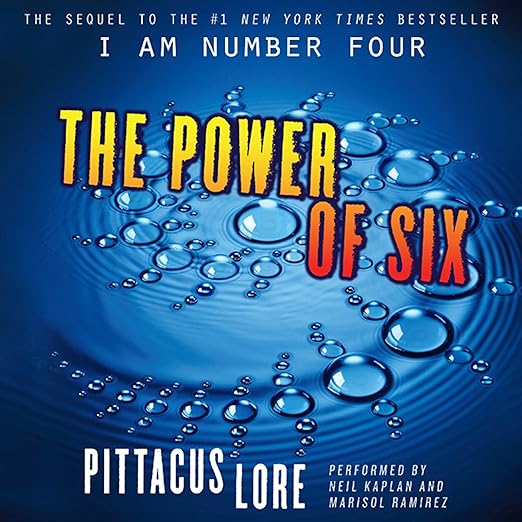
Quick Take
- Performance: Neil Kaplan handles dual storylines capably, differentiating John and Marina's perspectives through pacing and tone without overplaying the distinction.
- What it covers: Alien identity in hiding, loyalty and friendship under pressure, awakening to one's purpose
- Feel: Propulsive and action-focused, with enough character work to justify its runtime
- Our call: A satisfying step forward for the series that benefits considerably from the dual-perspective structure missing from book one.
I came to the Lorien Legacies series late, long after the film adaptation of the first book had come and gone. A reader I trust mentioned that The Power of Six was actually the stronger audiobook of the two, specifically because of how the narrative split opens up the world, and I tend to listen when someone says a sequel surpasses its predecessor. They were right.
Where I Am Number Four followed John Smith exclusively as he navigated Ohio high school life while hiding his alien origins, this second installment breaks into two alternating storylines. John and Six are on the run in Europe, hunted by Mogadorians and now also by US federal authorities who have placed them on the FBI most-wanted list as supposed terrorists. Meanwhile, Marina, Number Seven, has been hiding in a convent in Spain, quietly developing her abilities in secret and following news coverage for any sign that others like her are still alive. The contrast between these two narrative registers, one perpetually in motion, one claustrophobically still, gives the book a structural tension the first installment could not achieve.
What Pittacus Lore Delivers
The decision to split the perspective was the right one, and Pittacus Lore executes it with more discipline than I expected. Marina's Spain sections are genuinely different in tone from John's chapters: slower, more interior, and built around the particular loneliness of someone who has been waiting years for permission to act. One reviewer describes the book as blowing the first installment away, and I think the structural change accounts for most of that improvement. The Mogadorian mythology also deepens here in ways that feel earned rather than expository, and the introduction of new Legacies, the supernatural abilities specific to each of the nine, gives the action sequences more tactical interest.
Neil Kaplan's narration is the kind of workmanlike professionalism that serves genre fiction well without calling attention to itself. He moves through action sequences at a pace that maintains urgency without sacrificing clarity, and he distinguishes John's chapters from Marina's largely through a slight shift in energy rather than through distinct vocal characterization, which is probably the right call given that both narrators are meant to feel like teenagers under pressure. The audiobook is also well-suited to listening during commutes or exercise, since the chapters are structured around discrete action beats that make natural pause points easy to find.
Where Pittacus Lore Loses Some Ground
Listeners coming directly from the first book should be aware that Sam, John's human best friend, becomes significantly more important here, and the dynamic between John, Six, and Sam carries some of the book's more interesting relational tension. The Mogadorian threat is also escalated in ways that will matter for the rest of the series, so this is not a book to skip if you intend to continue. A reviewer notes this is something the whole family can enjoy, which I think accurately describes the tone: the violence is present but not gratuitous, and the romantic elements are subordinated to the action in a way that keeps the book accessible across a fairly wide age range. That said, adult listeners coming to this without nostalgia for YA science fiction of this era may find the characterization thinner than they prefer.
One structural limitation worth flagging: the book ends on a genuine cliffhanger that assumes continuation of the series. If you are the type of listener who prefers standalone resolution, this will be frustrating. If you are already committed to the Lorien Legacies world, the ending will simply send you directly to book three.
Who Should Pick Up The Power of Six
This is the right audiobook for listeners who enjoyed the first book but wanted more world expansion and a broader cast of perspectives. It also works for anyone who follows the YA science fiction tradition of Maze Runner or The Fifth Wave and has not yet tried this series. Listeners new to the Lorien Legacies should start with I Am Number Four rather than here, since the opening assumes familiarity with events and relationships established in book one. Adults who grew up with this series in its original publication window will find this a comfortable nostalgia listen. Those seeking hard science fiction with rigorous internal logic should look elsewhere.
Frequently Asked Questions
Does Marina get equal narrative time compared to John?
The balance leans slightly toward John's storyline, but Marina's Spain-set chapters are substantial and represent the most distinctive new material in the book. Most readers find them the more emotionally compelling sections.
How does Neil Kaplan's narration compare to the narration in I Am Number Four?
Kaplan narrates both books in the series and maintains consistency between them, which helps with continuity. His approach is clean and pace-appropriate for the genre without any particularly distinctive characterization choices.
Is the Mogadorian threat explained clearly enough for someone who only vaguely remembers book one?
The book provides enough context to follow the main conflict, but finer details of the mythology from book one may need to be revisited for full clarity. A brief re-read of any summary of book one before starting would help.