
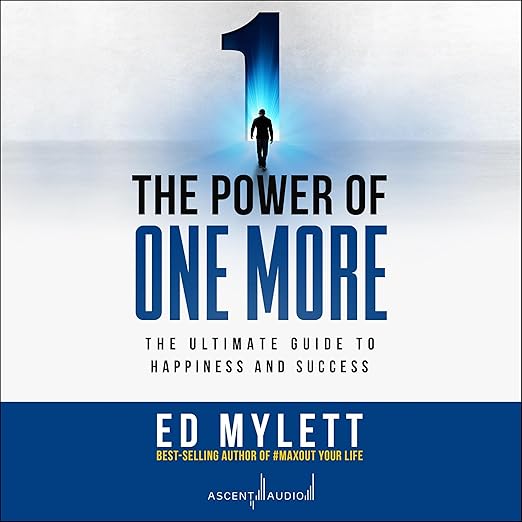
Ed Mylett's writing comes from the same place as his speaking: an accumulated conviction that the distance between where most people are and where they want to be is smaller than they believe, and that the margin is closed through one more intentional action at a time. The Power of One More is the audiobook version of that argument, and Mylett narrates it himself, which matters more than it might seem. At five hours and nineteen minutes, this is a tight, personal delivery from someone who has spent thirty years in entrepreneurship and performance coaching. The self-narration transforms what might otherwise read as motivational boilerplate into something with a direct and credible pulse.
A Thirteen-Year-Old's Own Sense of Possibility
The central concept is deceptively simple: at the moment when most people stop, the highest performers do one more. One more call. One more attempt. One more hour of deliberate work. But Mylett builds this beyond a mere perseverance slogan. He explores the psychological science behind threshold moments, explaining why the final repetition, the last push before stopping, produces disproportionate results in neurological conditioning and skill development. This is where the book earns its intellectual credibility, by connecting the felt experience of persistence to something that actually happens in how the brain builds patterns and tolerates discomfort.
The chapters on identity and self-image are among the strongest. Mylett's argument that most people underachieve not because of lack of talent but because their internal narrative about who they are caps their performance is a familiar idea in the personal development space, but he renders it with specific, personal examples that make the mechanism feel concrete. Reviewer Vanessa describes how the book affected a thirteen-year-old who had lost both parents, one to cancer and one to a drug overdose, noting the transformation in how the young person approached her own sense of possibility after reading it. That specificity of effect is a meaningful signal about how Mylett writes: he aims at the reader's sense of what is possible, not just their behavior. Reviewer William James Leonard Jr. describes the book as resonating deeply and empowering readers to embrace the transformative power of perseverance, which reflects the consistent impact the framework delivers across different personal circumstances.
The coaching framework Mylett has developed working with elite athletes, entertainers, and executives gives the business-facing chapters their texture. He is not offering theoretical advice about goal-setting; he is describing what he has watched high performers actually do differently under pressure. That experiential base makes the strategies feel earned rather than assembled from best-practice summaries.
A Rawness No Professional Narrator Could Access
Mylett's narration is one of the most effective examples of an author reading their own work across the personal development genre. His speaking cadence is trained, his emphasis is deliberate, and he delivers the vulnerable personal moments, particularly stories involving his family and his own struggles with self-worth, with a rawness that a professional narrator reading the same text could not fully access. The audio format amplifies everything that makes his live presentations compelling. If you have encountered Mylett through his podcast or his speaking appearances, this audiobook will feel like a direct extension of those experiences.
The five-hour runtime is calibrated to keep the energy consistent without exhausting the listener. Mylett does not pad. Each chapter moves, and the through-line of the one-more concept is present throughout without becoming repetitive, because each chapter applies it to a different domain of life, from habits and identity to relationships and the specific mechanics of wealth creation. The forward momentum of the listening experience itself models the principle it is advocating, which makes the format choice feel both purposeful and well-executed.
Built for the Motivated but Currently Blocked
Listeners who find motivational literature formulaic or emotionally pressured may find Mylett's high-energy delivery taxing across the full five hours. The approach is explicitly optimistic and conviction-driven, which is its greatest strength for the audience it is designed to reach and its potential friction point for listeners who prefer more measured or empirically hedged frameworks for personal change. The book does not spend much time with failure case studies or the legitimate limits of effort-based models; it is built to move people toward action, and that is both its purpose and its limitation as a complete picture of how high performance actually develops.
The strategies are also most immediately applicable for people who are already motivated but blocked, rather than those who are in a period of genuine burnout or structural disadvantage. Mylett's framework assumes the listener has the capacity to do one more and is primarily held back by psychology. Listeners in more constrained circumstances may need to actively calibrate the advice to their actual conditions rather than accepting the framework as universally applicable without modification.
Three Decades of Coaching Back This Claim
This audiobook is for people who respond to conviction-driven personal development and who are ready to engage with their goals through a framework of incremental, compounding effort. It is especially well-suited to entrepreneurs, athletes, and anyone in a performance environment who wants to close the gap between current output and actual potential. Listeners who have followed Mylett's podcast or attended his live events will find the audiobook a natural extension of that work. Those looking for a research-heavy behavioral science text, or for a more nuanced accounting of the conditions that shape high performance, should pair this with something from the empirical psychology shelf. As a direct, energized coaching experience in audio form, it does exactly what it sets out to do, and Mylett's three decades of applied coaching give that claim a foundation that purely theoretical self-help books rarely match.
Questions Listeners Ask
Does Ed Mylett narrating his own audiobook make a noticeable difference to the listening experience?
Yes, significantly. His delivery comes from decades of public speaking, and the personal stories, particularly those involving family and identity, carry a conviction and vulnerability that a third-party narrator reading the same words could not fully replicate.
Is The Power of One More audiobook based on Mylett's coaching work with elite performers?
Directly. Mylett draws on thirty years of experience coaching athletes, entertainers, and executives, and the framework reflects patterns he has observed in high performers rather than abstracted theory.







