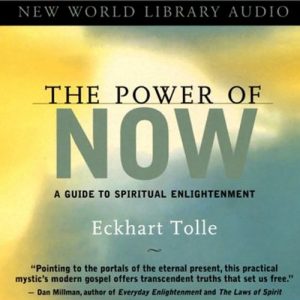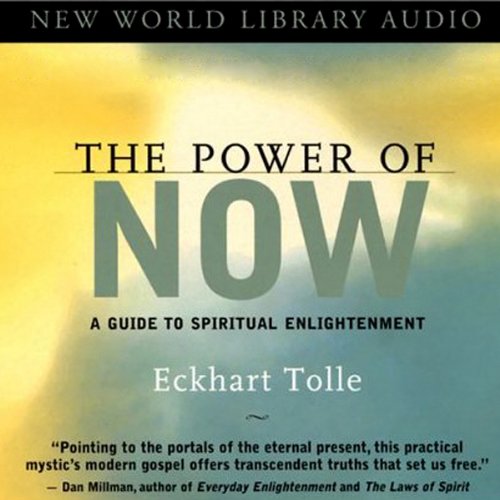
I first encountered this one not as a deliberate choice but as something playing in the background of a friend's apartment on a rainy Saturday afternoon. I caught maybe twenty minutes of Eckhart Tolle's voice and then forgot about it for two years. When I finally returned to it properly, sitting alone with headphones late on a Tuesday night when sleep was not coming, the effect was entirely different. There was something about the stillness of his voice that matched the particular kind of restlessness I was feeling, the mind-spinning-over-nothing that Tolle spends the entire book diagnosing.
First published in 1999 and marking its 25th year as a New York Times bestseller, The Power of Now has sold more than 16 million copies. That number is either evidence of its genuine resonance or evidence of a particular cultural hunger it has always been skilled at naming. Possibly both.
Tolle's Pauses Are the Philosophy Itself
Most books suffer something in translation when the author reads their own work. Tolle is an exception that proves a rule. His accent, his deliberate pauses, his refusal to rush past a sentence that might need to be felt rather than simply processed, these are not incidental to the experience. They are the philosophy in audio form. When Tolle says the word "now," he gives it a weight that a professional narrator almost certainly could not manufacture, and the effect is different from reading the page. The listener is not simply being told to be present; the voice is modeling it.
Reviewer Jana described it as carrying "a depth that invites you to slow down and reflect on each page," and in audio that invitation is made literal. You cannot skim. You cannot read at your own pace. The book moves at the pace Tolle sets, and if you have any resistance to that, if you are someone who listens at 1.5x speed and considers it an efficiency gain, this particular audiobook will frustrate you. I say that as someone who is absolutely that person with most titles. Here, I left the speed at 1x and something shifted.
Pain-Body Language Earns the Book's Reputation
Tolle begins by describing his own breakdown and sudden awakening, a story that either reads as genuine spiritual insight or as the kind of extraordinary claim that requires extraordinary evidence. I was in the skeptic camp for the first thirty minutes. The language around "enlightenment" and "Being" (consistently capitalized in the text, audible in the weight Tolle places on the words) can feel like a spiritual vocabulary designed to resist scrutiny.
Stay with it. The shift in the second and third chapters, when Tolle moves from metaphysical claims to the much more graspable concept of the "pain-body," the accumulated emotional residue that colors present experience, is where the book earns its reputation. Reviewer Bri Luna described it as "freeing and powerful" for releasing trauma, and I understood that response by the time I reached those sections. Whatever one thinks of the theoretical scaffolding, the practical observation that most human suffering is generated by the mind rehearsing the past or projecting into the future is hard to dismiss.
Tolle's Questioner Voice Breaks the Spell
This is not a comfortable audiobook for multitasking. Tolle occasionally moves into dialogue format, a questioner poses a spiritual problem, Tolle answers, and while this works well on the page, in audio it can feel slightly awkward. The "questioner" voice is clearly Tolle himself performing a device, and the artifice is more visible in audio than in print. It does not undermine the content, but it breaks the spell occasionally.
Some listeners have noted that the depth of the material requires multiple passes. Reviewer Netspiderz described it as a book that depends on readiness: "when you are ready, you may understand it. Otherwise, it may be a heavy book." That is not false, though it can also be used as a way of insulating the ideas from any fair criticism. The honest position is that some of Tolle's claims about consciousness and Being are genuinely difficult to evaluate, and the audiobook format does not give you the margin-writing space to push back.
Full Attention Is the Price of Entry
Listen if you are genuinely curious about present-moment philosophy and do not mind a slower, more meditative listening pace. Listen if you are going through a period of anxiety or rumination and want something that addresses that experience directly. Skip if you need rigorous philosophical argument rather than guided spiritual reflection. Skip if you need a book that rewards multitasking, this one asks for your full attention and returns very little when it does not get it.
Common Questions
Does Eckhart Tolle narrate the full audiobook himself, or only part of it?
Tolle narrates the entire audiobook himself. His delivery is calm and deliberate throughout, and the author-as-narrator choice is generally considered one of the strengths of this particular audio edition.
Is The Power of Now better experienced as an audiobook or in print?
Many listeners find the audiobook especially effective because Tolle's voice and pacing embody the philosophy of presence he describes. That said, the print version allows for annotation and rereading of difficult passages. Both formats have devoted advocates.