
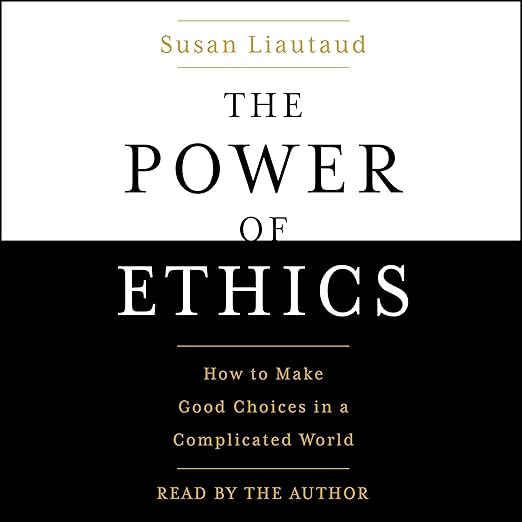
Susan Liautaud's The Power of Ethics audiobook arrived at an interesting moment. I had spent several weeks reading about corporate misconduct, including the Boeing safety failures, debates over AI governance, and the slow unraveling of various tech platforms' commitments to user privacy, and I kept circling the same question: how do the people inside these organizations justify their decisions to themselves? Liautaud, drawing on two decades as an ethics advisor and her work teaching ethics at Stanford University, offers a framework that attempts to answer exactly that. This is not a philosophical treatise. It is a practical manual for ethical decision-making in conditions that are genuinely ambiguous, and the audiobook version delivers it with the authority of an author who has been inside the rooms where these decisions are actually made.
Naming the Twenty-First Century's Gray Choices
Liautaud's central argument is that the moral challenges of the twenty-first century are not failures of good intentions but failures of decision-making tools. We face what she calls increasingly gray choices: situations where no clear right or wrong answer exists, where concentrated power structures, rapid technological change, and insufficient regulation all operate simultaneously. Her response is a four-step process for ethical decision-making that she walks through with care and real-world examples. She also identifies six forces that shape virtually every ethical choice we face, from power dynamics to technology's expanding reach. The structure is teacherly without being condescending, which is exactly what it needs to be for an audience that may have no background in moral philosophy but needs to make consequential decisions today.
One of the strongest sections covers the ethics of privacy, particularly around children's digital lives. Liautaud does not moralize here; she asks the practical question of how a parent makes an informed choice when platforms are deliberately designed to be opaque. The same rigor applies to her treatment of corporate misconduct. The Boeing case study she uses is not a simple story of evil actors but a more uncomfortable portrait of how ethical erosion happens incrementally inside large organizations where everyone along the chain makes a locally defensible decision. That willingness to sit with complexity rather than resolve it into easy villains is what separates this book from most business ethics titles on any shelf.
Explaining Concepts She Genuinely Inhabits, Not Performing
Liautaud narrates her own work, and the decision to self-narrate matters here in a way that it does not for every author. Her voice carries the specific confidence of someone who has been in the room when these decisions are being made, advising corporations, testifying, teaching. She is not performing accessibility; she is explaining concepts she genuinely inhabits. The delivery is calm and measured at 8 hours and 25 minutes, and she handles the book's more emotionally charged examples around gene editing, surveillance, and child safety online with the same level tone she uses for the more abstract philosophical passages. The consistency serves the material's seriousness without creating distance from the listener.
The book earned a place as the top-rated resource in at least one ethics graduate course, and that endorsement points at the audiobook's real strength: it is equally useful for a professional encountering a real ethical dilemma right now and for a student wanting a rigorous introduction to applied ethics. Liautaud positions the work not as theory but as a sea change opportunity, the idea that individual ethical decisions ripple outward to families, communities, and workplaces. That framing gives the book genuine urgency without tipping into alarmism, which is a difficult balance to sustain across eight-plus hours of audio material on a subject that is inherently heavy.
The Audiobook Format Resists a Checklist Habit
Listeners expecting a more traditional philosophical ethics text will find the approach pragmatic to a fault in places. Liautaud's goal is portable tools, not nuanced moral theory, and she moves through some contested philosophical territory, including the nature of moral obligation and the limits of consequentialism, more quickly than a trained philosopher might prefer. That is a reasonable trade-off for the audience she is writing for, but it is worth naming. The six forces model is genuinely useful, though the audiobook format makes it harder to use as a reference checklist in the way a print reader might return to a specific page during a real-world dilemma.
The examples are drawn from technology, medicine, finance, and governance, giving the book broad relevance. But because many of the cases involve rapidly evolving situations, including AI ethics and social media regulation, some specific details will date. The decision-making framework itself holds up better than any particular case study, and that is ultimately where the book's durability lies for listeners who return to it after the specific news stories it references have faded from current memory.
For Almost Anyone Navigating Professional Life
This audiobook will serve business leaders, nonprofit executives, policymakers, and anyone who makes decisions that affect other people, which is to say almost everyone navigating professional life with any seriousness. It is particularly well-suited for people who feel ill-equipped to articulate ethical reasoning under pressure, or who recognize that their organization makes ethically ambiguous decisions routinely and has no shared language for discussing them productively. Academic ethics courses will find it a useful complement to primary texts. Those looking for a deeply philosophical treatment of moral theory should look elsewhere, but for applied, practical guidance rooted in real cases, The Power of Ethics delivers exactly what it promises across every hour of the listening experience.
Before You Press Play
- Narration: Susan Liautaud self-narrates with the measured authority of someone who teaches these ideas at Stanford; the delivery is clear, calm, and deliberately paced throughout.
- Themes: Ethical decision-making, corporate responsibility, technology and privacy
- Mood: Serious and clarifying, occasionally urgent
- Verdict: Liautaud's four-step framework and six forces model give listeners genuinely portable tools for navigating the moral gray zones that show up in daily professional and personal life.
A Few Questions About The Power of Ethics
Is The Power of Ethics audiobook useful for someone with no background in philosophy or ethics?
Absolutely. One reviewer described it as fantastically easy to read despite no philosophy background. Liautaud deliberately avoids academic jargon in favor of practical framing and relatable case studies from Boeing, AI, and gene editing.
Does Susan Liautaud narrating her own audiobook add value compared to a professional narrator?
For this material, yes. Her authority as an ethics advisor and Stanford professor comes through in the delivery in ways a third-party narrator replicating her words could not replicate. The self-narration lends the guidance a firsthand credibility that serves the subject.
Does the audiobook cover contemporary ethical dilemmas like AI, technology, and data privacy?
These are central rather than peripheral. Liautaud opens with Boeing, AI, robotics, and gene editing, and technology's ethical implications run throughout the book as live, unresolved challenges rather than historical case studies resolved by time.







