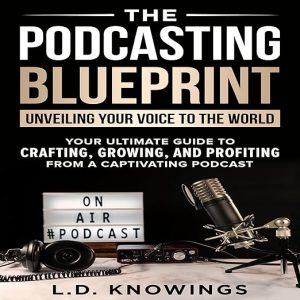
Have you ever thought, “I could do that!” while listening to a favorite podcast? That's the exact impulse this book is built around, and the real question is whether hearing that impulse validated is actually enough to get someone from idea to a published first episode. L.D. Knowings built The Podcasting Blueprint as a fairly compact guide, four hours and fifty minutes, structured around a seven-step blueprint covering everything from identifying a niche and crafting a name through equipment recommendations and eventual monetization, narrated by Mike Vallas at a brisk, coach-like pace that suits a short instructional audiobook aimed squarely at people who have never hit record before.
Grace Bell Calls This Full of Actionable Steps
The book's actual value is concentrated in its structure more than in any single revelatory piece of advice: podcasting content online is abundant and often contradictory, and what a total beginner usually lacks isn't information so much as a clear order to tackle it in. Knowing to nail down a niche and a name before worrying about a recording setup, and to think through episode structure before agonizing over monetization, is exactly the kind of sequencing a scattered tutorial-by-tutorial approach to learning podcasting rarely provides. The A-Z checklist of recommended equipment and software is the section I'd flag as most immediately useful for someone stuck in analysis paralysis over gear, since equipment choice is often the single biggest thing keeping a would-be podcaster from actually starting at all.
Listener reviews are short but consistent on the book delivering exactly what a beginner needs rather than overpromising. Grace Bell's review captures the tone well, noting the book is “full of actionable steps and creative strategies” rather than vague inspiration alone, while Juleeam's shorter take, “Easy read and gives great suggestions,” points to the same accessibility. Patty salegna-killeen's review adds a note of genuine enthusiasm about starting the process, which matches how the book is structured: less a reference manual to return to indefinitely and more a launch guide meant to get you from zero episodes to one finished show.
A real irony is worth naming in learning podcasting through an audiobook rather than through video, and it works entirely in the book's favor: absorbing advice about pacing, tone, and holding a listener's attention through audio alone is itself a demonstration of the exact skill the book is teaching, in a way a slideshow or written guide about audio simply can't replicate. Vallas's own pacing through the material becomes an implicit example alongside the explicit advice, whether or not that was the deliberate intent behind choosing audio as the format for this particular guide.
The niche-identification chapter gets more specific than the generic “find your passion” advice this kind of guide often defaults to, walking through how to weigh a topic's staying power against how crowded its existing podcast landscape already is, rather than simply telling a beginner to pick something they love and hope an audience finds them. The chapter on crafting a name follows the same practical instinct, treating a podcast's name as a discoverability decision as much as a creative one, worth real deliberation rather than the first pun that comes to mind during a brainstorm.
Vallas Avoids Over-Caffeinated Business-Audio Energy
Mike Vallas keeps the energy up without tipping into the over-caffeinated enthusiasm a lot of business and self-help audio defaults to, which matters for a book whose entire audience is people who might talk themselves out of starting if the material feels exhausting before they've even picked up a microphone. The pacing through the seven-step framework moves briskly enough that the whole thing is genuinely consumable in a single sitting, useful for a format explicitly designed to get someone moving rather than to be studied slowly over weeks of note-taking.
At under five hours, this respects the actual time budget of its target listener: someone weighing whether podcasting is worth pursuing at all usually isn't ready to commit to a ten-hour deep dive before finding out if the basic idea even appeals to them, and a shorter runtime here reads as a deliberate format choice rather than thin content stretched to fill space. Juleeam's straightforward “easy read” framing tracks with that design; this is meant to be finished in a sitting or two, not just started and shelved.
A fitting symmetry also shows up in the runtime itself: most individual podcast episodes run somewhere between thirty minutes and an hour, and absorbing this guide across a handful of sittings roughly mirrors the exact listening habit it's trying to help you build an audience around. A listener who finishes this audiobook in two or three sessions has, in a small way, already rehearsed the attention span and pacing expectations of the audience they're hoping to eventually build for their own show.
73 Listeners Back a Solid 4.7 Rating
This is explicitly a launch guide, not an advanced growth or monetization playbook, and anyone already several dozen episodes into an existing show looking for audience-growth tactics or advanced editing technique will likely find the content too basic to be worth the listen. The book stays honest about that beginner-only scope throughout, never pretending the seven steps double as an advanced playbook for growing an already-established show, and it doesn't oversell itself beyond the promise of getting a first episode actually published.
The 4.7 rating from 73 listeners is solid without being enormous, a reasonable sample for a shorter, niche how-to title but still modest enough that I'd treat it as a genuinely useful starting point rather than the definitive word on podcasting strategy; a landscape this fast-moving, equipment, platform algorithms, monetization models, tends to reward pairing any single guide with more current, ongoing sources rather than treating one book as a permanent reference years down the road.
Monetization gets real attention in the closing chapters, but it's worth being clear this covers strategy and mindset, sponsorships, listener support, cross-promotion, rather than negotiating specific ad rates or platform payout mechanics, which change too quickly for any book to track reliably. Treat that section as a map of the available paths rather than a current price guide, and expect to do additional, more current research once you're actually far enough along to start pursuing a specific monetization route seriously.
Zero Episodes Published Is the Starting Point
This is built for the total beginner: someone with a concept in their head and zero episodes published, who wants a clear sequence to follow rather than piecing one together from scattered videos and forum posts, and who values a short, finishable guide over an exhaustive reference they'll never actually complete.
Established podcasters with years of episodes already published probably won't learn much new here, since the content is calibrated entirely for the pre-launch phase rather than growth or retention strategy for an existing show. It's also a thin pick for anyone hoping for deep technical detail on audio editing or platform-specific algorithm behavior, since the seven-step blueprint stays intentionally high-level across all of its steps rather than drilling into any one of them exhaustively.
Frequently Asked Questions
Is this audiobook useful if I've already published a few podcast episodes?
Not especially. The content is calibrated for the pre-launch phase, niche selection, naming, equipment, structure, so an existing host looking for growth or advanced editing advice will likely find it too basic.
Does this audiobook cover equipment recommendations in enough detail to actually buy gear from it?
Yes, the A-Z checklist of recommended podcast equipment and software is one of the more concretely useful sections for someone stuck in analysis paralysis over what microphone or software to buy before starting.