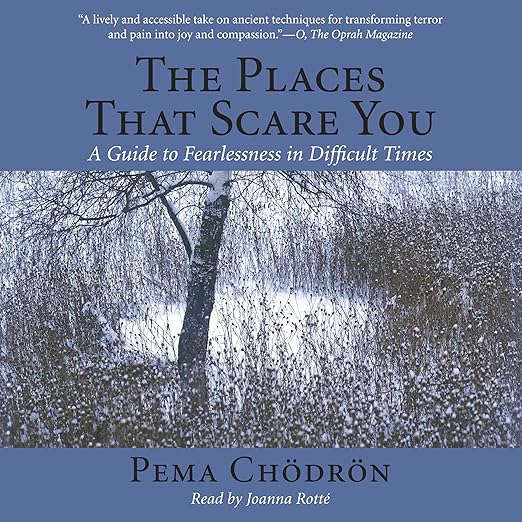
Four and a half hours is exactly the right length for this audiobook and, in one specific way, the wrong format for what it asks of you. The Places That Scare You is a set of practice instructions rather than a book of ideas about practice, and instructions want to be returned to, marked, argued with, and taken up again next month. Pema Chödrön's proposition can be stated in a sentence: circumstances will either harden you or soften you, and which one happens is a choice you make. Everything after that is method, and Joanna Rotte reads all of it.
Standing Deliberately in the Places You Avoid
Unusually for the genre, the description is precise about the mechanism, which I appreciate in a form that often settles for atmosphere. The claim is that the resource you need is already available and that habitual patterns rooted in fear are what block access to it. Past the fear sits openheartedness and tenderness. The work is to recognize the blocking patterns as patterns, accept yourself and other people complete with faults and imperfections, and stay in the present by seeing through the strategies the ego uses to resist life as it is.
So this is a specific program, not a mood. One reviewer, who works through the argument at length, sets the frame in traditional terms: the book opens with bodhichitta, glossed as enlightened heart or mind, and describes the people pursuing it as seekers training with the discipline of warriors. The title makes more sense in that light. The places that scare you are not external threats. They are the interior positions you habitually avoid, and the instruction is to go and stand in them deliberately.
Usable rather than merely admirable is the distinction it earns by refusing to promise that fear disappears. The offer is a different relationship to it. Softening rather than hardening, which is available on any given Tuesday and has to be chosen again on Wednesday.
Its title earns its keep as well. Most books in this space name the destination. This one names the obstacle and puts it in the second person, which warns you before you begin that the work will be personal rather than theoretical.
Rotte's Reading Goes Undescribed by Every Reviewer
Notice that the description was written for this format, and says so directly: this audiobook teaches us how to awaken our basic goodness. That is a small thing to notice and a rare one. Most spiritual titles carry copy about a book, retrofitted to a recording. This one addresses a listener.
Voice is the interesting complication. Chödrön is a teacher whose spoken transmission has its own audience, and one of the responses here makes that plain: this reader had already listened to her audio books and to recorded retreat dharma talks before choosing to work through this particular text. That was in 2015, two years before this recording existed. So the recording sits in an unusual position. It carries a teacher's instruction, in a form built for the ear, in someone else's voice.
How much that layer helps or hinders depends on what you want. A different reader removes the personality of the teacher and leaves the teaching, which some practitioners consider a feature rather than a loss. Others come to this material precisely for a particular cadence and will feel the substitution. Joanna Rotte's handling of it goes undescribed by everyone who wrote in, so the question stays yours to test.
Four hours and twenty-seven minutes suit the content genuinely well. Short enough to hear the whole argument in one weekend, short enough that a second pass costs very little, and a second pass is how a book of instructions actually gets used.
You Cannot Underline a Recording Like a Book
An honest limitation sits in the format itself, and it cannot be solved. You cannot underline a recording. Practice material rewards flipping back to a paragraph you half absorbed, and a listener has to either remember where something was or accept a more impressionistic relationship with it. Two of the responses call the book calming and comforting and mean it warmly, which is a fine outcome, but it is not the same as working with the instructions. If you want the second thing, plan for repeat listens or keep a notebook nearby.
Useful reservations come from the reader who awarded four stars rather than five, and who wanted more depth. Their objection is specific: they prefer Buddhist practice examined where it meets western psychology, applied to the nuts and bolts of daily life, and they find these books flowery and one step removed. The same entry notes that the material sounded very familiar compared with the author's other titles. If you already own several, expect meaningful overlap, and treat this as another approach to a consistent teaching rather than as new ground.
Two smaller notes on the listing itself. The shelving puts a book of Buddhist instruction under an alternative and complementary medicine tag, which is a category error rather than a description; nothing here is presented as a treatment. And the author's name loses its diacritics in the review column, spelled plainly by more than one reader, which is worth knowing if you go searching for related titles and come back with incomplete results.
Press Play When Something Is Actually Frightening
Press play if you are going through something and want method rather than consolation. Listen if the idea that difficulty can soften you instead of hardening you strikes you as a real proposition rather than a slogan. Listen if you have never read this author and want a compact entry point, since four and a half hours covers the core argument without asking for a long commitment.
Set it aside if you want the intersection of contemplative practice and clinical psychology, because the four-star response on this page is describing exactly the book this is not. Set it aside too if you already have three or four titles by the same teacher on your shelf, unless revisiting a familiar framework in a new arrangement is itself the appeal.
Last thing, offered as practical advice rather than as a caveat. Material like this changes depending on when you arrive at it. The responses here span more than a decade, and the people who wrote the warmest ones were plainly reading during difficult periods of their own. If nothing in your life is currently frightening, this will read as sensible. Come back when something is, and it reads as instructions.
At a Glance
- Narration: Joanna Rotte reads a teacher whose own recorded talks have their own following, which places an interpretive layer between listener and source that nobody on this page has assessed.
- Themes: fear as habitual pattern, bodhichitta, self-acceptance, staying present, softening rather than hardening
- Mood: Calm, direct, quietly demanding
- Verdict: A compact set of practice instructions worth repeat listens, provided you want method rather than reassurance.
Before You Listen
How long is the audiobook and is four hours enough for the subject?
It runs four hours and twenty-seven minutes, which covers the core argument in a single weekend. For instructional material that length is an advantage rather than a shortfall, because a second pass costs very little and repetition is how practice books actually get used rather than merely finished.
Does Pema Chödrön narrate this audiobook herself?
No. Joanna Rotte is credited as the reader. That matters here more than usual, since Chödrön's recorded dharma talks have their own audience, and one reviewer on this page had already listened to those before turning to this text. Expect the teaching in another voice.