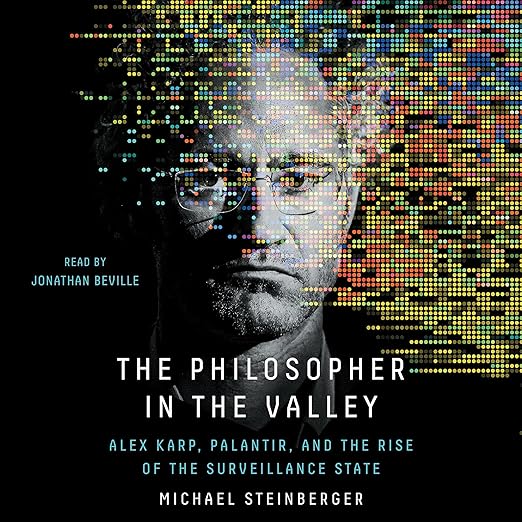
Quick Take
- Narration: Jonathan Beville delivers a clean, confident read suited to investigative nonfiction, he handles Karp’s philosophical digressions and Steinberger’s more journalistic passages with equal steadiness.
- Themes: Surveillance capitalism, data power, the ethics of defense technology
- Mood: Methodical and revelatory, with the atmosphere of a very well-sourced long-form magazine piece stretched to book length
- Verdict: An essential portrait of Palantir and Alex Karp for anyone trying to understand how data analytics became a geopolitical force, not a hagiography, not a hit piece.
I picked up The Philosopher in the Valley during a stretch when I was reading everything I could find about the infrastructure of the modern surveillance state, trying to understand how data flows between private companies and government agencies without most citizens being aware of any of it. Palantir kept appearing at the edges of other books, mentioned and then left unexplained. Michael Steinberger has done the work of going much closer, and what he found is both more complicated and more human than the company’s secretive reputation suggests.
The title is not metaphorical. Alex Karp, Palantir’s CEO, genuinely trained as a philosopher. He completed his doctorate in neoclassical social theory under the sociologist Jürgen Habermas in Frankfurt, and he has never fully shed that orientation. One of the more striking details in the book is that Karp actually wanted the biography to center on himself rather than the company, which tells you something about how he understands his own role.
The Company That Defies Simple Categorization
Palantir was founded in 2003, partially funded by the CIA, and built its early reputation on counterterrorism data analysis. By the time of this book’s writing, it had become a $400 billion company whose software is used by major intelligence services including the Mossad, the US military, dozens of federal agencies, and corporate clients including Airbus and BP. Steinberger is clear-eyed about what this means: Palantir is not a neutral data-processing vendor. It is a company whose technology is inseparable from questions of power, surveillance, and the willingness of liberal democracies to use those tools.
What Steinberger does well is resist the temptation to flatten this into a simple tech-company-bad narrative. Karp is genuinely conflicted about some of Palantir’s work, or at least performs that conflict convincingly in his public statements. He supports his employees’ right to know what contracts the company takes, has refused certain government contracts on ethical grounds, and has written publicly about the moral responsibilities of companies that build defense technology. Whether this represents genuine philosophical seriousness or sophisticated reputation management is a question the book raises but does not definitively answer, which feels honest.
Alex Karp as Portrait Subject
The most absorbing sections of The Philosopher in the Valley are the biographical ones. Karp is a genuinely unusual figure: biracial, Jewish, severely dyslexic, trained in continental philosophy, with no background in business or computer science. He was largely shaped by his friendship with Peter Thiel, who cofounded Palantir with him, and the book is careful to trace both the intellectual alignment and the eventual divergence between them. One reviewer noted that Karp accepted years of access to Steinberger on the condition that he be the book’s central subject, not just a figure in a corporate history, and that arrangement produces unusually personal access.
Jonathan Beville’s narration moves between Karp’s more philosophical register and Steinberger’s journalistic analysis without friction. The audiobook format works particularly well for the sections where Karp is quoted at length: there is a quality to his actual speech patterns that Steinberger has preserved in his text, and hearing those passages read aloud makes them feel more immediate.
The Final Chapter Problem
One reviewer called the book great until the author had to step in, referring specifically to the final chapter, where Steinberger’s own discomfort with what he describes as Karp’s right-wing turn becomes more visible. It is a fair criticism. Steinberger has spent the previous eight-plus hours presenting Karp’s worldview with genuine curiosity and interpretive generosity, and then the book ends with a more openly evaluative register that feels slightly discordant with what came before. This is a minor structural issue rather than a fundamental one, but it is worth knowing about.
The political and ethical questions the book raises have only grown more urgent since its publication. Palantir’s role in immigration enforcement, military AI, and government data infrastructure is the subject of ongoing public debate, and The Philosopher in the Valley provides the essential background context for understanding how the company got to where it is.
Who Should Listen, Who Should Skip
This audiobook is essential for listeners who want a serious, reported treatment of Palantir and the surveillance data economy, and particularly for anyone interested in the intersection of Silicon Valley, defense contracting, and political power. It is also a compelling portrait of an unusual mind. Skip it if you want ideological clarity: Steinberger gives Karp more latitude than some readers will feel is warranted, and the book does not provide a simple verdict on whether Palantir’s work is ultimately good or bad for democratic society. That is a feature for some listeners and a frustration for others.
Frequently Asked Questions
Is The Philosopher in the Valley sympathetic to Palantir and Alex Karp, or critical?
Neither cleanly. Steinberger spent years with extensive access to Karp and presents his worldview with genuine curiosity. The final chapter is more openly evaluative and critical of Karp’s political trajectory, which some reviewers found jarring after the relative generosity of what precedes it.
Do I need background knowledge of Palantir or Silicon Valley to follow this audiobook?
No. Steinberger explains Palantir’s technology, history, and business model clearly for general readers. The book functions as an introduction as much as a deeper dive.
How does this book handle Peter Thiel’s role in Palantir, given his political prominence?
Thiel appears throughout as Karp’s close friend and co-founder, and Steinberger traces the intellectual and personal relationship between them carefully. The book documents where Karp and Thiel align and where they have diverged, particularly on questions of democratic norms and institutional responsibility.
Is the audiobook’s 9.5-hour runtime well-paced, or does it drag in places?
The biographical sections on Karp’s background and Palantir’s founding are the most propulsive. The middle sections covering Palantir’s various government contracts are more methodical. The pacing suits investigative journalism readers; it may feel slow to listeners expecting a narrative biography.