Quick Take
- Narration: Jason Zenobia reads clearly and neutrally – well-suited to the survey format but without the tonal variation that would help listeners feel the shift between the two manuscripts.
- Themes: American imperial expansion, forgotten wars, colonial violence and its long aftermath
- Mood: Brisk and introductory – this is a doorway, not a destination
- Verdict: A serviceable two-book introduction to conflicts most Americans barely know happened, though the compilation format means neither the Spanish-American War nor the Philippine campaign receives the depth it deserves.
I came to this one having just finished a much longer account of the Spanish-American War, the kind of deeply sourced narrative that takes its time with individual participants and follows consequences across decades. So listening to this Captivating History two-in-one during a long drive was probably not the ideal test. By the time I reached the Philippine-American portion – which is genuinely the more overlooked and more disturbing of the two conflicts – I found myself wanting more than the format could offer. Still, there is real value here for the right listener, and the subject matter deserves far more attention than it typically receives in popular history.
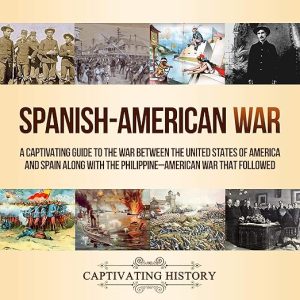
The audiobook bundles two separate manuscripts: a guide to the Spanish-American War and a guide to the Philippine-American War, running together at just over seven hours. That structure matters for how you approach it. This is survey-level history, aimed at the listener who genuinely does not know much about either conflict rather than the one who arrives with a foundation and wants it deepened.
The Conflict the Standard Textbook Skips
The Spanish-American War section is the more polished of the two. The book covers the acceleration of American imperial ambition well – Spain’s waning influence in the Caribbean and Pacific, the complicated role of Cuba, the explosion of the USS Maine, and the transformation of the United States into a formidable player on the world stage. The Buffalo Soldiers, who contributed significantly to the famous charge at San Juan Hill and received almost none of the credit Teddy Roosevelt claimed for himself, get more attention here than in many popular accounts, and that emphasis is genuinely valuable for listeners who know the Roosevelt mythology without knowing the more complex reality behind it.
The Philippine-American War material is where this audiobook does its most distinctive work, simply because the war itself is so rarely addressed. The transition from the Spanish-American War to the Philippine Insurrection – as American officials preferred to call it – is a story about imperial logic playing out over years rather than the ten weeks of the preceding conflict. The suppression of Philippine independence, the brutality of American counterinsurgency tactics, and the moral contradictions of a nation fighting for Cuban self-determination while denying the same to Filipinos: these are subjects that deserve far more attention than they typically receive in American historical education. That the war is largely forgotten now, as one reviewer notes, makes a survey like this one more valuable as an entry point despite its limitations.
What the Captivating History Format Costs
The series format imposes a ceiling, and this audiobook bumps against it repeatedly. This is history designed to introduce rather than to analyze, and the synthesis it offers is necessarily thin on primary sources, contested interpretations, and the kind of human detail that makes history stick in memory. The book’s synopsis includes promotional language that hints at the production’s priorities – comprehensive coverage is promised but the format cannot fully deliver it.
The reviews split in a way worth naming. One listener found the book revisionist and factually unreliable; another found it valuable and honest about America’s conduct. That gap suggests the book sits in contested interpretive space, particularly around American conduct in the Philippines, where the historical record is genuinely ugly and some popular accounts have been more apologetic than the evidence warrants. Listeners with existing knowledge of the period will form their own judgments; those coming entirely fresh to the subject will mostly be unaware of the choices being made in the framing.
The overall rating of 3.5 across 86 reviews is lower than most Captivating History titles, and that spread is consistent with a subject where historians disagree substantially about how American conduct should be characterized. The negative reviews tend to focus on perceived inaccuracies or tendentious framing rather than on poor writing or production quality. For a listener who simply wants an orientation to two neglected conflicts, this is adequate. For one who wants a reliable scholarly account, the rating signals real caution is warranted.
Who Should Listen / Who Should Skip
Listen if you want a brisk, accessible introduction to two conflicts that rarely appear in American history courses beyond a sentence or two. This is a doorway, not a destination. For serious historical analysis, primary source engagement, or any sustained examination of the war’s long-term consequences for the Philippines, David Silbey’s A War of Frontier and Empire or Stanley Karnow’s In Our Image are considerably more substantive alternatives, both available in audio. Zenobia reads clearly throughout, but there is little in his delivery to distinguish the two manuscripts from each other, which can make the transition between the Cuban and Philippine theaters feel less distinct than the geographic and moral distance between them warrants. The Philippine-American War is not a footnote to the Spanish-American War; it is a longer, bloodier, and more morally complex conflict, and listeners who arrive at it through this compilation may find it prompts them toward more dedicated sources – which is itself a worthwhile outcome.
Frequently Asked Questions
Is this audiobook actually about the Philippine-American War, or mostly the Spanish-American War?
It covers both in roughly equal measure. The first manuscript focuses on the Spanish-American War; the second on the Philippine conflict. The two are sequential – the Philippine war grew directly out of the American acquisition of the Philippines following the Spanish defeat – so treating them as a pair makes historical sense, even if the title emphasizes one over the other.
Does the book address American atrocities during the Philippine campaign?
It touches on the violence and moral contradictions of American conduct in the Philippines, though briefly given the survey format. Listeners wanting a more thorough account of the water cure, reconcentration camps, and the civilian death toll should supplement with a dedicated history of the conflict.
One review calls the book revisionist history with no factual basis – is there a genuine accuracy problem?
The mixed reviews suggest contested interpretive ground rather than straightforward factual error. The Philippine-American War is a topic where mainstream American historical accounts have historically been more charitable to US conduct than the evidence supports. Listeners with deep expertise may find the framing tendentious; those coming fresh to the subject are unlikely to notice interpretive choices at this level of overview.
Are the two manuscripts clearly distinguished in the audio, or does the whole thing run together?
They are presented sequentially with a transition between them, but the narration style does not change significantly across the two sections. The shift in subject is announced, but listeners who are not tracking the runtime closely may find the geographic and contextual shift from Cuba to the Philippines less clear than the chapter structure implies.