
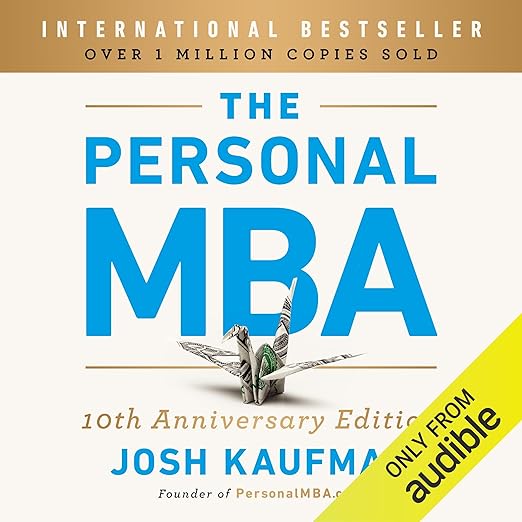
Kaufman's central provocation is one worth sitting with before you even press play on this audiobook: that the credential system for business education has decoupled entirely from the actual education. The Personal MBA was first published in 2010 and updated in 2012, earning an Audie Award nomination in Business and Educational in 2013, and its argument has only grown more pointed in the years since. Business school costs have continued to climb while the information those programs deliver has become increasingly accessible outside their walls. What Kaufman offers is not a shortcut but an alternative framework entirely, one built around mental models rather than case studies and credentials.
At 15 hours and 25 minutes, this is a substantial audiobook, and the self-narration matters here. Kaufman reads with the assurance of someone who has taught this material rather than simply written it. His pace is deliberate and he emphasizes the structural logic of each concept clearly, which is helpful because the content is organized around principles rather than narrative. The listener is not following a story but building a mental architecture, which demands a different kind of attention.
The book's argument against traditional MBA programs lands early and hard. Kaufman's case is economic and practical: the return on investment for most MBA programs is negative when measured against alternatives, and the actual business knowledge transferred is replicated more efficiently through direct reading, practice, and mentorship. The comparison one reviewer draws to the Matt Damon line from Good Will Hunting is apt. Kaufman is essentially systematizing the insight that formal gatekeeping in knowledge transmission is often more about social signaling than learning.
What Kaufman does well is synthesis. He has read across an enormous range of business, psychology, economics, and systems literature and pulled the frameworks that actually hold up under application. The result is a taxonomy of business thinking that covers entrepreneurship, marketing, sales, negotiation, operations, productivity, and systems design without feeling encyclopedic in the numbing sense. Each concept is short and self-contained. The structure is closer to a collection of precisely defined terms than to a continuous argument, which makes the audio format both its strength and its limitation.
Kaufman Knows Which Word Carries the Weight
Self-narration is frequently a risk, but Kaufman earns it. He is not an actor and the performance is not emotionally varied, but the clarity of delivery is consistent across the full 15-plus hours, and for a book organized around precise definitions of mental models, clarity is the critical variable. He knows exactly which word in each sentence carries the logical weight and he places emphasis accordingly. The audiobook also benefits from the fact that Kaufman has been teaching this content through PersonalMBA.com for years. He has refined the language until the concepts snap into place.
Reviewers who note that it reads like a textbook are identifying something real, but that framing undersells the value of a well-constructed textbook. The Personal MBA is organized so that each section can stand alone, which means the audio format supports non-linear use. You can skip to the sections most relevant to where you are in your professional life and get complete value from them without the surrounding context. For active practitioners in sales, operations, or product development, the relevant sections are likely to generate immediate applicable insight rather than abstract theory.
This Maps the Territory Rather Than One Region
Two tensions in the material are worth tracking as you listen. First, Kaufman's anti-credentialist argument is stronger for some fields and career stages than for others. For people entering industries where the credential is also the access point (consulting, investment banking, certain corporate environments), the argument needs more nuance than the book provides. He is not wrong about the economics, but the social reality of hiring in those sectors is not purely about knowledge and skill. Second, the book's frameworks sometimes arrive at a level of generality that can feel thin without case material to anchor them. The audio format amplifies this: on the page, you can sit with a framework and test it against your own experience. In audio, the concepts move quickly and the abstraction can feel unmoored.
The strongest sections tend to be those dealing with systems thinking and value creation, where Kaufman's own intellectual interests clearly run deepest. The weaker moments come in sections on negotiation and sales where the frameworks are real but have been covered more richly in dedicated books on those subjects. For a reader building a comprehensive library, The Personal MBA works better as a map of the territory than as the definitive guide to any single region of it.
A Foundation Instead of a Ceiling, Kaufman Says
The ideal listener is someone early in their career who is trying to build a conceptual vocabulary for business before diving deep into specialized reading, or someone mid-career who has accumulated practical experience but never found a framework for organizing what they know. Entrepreneurs who built something intuitively and now want language for what they did will find many sections clarifying in retrospect.
Listeners who already have deep fluency in one or more of the covered domains, such as experienced marketers, seasoned operators, or finance specialists, will likely find their core domain underdeveloped while discovering genuinely useful material in adjacent sections they know less well. Anyone treating this as a replacement for domain-specific study in a complex field will leave underprepared. Kaufman is clear about this himself: the book is a foundation, not a ceiling.
- Narrator: Josh Kaufman self-narrates with the confident clarity of someone who has delivered these frameworks hundreds of times in lectures and seminars.
- Subjects: Self-directed business education, mental models for decision-making, entrepreneurship without gatekeeping
- Tone: Practical and energizing, with a persistent anti-institutional undercurrent
- Bottom line: Dense with useful frameworks but best treated as a reference audiobook you return to rather than absorb in a single pass.
Common Questions
Is this audiobook appropriate for someone with no formal business background?
Yes. Kaufman explicitly designed the content for people who want to learn business fundamentals outside of formal education. The language is accessible and each concept is introduced from first principles rather than assuming prior coursework.
Does Josh Kaufman's self-narration hold up across the full 15-hour audiobook?
It holds up well. His delivery is clear and consistent even if not dramatically varied. The main advantage of self-narration here is that he knows exactly where the emphasis belongs in each defined concept, which matters for content organized around precise mental models.
How does this audiobook compare to reading the print version?
The print version allows you to annotate and flip between sections more easily, which suits the reference structure of the content. The audiobook works well for initial exposure and for revisiting familiar sections, but listeners who want to actively build on the frameworks may want both formats.
Is the content in this audiobook still current given it was originally published in 2010?
The core mental models Kaufman covers are durable, covering psychology, systems thinking, and basic economics rather than technology trends or market conditions. Some examples are dated, but the underlying frameworks remain applicable to contemporary business contexts.







