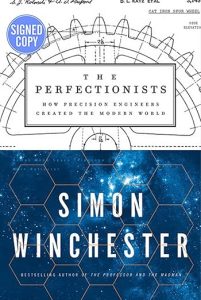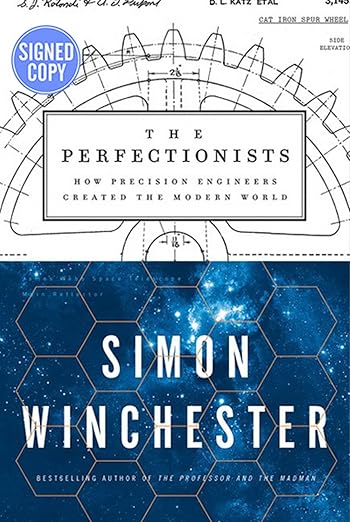
I started The Perfectionists during a weekend trip to Birmingham, which felt appropriate given that the West Midlands is one of the birthplaces of the precision manufacturing that Winchester is writing about. I was standing near what had been a canal wharf used to transport the products of Birmingham's early industrial workshops when the audiobook reached its description of Joseph Whitworth's standard screw thread, and the sense of historical layers collapsed pleasantly. Winchester does that to you: he makes the industrial past feel present and inhabited rather than remote.
The Perfectionists is, on its surface, a history of precision manufacturing from the Industrial Revolution through the digital age. But Winchester's real subject is the concept of precision itself, what it means, why it matters, how the ability to make things to ever-finer tolerances has shaped every aspect of modern life, and what might be lost in a civilization that values exactness above all other qualities. This is popular history with a philosophical undertow, and it is more interesting for the ambivalence Winchester brings to his subject.
The organizing principle of the book is developmental. Winchester traces precision from the moment when standardized measurement became possible, roughly the 1760s in England with figures like John Wilkinson whose boring mill made James Watt's steam engine practically viable, through successive generations of engineers and innovators who pushed tolerances to ever-finer degrees. Henry Maudslay's screw-cutting lathe, Jesse Ramsden's dividing engine, Joseph Whitworth's flat surfaces accurate to millionths of an inch. These are not household names, but Winchester makes them feel like the architects of a world we now take entirely for granted.
The narrative gains momentum as precision moves from mechanical engineering into optics, electronics, and ultimately particle physics. The Hadron Collider section is genuinely astonishing in what it reveals about the degree of precision required to accelerate particles around a 27-kilometer ring at near-light speed. Winchester communicates the scale of this achievement without losing the human element, the engineers and physicists whose obsessive attention to exactness made the impossible merely very difficult.
What Simon Winchester Gets Right
Simon Winchester is one of a small group of nonfiction writers whose self-narrated audiobooks are consistently better than any alternative narration would have been. He has a particular quality of engaged curiosity in his voice, as though he is discovering things as he explains them rather than reciting from a finished text. His British accent and his tendency toward precise, slightly formal prose are suited to material about precision manufacturing in ways that feel more than coincidental.
At eleven hours and forty-six minutes, the audiobook is substantial but never padded. Winchester's chapters are organized around specific technological inflection points, and each has its own internal narrative arc. The movement from one era to the next is handled smoothly enough that you rarely feel the structural seams. The production quality is what you expect from a Winchester audiobook: clean, well-mastered, with no distracting audio artifacts.
Where Simon Winchester Loses Some Ground
The most interesting dimension of The Perfectionists is its willingness to interrogate its own subject. Winchester asks, with increasing seriousness as the book progresses, whether the civilization-wide pursuit of precision has costs that are not visible inside the precision paradigm itself. The decline of craft traditions, the marginalization of intuitive skill, the way standardization can flatten the variations that give objects and places their character. These are not anti-technology arguments so much as attempts to see the full ledger of what precision manufacturing has produced.
The question Winchester poses at the end, whether the precise and the natural can coexist in society, is not answered definitively. It is left as the kind of open question that good popular history raises rather than resolves, and it gives the book an intellectual gravity that distinguishes it from histories that simply celebrate what they document. Listeners with backgrounds in craft traditions, architecture, or cultural history will find this dimension of the book particularly engaging.
Who Should Pick Up The Perfectionists
The Perfectionists is for anyone who has ever wondered how modern manufacturing actually became possible and wants to understand the deep history of precision that underlies everything from gun production to microchips. It is particularly rewarding for listeners with any engineering background, who will find their professional world illuminated historically in ways that most engineering education ignores entirely.
Those looking for pure narrative history without the philosophical dimension may find Winchester's reflective passages slower than the biographical and technological sections. But the book's real achievement is precisely this combination of narrative and reflection, and readers who engage with it fully will find themselves thinking differently about the made world around them. The 4.7 rating from over two thousand listeners is deserved. This is Winchester at close to his best.
Good to Know
Do you need an engineering background to follow The Perfectionists audiobook?
No specialist knowledge is required. Winchester is a generalist writer and explains all technical concepts in plain language. The book is written for curious general readers, not for practicing engineers, though engineers will find additional layers of resonance in the material.
Does The Perfectionists cover digital precision and modern technology, or is it primarily industrial history?
The book traces precision from the eighteenth century through to contemporary high-tech manufacturing, gene splicing, and the Hadron Collider. The arc is explicitly from the Industrial Age to the Digital Age, so the coverage of modern technology is substantial and forms the final third of the book.
How does Simon Winchester's self-narration of The Perfectionists compare to his other audiobooks?
Winchester has self-narrated several of his books, including The Professor and the Madman and The Map That Changed the World. His narration of The Perfectionists is consistent with that work: precise, warm, and genuinely engaged. Listeners who have enjoyed his other self-narrated audiobooks will find this equally satisfying.