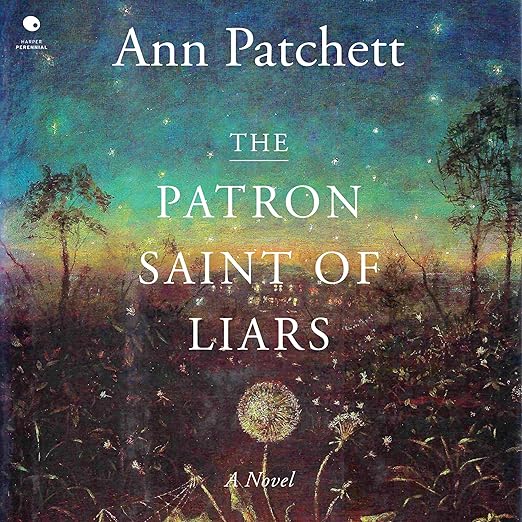
Key Details
- Narration: Julia Gibson delivers Patchett's measured prose with quiet authority, holding the novel's emotional restraint without making it feel cold.
- Themes: Displacement and self-invention, the costs of running, motherhood as transformation
- Mood: Contemplative and slow-burning, like a long afternoon in a house full of complicated people
- Verdict: Ann Patchett's debut is not her most polished work, but it has a gravity and a structural daring that her admirers should not miss.
I first read Ann Patchett out of order, which is probably not unusual. Most people come to her through Bel Canto, or Commonwealth, and work backward. I came to The Patron Saint of Liars late, which meant I came to it knowing what Patchett is capable of. That knowledge made the experience of her debut both more and less interesting: more, because you can see the architecture of her later work forming here; less, because the control she would develop is not yet fully present, and the gaps are visible.
But the gaps are interesting too. Rose Clinton is one of Patchett's most genuinely mysterious protagonists, and that mystery is structural. We are not given access to her interiority in any conventional way. She is a woman who drives, who leaves, who stays when she did not plan to, and who cannot entirely explain herself even when asked directly. That opacity could be frustrating. In Patchett's hands, it reads as a serious engagement with the question of how well we can actually know another person.
First, the Big Picture
St. Elizabeth's home for unwed mothers in Habit, Kentucky, is as real and specific a setting as any Patchett has created. The community of nuns and rotating residents, the strange permanence of a place designed for temporary inhabitants, the hot spring that gives the location its reputation, all of this is rendered with the kind of patient attention that makes a fictional place feel like somewhere you have been. When Rose arrives and chooses to stay, the decision feels strange to her and to us, and Patchett refuses to make it fully legible.
The novel shifts perspective across three narrators and three time periods, and this structural choice is the most ambitious thing about it. What the structure reveals is that no single perspective can contain Rose, and that the people who love her are left to reconstruct her from fragments. It is a formally interesting choice for a debut, and it works better than it has any right to.
Why The Patron Saint of Liars Works as an Audiobook
Julia Gibson's narration honors the prose without embellishing it. Patchett writes clean, controlled sentences that carry weight through accumulation rather than individual effect, and Gibson understands that. She reads Rose's sections with a stillness that can feel productively withholding, we are not given emotional cues to tell us how to feel about this woman who lies to almost everyone she loves.
The 14-hour runtime accommodates the novel's generational scope. This is not a fast story, and it should not be. Gibson's pacing makes the time feel inhabited rather than consumed.
A Few Reservations
This book will frustrate readers who expect emotional transparency from their protagonists. Rose is a liar in the title's sense, but also in a deeper sense: she has constructed a version of herself that even she may believe, and Patchett never fully dismantles it. If you need resolution, catharsis, or a protagonist who learns and articulates what she has learned, you will finish this feeling unsatisfied.
One reviewer described being left flat by it, and I understand that response even if I do not share it. The novel's refusal to provide the comfort of full understanding is its point. It is a genuine aesthetic position, not a flaw, and readers who can receive it on those terms will find more here than those who cannot.
Should You Listen to The Patron Saint of Liars?
This is best suited to readers who are already admirers of Patchett and want to understand where her preoccupations began, or to literary fiction listeners who prefer moral ambiguity over emotional resolution. It holds up alongside her later work as a debut that already knows what it is trying to do.
Less suited to listeners who prefer clear emotional arcs or sympathetic protagonists in the conventional sense. Rose is not a character designed to be liked, though she is designed to be understood, partially, incompletely, in the way we understand people who are determined to remain mysterious.