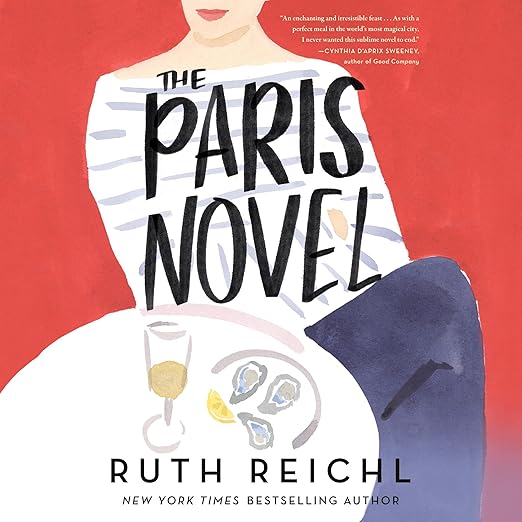
Saveur, Food & Wine, Bookreporter and The Charlotte Observer all get a mention in the copy for this audiobook before Stella does. So does a bestseller banner, a mouthwatering verdict credited to The New York Times, and a blurb from Cynthia D'Aprix Sweeney calling the thing an enchanting and irresistible feast. Four layers of endorsement arrive before a single sentence of story. When the apparatus is stacked that high, it is generally worth asking what it has been built in front of.
A Closer Look at The Paris Novel
Stella's inheritance is a one-way plane ticket and a note reading go to Paris, left by an estranged mother who has just died. She is not built for it. A traumatic childhood has kept her inside strict routines and a narrow comfort zone, and she goes only because her boss pushes her toward the time off and because the instruction is a dead woman's last one. Once there she does what she always does, living cautiously and frugally, until a vintage shop and a Dior dress the shopkeeper insists was meant for her produce the first impulsive act of her adult life.
Jules does the rest. An octogenarian art collector who meets Stella over her first oysters at Les Deux Magots decides to take her under his wing, and from that point the novel becomes a tour: the literary, artistic and culinary circles of 1980s Paris, a stretch of living as a tumbleweed at Shakespeare and Company, a hundred-year-old puzzle inside a Manet painting. It is a wish-fulfillment structure with a research project buried in it, and the readers who liked it most were responding to the second half of that sentence rather than the first. Ruth Reichl is not being coy about the fantasy element either, which is part of why it works: the dress really is magic, the collector really does open every door, and the novel proceeds as though neither claim requires a defense.
Lulu, holding the only grade below four, is having none of it. Were the prose as good as the food, that entry argues, the book would be considerably more interesting. The passage about Shakespeare and Company and George Whitman earns real credit; the writing around it is called trite, and the review signs off with an instruction about cutting the cliches. The author's surname is misspelled in the same breath, which does not make the objection wrong. It is the only dissent here, and the only remark anywhere about the sentences themselves.
What Makes The Paris Novel Worth Hearing
Nine hours and twenty-six minutes carries all of that, and the record has been strangely quiet about it. Random House Audio published in April 2024, and the entire written column arrived between January 5 and February 6 of 2026: five responses inside five weeks, after some twenty months of nothing at all. A pattern like that usually means a book found a second audience, never a first, and no one among the five says what brought them to it.
Kiiri Sandy carries the entire reading alone, and this is a book that puts real weight on that credit. The vocabulary is half French. A brasserie with a reputation, a couture house, a bookshop with its own mythology, a painter attached to an unsolved question. None of it is decorative, and the reader has to place each reference in passing, without stopping to explain any of it. Not a word of this listing reports how that goes, which leaves the most consequential question about the edition entirely unaddressed.
Every one of the four positive entries is describing sensory transport, not story. Mrs. Rich M reports seeing, tasting, smelling and feeling everything alongside the characters, and pushes back hard at the idea that this is fluff. KAM disconnected from the world completely. Chris Haley came away wanting to visit Paris and soak in the culture. L. L. Marshall says you can imagine the city and every dish in it. Four people, four versions of one compliment, and the compliment is about atmosphere.
Things to Know Before Starting The Paris Novel
One small oddity in that column deserves a mention, because it is the kind of thing a reader notices and then doubts. The entry filed under the name Chris Haley signs off in its final two words as Cindy Haley. Whether that is a shared household account, a slip, or simply the habit of signing letters, the record has no way of saying. It changes nothing about the review, which is warm and specific, but it is a useful reminder of how little weight any of these names can bear.
Nothing in the description tells you what kind of novel this is emotionally. Enchanting, irresistible, mouthwatering, sublime: every adjective on offer comes from somebody selling it. The one piece of actual text quoted, Stella tipping back her first oyster and wondering where oysters have been all her life, does more honest work than the rest of the page combined, and it sets the register exactly. If that sentence charms you, the book will charm you. If it reads as precious, nine hours is a long stretch to spend disagreeing with a narrator.
Watch the mystery expectation as well. Mrs. Rich M wanted the discovery of Victorine expanded and wondered aloud whether it might become another book entirely, which is a courteous way of saying the strand felt underweighted. The description promises a hundred-year-old mystery inside a Manet painting and then tucks it into the tail of a paragraph about decadent meals. Anyone arriving for the art-historical thread should know it shares the running time with a great deal of eating. Leave it alone when a plot is what you actually need.
Who Ruth Reichl Is Writing For
Readers who want to be somewhere else for nine hours are the natural audience, and 1980s Paris rendered through food, clothes and paintings is a generous version of somewhere else. It suits people who came for the author of Save Me the Plums and Delicious! and want that same attention turned on a character instead of a menu. It suits people who read to watch a life get larger, with no suspense required. The self-discovery arc is not subtle. Neither is the Dior dress. The book is perfectly aware of both facts and proceeds anyway, which is most of its charm.
Take the endorsements at their own valuation, which is to say as marketing, and read the column underneath them instead. The dissent in that column is one voice objecting to the sentences, and every other voice is describing a meal.
Questions Listeners Ask
Is the Manet mystery a large part of the audiobook?
Less than the description implies. It surfaces at the end of a paragraph otherwise concerned with meals, and one reviewer specifically wished the discovery of Victorine had been expanded, wondering whether it might have become a separate book. Treat the art-historical thread as one strand among several rather than the spine of the thing.
Why did every review of this audiobook appear at the same time?
All five written responses carry dates between early January and early February of 2026, roughly twenty months after the April 2024 release, with nothing before and nothing since. A cluster like that usually indicates a late rediscovery instead of a reception on arrival, though none of the five explains what led them there.