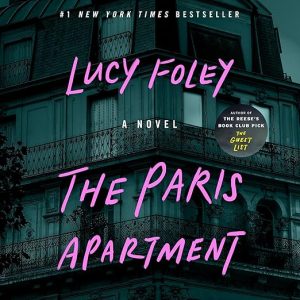
The Short Version
- Read by: One credited reader carries five rotating viewpoints across nearly thirteen hours, which makes voice separation the whole ballgame on this production.
- At its heart: Locked-room mystery, a missing sibling, neighbors with something to hide, Paris as a closed world
- Vibe: Brittle, claustrophobic, fast
- Short version: A sturdy sorting puzzle with real momentum, best approached as plot machinery rather than prose.
Locked-room mysteries usually hand you one house, one night and a fixed cast. Lucy Foley builds this one vertically instead: a Paris apartment building where every floor holds a suspect and the staircase does the work a country-house corridor normally does. The audiobook runs twelve hours and fifty-three minutes, a long stretch to spend somewhere nobody wants to talk to you, and the 2022 William Morrow production hands all of it to Clare Corbett. That single credit is the first thing worth weighing, because the novel is assembled from rotating points of view and the sales copy lists the residents as five separate labels.
First, the Big Picture
Ruthless efficiency governs the setup. Jess is broke, alone and freshly out of a job she left under circumstances the copy declines to specify. Her half-brother Ben sounded less than thrilled when she asked to crash with him, but he did not say no. She arrives to find an apartment far nicer than anything his situation should support, and no Ben. The five-star response filed in July 2025 lays out those first minutes better than any blurb does: the address at number 12, Rue des Amants, third floor, the instruction to ring the buzzer, the promise that he would wait up, and then an empty apartment with a cat in it.
Foley's other structural move is to announce the suspects as functions rather than people. The socialite, the nice guy, the alcoholic, the girl on the verge, the concierge. That is a deliberately old-fashioned gesture, closer to a golden-age cast list than to contemporary psychological suspense, and it sets the terms of the game in the first minute. You are not being asked to care about these residents. You are being asked to sort them, and the novel is honest about that from the cover in.
Why Listen to The Paris Apartment
Short chapters are the reason this works so well by ear. The three-star response from March 2022 describes the book as told in short chapters through multiple points of view, and that architecture suits audio better than almost any other thriller shape. Every perspective switch gives the ear a handhold, the plot resets every few minutes, and thirteen hours stops feeling like one commitment and starts feeling like a stack of small ones. Listeners who lose the thread of long chapters while doing something else with their hands will find this unusually forgiving.
Paris earns its place on the cover, too. Foley is not writing a travelogue, but the courtyard, the buzzer and the closed-up formality of the address do real atmospheric work, and the five-star dated 6 February 2026 reports reading the book while actually in Paris and finding that overlap enormous fun. That is a real use case: this is location fiction that rewards proximity, and it will land differently on a trip than it will at home.
As a guessing game it holds up. Everyone in the building has something to hide, the neighbors are unfriendly in ways that first read as guilt and then resolve into something more complicated, and the reveals arrive at intervals a listener can feel approaching without being able to name. Momentum matters more than elegance in a thriller this long, and the book is engineered for momentum from its chapter lengths up.
A Few Reservations
One credited reader, five rotating perspectives, and a warning that comes from the page itself. The four-star filed on 23 February 2026 puts the problem plainly: the prose is not the most elegant, and the characters get confusing because "they all have the same mannerisms, speech and vocabulary." That is a critique of the writing, but it lands squarely on a recording, because everything print uses to separate voices, the chapter header, the white space, the name at the top, evaporates when the text is spoken aloud. A production that assigns five viewpoints to one reader is asking that reader to supply the differentiation the prose withholds. Play a sample first if distinct character voices are what keep you oriented.
Look twice at the listing as well. The description opens with a promotional line for a different Foley novel, The Midnight Feast, announced as coming on June 18th with no year attached, which is a leftover from an old sales cycle rather than information about this title. A pull quote from People sits inside doubled quotation marks, a scrape artifact rather than an editorial flourish. Neither touches the recording, but both signal a page nobody has maintained, and a stale cross-promotion is exactly the sort of thing that sends a buyer to the wrong book.
Then the grades. A 4.0 across fifty-eight ratings sits just under what the five posted responses collectively award, so the silent majority of that pool is marking this down rather than up. All five of those responses also describe a printed reading experience: pages flipped, an easy read, a novel finished on a trip, prose judged on the page. The badge attached to an audio listing is being carried almost entirely by people who met the book in print, which is worth remembering before you treat 4.0 as a verdict on twelve hours of listening.
Should You Listen to The Paris Apartment?
Puzzle-first mystery readers are the natural audience, especially those who like a sealed setting and a suspect list short enough to hold in the head. If The Guest List worked for you, the machinery here will be familiar. Newcomers do fine as well: the four-star from October 2023 arrived at this as a first Foley novel and bought two of the earlier books before finishing it, which says something about how quickly the hook sets. It also suits travelers heading to Paris, and readers who need a thriller they can pause for two days without losing the plot.
The people who should think twice are prose-first readers and listeners who rely on distinct character voices to stay oriented. This is a plot delivery system, and the copy admits as much when it reduces its own cast to five job titles. Come for the building, the sorting and the reveals, treat the runtime as a series of small rooms rather than one long climb, and you will get exactly what the novel is offering. Go in expecting elegance and you will spend the whole staircase wishing the residents sounded less alike.
Questions Listeners Ask
Do I need to have heard The Guest List before this audiobook?
No. The Paris Apartment stands completely alone, with no series name or number attached to the release. The Guest List appears in the copy only as the author's previous bestseller, so nothing carries over in plot or cast. Either book can be your first Foley without any loss.
How is the audiobook structured, and how long does it run?
Twelve hours and fifty-three minutes, built from short chapters that rotate between residents of the building rather than following Jess in a straight line. The structure means frequent natural stopping points, which makes it easier to listen in short bursts than most thrillers of comparable length.
Which residents get to tell the story?
The copy labels five of them: the socialite, the nice guy, the alcoholic, the girl on the verge and the concierge. Jess drives the search for her missing half-brother, while the neighbors supply the competing accounts. Not every apartment in the building gets a viewpoint, which is part of the puzzle design.
Is this frightening, or more of a puzzle?
Firmly a puzzle. The tension comes from a missing person, an apartment nobody can explain and neighbors who will not answer straight questions, rather than from graphic threat. The copy sets the terms itself with the line that everyone is a neighbor and everyone is a suspect, and the book plays that as a sorting game.