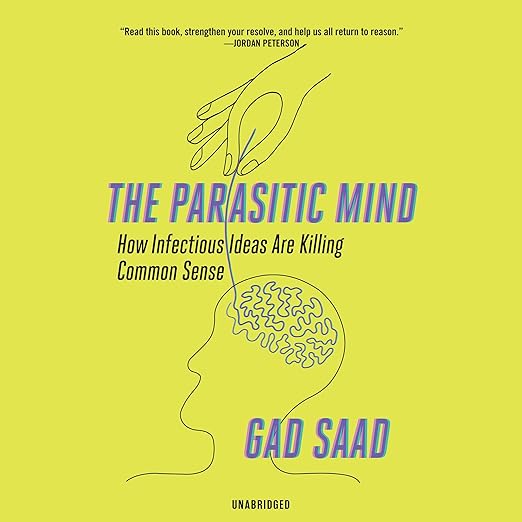
I came to The Parasitic Mind during a week when I had already consumed two very different books on the culture wars, and I was curious whether Gad Saad, a professor of evolutionary behavioral sciences at Concordia University, would bring something analytically distinctive to a crowded genre. The short answer is that he does, and that he doesn't, in roughly equal measure. Let me explain both.
Saad is not a pundit performing outrage. He is a scientist making an argument, and for most of this seven-and-a-half-hour listen that distinction matters. His central claim, that certain bad ideas propagate through social systems the way pathogens propagate through populations, is not original to him, but he grounds it in his own academic work on evolutionary psychology rather than in anecdote alone. That grounding gives the book a different texture from most conservative cultural commentary.
Where This One Lands
The strongest sections of this audiobook are the ones where Saad leans hardest into his expertise. His chapter on what he calls Collective Munchausen syndrome, the phenomenon of individuals adopting victimhood identities for social capital, draws on real behavioral science rather than cocktail-party observation. His discussion of how Darwinian logic applies to the spread of ideas is genuinely interesting, even if listeners familiar with memetics theory will find it covers ground Dawkins laid decades ago. What Saad adds is a clinician's irritation with what he sees as the abandonment of empirical thinking in public discourse, and that irritation is, at its best, productive.
Jim Meskimen's narration suits the material. He reads academic argument cleanly, with emphasis that tracks the logic rather than performing emotion, which is the right call for a book that wants to be taken seriously as intellectual discourse. He occasionally drops into a slightly wry tone when Saad makes a joke, which is welcome, because Saad does have genuine wit. The performance is competent throughout and never becomes a liability.
Why Listen to The Parasitic Mind
The case for spending your listening time here, rather than on one of several dozen similar books, comes down to Saad's specific vantage point. He was born in Lebanon, survived the civil war, emigrated to Canada, and built a career in a field that studies why humans behave the way they do. That biography shapes how he writes about free speech and intellectual courage, and it keeps the book from feeling like the work of someone who has never had anything at stake. His chapter on his own experiences with campus cancellation attempts is more interesting than the abstract arguments because it is personal and specific.
The book is also short enough that its weaknesses do not have time to become fatal. At under eight hours it makes its case efficiently. Listeners who agree with the general premise will find it useful as a structured argument. Listeners who disagree will find it a reasonably fair representation of the viewpoint, even if they reject its conclusions.
What Gives Us Pause
The book works better as a series of connected essays than as a unified theoretical framework, and the seams show. Saad's broader claim that Western civilization is in genuine danger from these idea pathogens is stated with great confidence but supported with less rigor than his more specific behavioral science arguments. The book is also, as one thoughtful reviewer noted, very much of its moment. The specific examples Saad reaches for in 2020 may age unevenly, and listeners coming to this in a different political climate will need to do some contextual translation.
Jordan Peterson's endorsement, prominently displayed, will function as a signal to different listeners in opposite directions. That is worth knowing before you start.
Who Should Listen to The Parasitic Mind
If you have spent time with Saad's YouTube show and want a more structured version of his arguments, this audiobook delivers exactly that. If you are genuinely curious about how an evolutionary behavioral scientist approaches questions of cultural conformity and intellectual cowardice, this is worth the time. If you are looking for a book that will change your mind on these issues rather than reinforce a position you hold, this is probably not it.
- Narration: Jim Meskimen delivers Saad's argumentative prose with clear diction and a measured pace that suits the lecture-style material, though the performance stays in a fairly narrow emotional register throughout.
- Themes: Intellectual freedom, ideological contagion, science vs. political correctness
- Mood: Pointed and combative, with flashes of dry academic humor
- Verdict: A well-argued polemic that rewards listeners already sympathetic to its thesis more than those approaching it with skepticism.
Good to Know
Is this book primarily political commentary or behavioral science?
It is both, weighted toward political commentary. Saad uses behavioral science as a foundation but spends most of the book applying those ideas to specific cultural and political phenomena he finds troubling. Readers expecting a pure science text will want to know that upfront.
Do I need to be familiar with evolutionary psychology to follow Saad's arguments?
No. Saad writes accessibly and explains his scientific concepts as he goes. The behavioral science background adds credibility but the book does not require specialized knowledge to follow.
How does Jim Meskimen handle the more sarcastic passages in the book?
Reasonably well. Meskimen reads the dry humor with a slight tonal shift rather than going broad, which keeps the audiobook from tipping into performance. It works for the material.