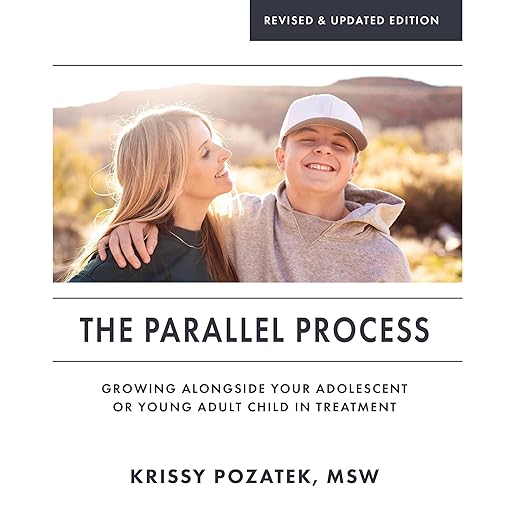
I have read a significant number of parenting books over the years, enough to be genuinely skeptical of most of them. They tend to offer frameworks that sound compelling in principle and then dissolve in the actual, specific difficulty of a real teenager having a real crisis in your actual kitchen at an hour when everyone is exhausted. The Parallel Process is the kind of book that holds up better under those conditions than most, and its revised and updated edition, arriving nearly a decade after the original, refines rather than reinvents what made it worth reading in the first place. Krissy Pozatek has had another decade of clinical observation since the original edition, and it shows in the specificity of the new material.
Pozatek is a licensed clinical social worker who has worked for years as an adolescent and family therapist, primarily with wilderness therapy programs. The framework she has developed is called the parallel process, and it refers to the parallel growth that needs to happen in parents at the same time it is happening in their struggling teens or young adults. The central provocation of the book is this: when parents take responsibility for their children's emotions, problems, and behaviors, they inadvertently prevent their children from developing the capacity to take that responsibility for themselves. It is a simple idea that becomes harder to hold the closer you get to an actual child in actual distress.
Pozatek is asking parents to do something that runs directly counter to a deep biological instinct. When your child is in pain, the impulse to fix it, to call the school, to smooth the conflict, to provide the solution, is not just culturally conditioned; it is physiologically encoded. What the book argues, carefully and with extensive case examples, is that this instinct, when consistently indulged, communicates to the adolescent something they cannot always articulate but deeply absorb: that they are not capable of handling their own experience.
The concept of enmeshment, the blurring of boundaries between parent and child emotional life, is not new to family therapy, but Pozatek applies it with unusual specificity to the practical decisions parents face. What does it look like to attune to your child's emotions without absorbing them? How do you set a safety boundary that is genuinely about safety rather than about managing your own anxiety? What is the difference between support and rescue? These are not rhetorical questions in this book. Each of them gets worked through with case examples drawn from Pozatek's clinical experience, examples specific enough to feel real and general enough to prompt recognition.
Ten More Years of Clinical Observation Added
Reviewer Elle J. had read and benefited from the original edition approximately ten years before encountering this revised version, and found the updates substantive rather than cosmetic. The new chapters and integrated insights reflect a decade of additional clinical observation, and the revised edition also includes forewords from a care provider and a parent, which add perspectives the original lacked. The parent foreword in particular grounds the clinical framework in the specific experience of a family that has lived through it, which is a useful counterbalance to Pozatek's necessarily therapeutic vantage point.
One of the book's ongoing strengths, identified by Elle J., is Pozatek's communication style: clear, down to earth, and relatable rather than clinical or academic. This is rarer in therapeutic parenting literature than it should be. The tendency in this genre is to either over-professionalize, turning the content into a therapy manual, or over-simplify, reducing complex family dynamics to a few bullet points. Pozatek occupies the productive middle ground, which is part of why the book has remained in circulation long enough to warrant a revised edition at all.
Hanna Gates Reads Case Examples With Clinical Clarity
The book is most useful for parents of teens who are actively struggling, whether that means a wilderness therapy placement, substance use issues, significant emotional dysregulation, or patterns of crisis that have destabilized the family system. Reviewer Andi Boutin called it the most important book they had ever read after years of dealing with their son's difficulties. That is the kind of endorsement that comes from a specific place of need being met, not from general admiration for the craft.
Parents of relatively well-functioning teenagers may find the framework intellectually interesting but less immediately urgent. The case examples are drawn from high-stakes contexts, which makes the principles vivid but can make them feel less applicable to lower-intensity parenting challenges. That is not a flaw in the book so much as a description of its appropriate audience. Hanna Gates's narration supports all of this with professional steadiness, reading the case examples with clinical clarity rather than dramatizing them, which is exactly what therapeutic content requires.
Listen If Your Own Patterns Are the System
Listen if you are the parent of a struggling adolescent or young adult and have begun to suspect that your own patterns are part of the system you are trying to change. Listen also if you work with families in a therapeutic or educational capacity and want a clinically grounded framework you can reference practically. The revised edition is the version to start with; it has more texture and more clinical refinement than the original, and the additional forewords give it a human dimension that the first edition lacked. Skip if you are looking for behavior management strategies aimed at changing your child's conduct rather than your own patterns of response, because this book is fundamentally about the parent's parallel growth, not the child's.
Frequently Asked Questions
Is The Parallel Process relevant for parents whose children are not in crisis situations, or is it primarily for families with struggling teens?
The book is most immediately useful for parents of struggling adolescents, and most of the case examples come from high-difficulty contexts including wilderness therapy programs. Parents of generally well-functioning teens will find the framework valuable as preventive thinking, but the material has its sharpest application in high-stakes family situations.
Does the revised and updated edition differ significantly from the original, or is it primarily the same content with small additions?
Reviewers who have read both editions found the revision substantive. It includes new chapters and integrated updates throughout, as well as forewords from both a care provider and a parent perspective that the original lacked. For listeners who have already read the original edition, the update is considered worthwhile.
How does Hanna Gates's narration handle the case study material, which involves difficult family situations?
Gates reads the case examples with clinical steadiness rather than dramatizing them, which is appropriate for therapeutic content. The case studies are intended as illustrative frameworks rather than emotional narratives, and her narration honors that intention by keeping the focus on the pattern being illustrated rather than on the emotional weight of the individual story.