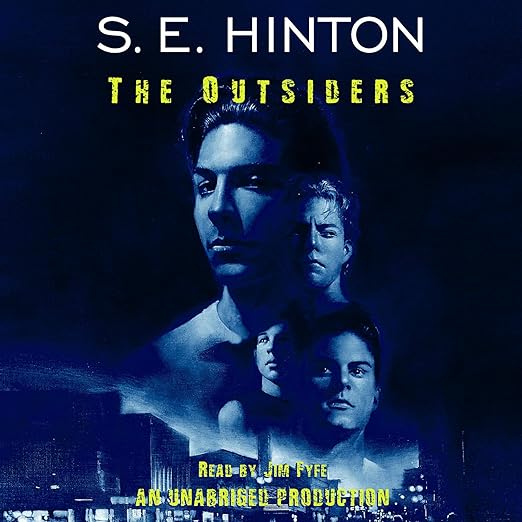
Ponyboy Curtis walks through the park alone at night, and you already know something is about to go wrong. S. E. Hinton's The Outsiders, the audiobook narrated by Jim Fyfe, opens in the voice of a 14-year-old boy who has already worked out the world's basic unfairness but has not yet stopped caring about it. That combination, hardened by experience but not yet dead to feeling, is the engine the novel runs on, and Fyfe finds a register for Ponyboy that is young enough to be credible and searching enough to carry the book's emotional weight across five hours and nine minutes. Hinton wrote this novel at 15 and 16, and that proximity to its subject is immediately visible in the writing's texture.
Hinton Wrote the Greasers and Socs from Inside
She did not have to imagine what it felt like to be suspended between two worlds, belonging fully to neither, watching friends die for the geography of their birth. She was living adjacent to it. The result is a book that does not moralize about class conflict; it dramatizes it through the specific weight of two gangs, the working-class Greasers and the wealthy Socs, whose violence is a proxy for a division that has nothing to do with the kids themselves and everything to do with circumstances they inherited. That specificity is why the novel has outlasted virtually everything published alongside it in the mid-1960s: the problem it describes is not local to Tulsa or to that decade.
Fyfe's performance is one of the audiobook's central assets. He does not attempt to voice every character distinctly in the way a full cast recording would, but he gives Ponyboy's interiority enough texture that the first-person narration never feels monotonous. The pivotal scenes, the park attack, the church fire, the rumble, the final collapse of certainty that closes the book, are handled with restraint that serves the material. Hinton's prose is already emotionally direct; it does not need theatrical amplification. Fyfe seems to understand that, and the places where he does pull back slightly, letting silence do work after a line, are among the most effective moments in the recording.
Stay Gold Lands Because Fyfe Stays Quiet
The friendship between Ponyboy and Johnny is the book's moral center, and it is constructed with an economy that middle-grade and YA fiction rarely manages. Their relationship is not explained or analyzed; it is shown through small, specific gestures and shared understanding in the margins of dangerous situations. When Johnny tells Ponyboy to stay gold near the end, the line lands because the whole novel has been building the conditions under which it means something. In audio, Fyfe's delivery of that scene is quiet and controlled, which is exactly right. A more theatrical approach would drain it of the quiet devastation the moment requires.
A Tulsa Story Still Passed to Grandchildren
For adult listeners returning to the book after encountering it in school, the audiobook experience often produces a different kind of recognition: not the shock of seeing characters like people you knew, but the quieter understanding of how the book itself knew things about class and loyalty that adults often work their whole careers to articulate. Reviewers consistently note that Hinton's achievement is more remarkable given her age at writing, and that observation carries more weight on a second or third encounter than on the first. Reviewer Melissa Hall noted saving the book for her grandchildren, which captures something true about the novel's transmission across generations: it does not just get read once and filed away.
Hinton's Tulsa, the specific geography of her Greasers and Socs, is also a universal geography: any place where who your parents are determines which side of a line you stand on. The inspiration for the Tony Award-winning Broadway musical is a credit the book's contemporary marketing carries, and it is a sign of the story's structural durability that it has continued generating new adaptations more than fifty years after its first publication.
Fyfe's Solo Narration Still Handles the Ending's Loop
Listeners coming to the novel for the first time should know that it moves fast and does not soften its violence or its grief. The deaths in the book are not abstract. Hinton gives them weight through the relationships she has built, which means they land harder than the body count alone would suggest. For younger listeners, particularly those in the 12 to 15 age range that is the novel's natural target readership, the book is age-appropriate but not sheltered. That is its point, and it has remained its point through generations of classroom use.
Fyfe's narration is strong in the emotional sequences and reliable throughout, but the audiobook does not have the production ambition of a full-cast recording. Listeners who encountered dramatized versions of The Outsiders and are looking for something closer to that experience may find a single narrator less immersive than expected. Within the constraints of a solo narration, however, Fyfe does the job with genuine craft. The novel's ending has generated decades of discussion, and the audiobook delivers it in a way that respects the ambiguity Hinton built in. Ponyboy's final words loop back to the novel's beginning in a structural move that works particularly well in audio, where the returning listener will hear it differently the second time.
The New York Times Confirms Its Influence
Young adult listeners encountering Hinton's novel for the first time will find Jim Fyfe's narration an accessible and emotionally honest entry point. Adults revisiting the book through audio, particularly those who first read it in school and are curious whether it holds up, will find that it holds up remarkably well and often means something different at a greater distance from its events. The New York Times observation that The Outsiders transformed young-adult fiction is not marketing language; it is a claim about structural influence that the book's continuing presence in curricula and cultural conversation validates. Classroom listeners using the audiobook alongside the print text will benefit from hearing Ponyboy's voice performed rather than imagined. Listeners who need emotional distance from grief and violence in their fiction should approach carefully; Hinton does not provide it.
Before You Listen
Is Jim Fyfe's narration of this audiobook the definitive version, or are there other recorded editions worth considering?
Fyfe delivers a strong solo performance. Some listeners prefer the version narrated by the author, S. E. Hinton herself, which gives the material a different kind of authority. Both are legitimate choices depending on whether you value professional craft or authorial intimacy.
Does The Outsiders audiobook work for classroom or school listening, or is the content too mature?
The novel is standard middle and high school curriculum, and the audiobook is appropriate for that context. The violence and deaths are present but not gratuitous, and the emotional honesty Hinton brings is considered a feature of the book's educational value rather than a concern.
The novel is over 50 years old. Does it still feel relevant as an audiobook listen today?
Consistently so, according to reviewers. The class dynamics Hinton describes, rich kids versus working-class kids, the geography of privilege and disadvantage, remain structurally familiar. The specific details are dated; the underlying tensions are not.
How long does it take to listen to The Outsiders audiobook, and is it suitable for a single sitting?
The runtime is 5 hours and 9 minutes. Many adult listeners complete it in a single extended session or two commutes. The pacing Fyfe maintains makes it easy to sustain across the full runtime without losing momentum.