
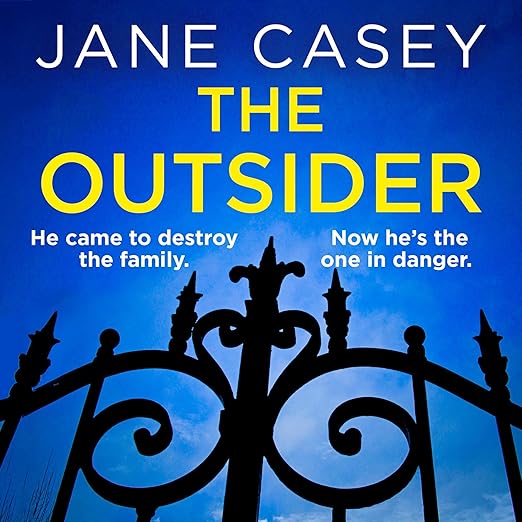
Rob Langton, the undercover police officer at the center of The Outsider, is in a position that crime fiction has always known is dramatically rich: he is in deep enough with the Carter family to do his job, and that depth is precisely what makes him dangerous to himself. Jane Casey's audiobook, narrated by Josh Wichard, is built around the specific tension of a man whose professional competence requires him to understand people who operate by entirely different moral rules - and who cannot afford to let his judgment show. The Guardian review quoted in the listing calls it pacy, gripping, and tightly plotted, and that assessment is accurate. What it undersells is the particular quality of dread Casey generates not through incident but through context.
What We Made of It
What Casey does well here is resist the genre temptation to let the Carter family function as simple villains. The synopsis describes their country-house lifestyle as picture-perfect on the surface, and Casey uses that surface seriously rather than as a thin cover to pierce quickly. The texture of the Carter family's world - the way their particular form of criminality is organized around appearance, around legitimate prosperity as a front for something explosive underneath - means that Rob's undercover work requires him to inhabit their values convincingly. That costs him something the story does not ignore. The Irish Times called it thrumming along at a breakneck pace, which is true in terms of plot movement but misleads slightly: the pace is driven by dread as much as incident.
The countdown structure - Rob running out of time before the Carters either discover him or do something he cannot prevent - is efficiently executed. Casey does not artificially extend the will-he-be-found-out tension by withholding information from the reader that Rob would have, which is a common thriller mistake. Instead the suspense comes from watching Rob make judgment calls in real time under pressure he cannot fully acknowledge. When he realizes the Carters are not just dangerous criminals but something that will be explosive if he cannot stop them, the book's stakes escalate in a way that feels earned rather than manufactured.
The Woman and Home description of it as fast-paced and action-packed sets appropriate expectations for the structure. This is a thriller that earns its pacing through tightly integrated plot mechanics rather than frenetic scene-setting. Casey's skill is in maintaining pressure during scenes that are not ostensibly action sequences - meals with the Carter family, conversations that might or might not be veiled threats, moments when Rob has to perform normality while internally calculating risk.
What Makes The Outsider Worth Hearing
Josh Wichard's narration is a genuine asset to this audiobook. The role of Rob Langton requires a narrator who can maintain the dual-register quality of undercover work - the performed version of himself that the Carters see and the real internal experience running underneath it - and Wichard manages that layering with consistency across the seven-hour runtime. The moments when Rob's composure holds under pressure that should crack it are more effective in audio than on the page because Wichard's steady delivery communicates what the character is suppressing rather than just what he is saying.
Those scenes where tension is generated entirely by context and subtext - where the threat is present in what is not said rather than what is - are where audio narration can add the most, and Wichard delivers them with appropriate tautness. His is a narration style that respects the intelligence of the thriller form rather than underlining every moment of danger. The seven-hour runtime means Casey never has to pad to fill space, and Wichard's pacing mirrors the structural efficiency of the plot itself.
What Might Not Land
Pay attention to what the Carter family's country-house lifestyle is specifically designed to obscure. Casey is deliberate about the function of appearance in criminal organization, and the gap between the picture-perfect exterior and the actual nature of what the Carters are doing is the book's most sustained thematic interest. The moment when Rob fully grasps that the consequences will be explosive is worth careful attention because it is also the moment when his investigation shifts from professional assignment to something more personally urgent.
The pacing of the third act is where Casey's structural discipline is most evident. Thrillers frequently use a third-act rush that sacrifices character for incident. Casey's review reception - multiple outlets commenting on tight plotting specifically - suggests she avoids that pattern. The resolution of Rob's situation and what it costs him is the book's culminating character question, and the plot efficiency of the final act supports rather than replaces the human stakes.
The Right Listener for The Outsider
This audiobook is for listeners who enjoy crime fiction with a clear undercover premise, genuine plot mechanics, and a narrator who carries the weight of a dual-identity protagonist convincingly. At seven hours and forty minutes it is an efficient listen - tight enough that nothing feels padded, developed enough that the central tension has real stakes. Wichard's narration is a specific reason to choose audio over print for this particular story.
Listeners who prefer their thrillers with more explicit procedural detail or a wider cast of investigators may find The Outsider leaner than expected - this is Rob's story primarily, and the investigation is filtered through his specific position rather than shown from multiple angles. If the undercover premise and the Carters' specifically textured menace are the hook, Casey executes both from start to finish.
Is The Outsider audiobook a standalone or part of a series?
Jane Casey's The Outsider functions as a standalone thriller based on available information. The central plot - undercover cop Rob Langton investigating the Carter family - is self-contained and no series continuation is indicated in the listing.
How does Josh Wichard's narration handle the dual nature of Rob's undercover identity in this audiobook?
Wichard manages the dual-register quality of undercover work effectively - maintaining a steady performed composure at the surface while communicating the internal calculation running underneath. This is the specific narration challenge The Outsider presents, and Wichard navigates it consistently across the seven-hour runtime.
How does this audiobook compare in pacing to typical British crime fiction?
The Outsider is faster and more propulsive than much British crime fiction, which tends toward investigation as process. Casey is working in thriller mode here - the Irish Times comparison to breakneck pace and the Guardian's tightly plotted assessment both indicate this is character-under-pressure storytelling rather than slow-burn procedural.







