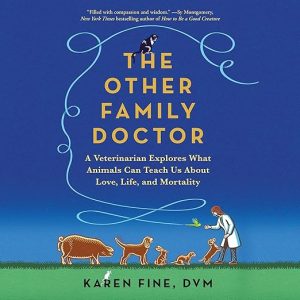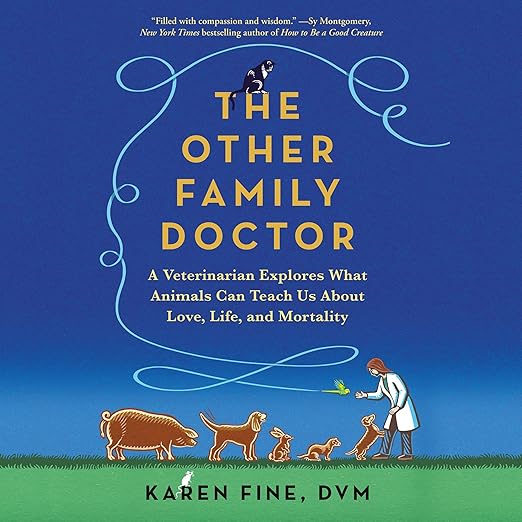
I started The Other Family Doctor on a Tuesday evening after a particularly long day and found myself still listening past midnight. Karen Fine narrates her own memoir, which covers her career as a veterinarian, from her decision to enter a profession that was still male-dominated in the 1980s, through decades of practice, through the animals and humans whose stories she carried with her. I had not expected to feel quite as much as I did. The book earns its emotional moments rather than simply announcing them, which is rarer than it should be in memoir.
The book has been compared in the publisher's framing to All Creatures Great and Small meeting Being Mortal. That pairing is more than marketing copy, it captures something real. Fine's veterinary practice is shaped by the same approach that James Herriot brought to the Yorkshire countryside: the belief that understanding an animal requires understanding their people. And the Atul Gawande comparison surfaces in Fine's unsentimental engagement with aging pets and the particular grief of losing an animal companion. She does not soften those passages, and they are the better for it.
Fine's Grandfather Sets the Template for Her Practice
Fine's narrative hook is her grandfather, a physician who made house calls and approached every patient as a full person rather than a presenting problem. She credits him as the model for her own practice philosophy, and that lineage gives the memoir a structural through-line that holds its various cases together. One reviewer who is themselves a veterinarian noted that Fine's approach, combining medical examination with an understanding of the animal's living environment and owner relationship, is precisely the kind of diagnostic thinking that distinguishes good vets from great ones.
The detail about Fine's cat allergy, and her decision to pursue veterinary medicine despite it, arrives early and functions as a signal about the kind of narrator she is: someone who acknowledges the contradictions in her own story without needing to resolve them into a tidy lesson. That honesty runs throughout the book. She does not present herself as someone who always made the right call, and the admissions of uncertainty are part of what makes her credible.
Ferrets, a Pig, and a Life-Saving Dog
The specific animals that populate Fine's memoir are what make it memorable. The feral cat who trusts a young vet with an injured paw. The pot-bellied pig who grows too large for the family car but remains inseparable from his people. The aging dog who allows his family one final vacation. The colony of ferrets, described in the synopsis as perfectly behaved, which sounds improbable and apparently is not. Each case is narrated with the particular attention you give to a patient you remember years later, the details are specific, not representative.
The dog who saves his owner's life in an unexpected way is the case that reviewers mention most often. I will not describe it in detail, but it sits with you after the book ends in the way that the best nonfiction stories do. Fine's restraint in the telling of it, she never overstates the lesson, is part of what makes it land. The same restraint governs the end-of-life passages, which are handled with a directness that feels like respect rather than avoidance.
Reading a Patient Who Cannot Describe the Pain
One of the things Fine does particularly well is explain what veterinary medicine actually requires as a cognitive and emotional discipline. You cannot ask a feral cat where it hurts. You cannot explain a diagnosis to a ferret. The entire practice depends on reading indirect evidence, behavior, posture, test results, and the owner's account, and synthesizing those signals into a working hypothesis. Fine describes this process in ways that make it feel genuinely difficult and genuinely rewarding, which is the combination that makes any professional memoir worth reading. She also captures the administrative and emotional labor that the public face of the profession rarely shows: the calls to owners about results they do not want to hear, the decisions about when treatment is a kindness and when it is not.
Slow Childhood Chapters Give Way to Real Feeling
One reviewer, describing themselves as an animal lover who came to the book with specific expectations, noted that the childhood and ancestry sections were useful for understanding Fine's path but that the pace differed from what they expected. That is a fair observation. The early chapters move through Fine's family history and medical school at a different rhythm than the case-study sections that follow. Listeners who come primarily for the animal stories may find the framing material slower than what they are waiting for.
The audiobook also includes a downloadable PDF of additional resources, a nice practical addition for the pet-owner listeners who will make up a large portion of Fine's audience. At nine hours and two minutes, Fine's memoir is long enough to feel substantial and short enough to complete in a few listening sessions. The author narration is the right choice, her voice has a quietness that the material earns. This is not a book that performs its emotion. It simply has it, and Fine's reading trusts the listener to feel it without being prompted. For anyone who has ever had a pet they would describe as family, this free audiobook will feel like it was written specifically for them.