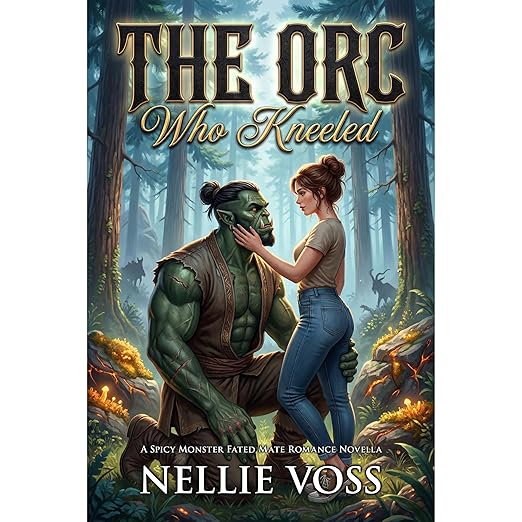
Maeve walks into an alien matchmaking facility expecting to get on a waiting list for 'someday,' the low bar she's set for herself after years spent managing her mother's dementia, her brother's money troubles, and her sister's emotional breakdowns. What happens when the seven-foot orc who rounds the corner isn't even in the matching pool, and drops to his knees anyway? This is a short, explicit audiobook built around a scent-triggered fated-mates bond and a heroine who has spent her whole life taking care of everyone but herself.
The synopsis is unusually self-aware about its own genre, listing its target tropes directly: fated mates, orc romance, scent bonds that override higher brain function, monster size difference, a hero who falls first and falls harder, claiming bites. One phrase in particular does real thematic work: 'who takes care of the caretaker?' isn't just a trope tag here, it's the actual emotional engine of Maeve's arc, a woman who came looking for a distant someday and instead got someone whose entire biology responds to her specifically, immediately.
A specific, disarming detail is worth calling out: alongside claiming bites and scent bonds, the synopsis promises 'a warrior who will ruin you and then make you midnight porridge, and the kind of heat that soaks through the pages.' That small, domestic image landing right next to the heat, tenderness immediately following intensity, tells you almost everything about the tonal balance the book is going for.
Monster romance and orc romance specifically have grown into one of the more reliably popular corners of the broader paranormal romance market, built on a consistent appeal: a partner whose otherness is total, physically and often biologically, paired with a devotion that reads as more absolute for being involuntary. The scent-bond mechanic here, Ruhn's body responding before his conscious mind catches up, is a clean, efficient version of that trope, doing in a sentence what slower-burn romance often takes chapters to establish.
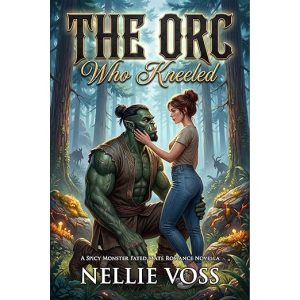
The synopsis names 'monster size difference (everywhere)' as one of its own selling points, and a seven-foot scarred orc opposite a human heroine is a physical mismatch the genre typically uses to signal safety inside danger, overwhelming strength placed entirely at the heroine's service rather than turned against her. Ruhn dropping to his knees before he even has Maeve's name inverts the expected power direction immediately, which is precisely the move genre-savvy monster-romance readers show up for.
The synopsis promises a 'snarky first-person heroine,' and that voice matters structurally as much as tonally; a story this short leans almost entirely on Maeve's narration to establish both her exhaustion and her attraction quickly, so the specific flavor of her internal voice, wry rather than earnest, does a lot of the pacing work a longer book could hand off to plot instead.
Overwhelming Response Needs Nuance This Narration Lacks
The narrator credited is Virtual Voice, AI-generated rather than a human performer, and that's worth naming honestly as a real limitation for character-driven romance specifically. A scent-bond premise depends on conveying overwhelming, involuntary physical response, exactly the kind of vocal nuance synthetic narration tends to flatten across similar erotica titles.
One reviewer's reaction cuts right to what the book is actually trying to do: 'When I chose this book I expected high heat and little romance what I got is both. I love Maeve and Ruhn together. He is so sweet. They are perfect for each other.' That's a genuinely specific endorsement, not just enthusiasm for the trope list, and it lines up with the caretaker-gets-cared-for arc the synopsis sets up from the start.
Physical description does a lot of characterization work before a single line of dialogue happens: seven feet tall, scarred, forest-green skin, dropping to his knees 'like he just took a blow he wasn't braced for,' per the synopsis's own phrasing. That image, an enormous, dangerous-looking creature caught off guard by his own reaction, sets up the power reversal the rest of the story runs on.
The pacing itself mirrors the premise: a scent bond is supposed to be instant and overwhelming, and the novella's own compressed runtime replicates that immediacy structurally rather than just describing it.
Too Short According to Its Own Reviewer
Length is the most consistent complaint. One reviewer calls it 'about an hour read novella' and says plainly 'it actually is too short,' adding that other plot threads are clearly being set up for a series without being resolved here. If you want a complete, standalone arc, this novella format won't fully deliver that; it reads more like a strong opening chapter than a finished story.
The series itself, 'Her Orc match,' doesn't carry a number in its listing, suggesting this is meant as an entry point rather than a numbered sequel, but the same reviewer's note about unresolved setup elements confirms you should expect a cliffhanger-adjacent structure rather than a tidy close.
Compared to a full-length monster romance novel, expect this to function more like a proof of concept than a complete arc: the central attraction and bond are established fully, but supporting world-building, the matchmaking facility's rules, the broader alien-human relations implied by its existence, is sketched rather than developed, consistent with a novella clearly positioning itself as a series opener.
The alien-matchmaking-facility setup itself is a clean, efficient bit of world-building shorthand, instantly legible to anyone who's encountered the broader 'arranged interspecies pairing' convention elsewhere in the genre, which frees the actual page count to focus entirely on Maeve and Ruhn rather than explaining how the facility works.
Claiming bites as a mechanic carry real narrative weight in fated-mates romance specifically, functioning as a permanent, physical marker of the bond rather than a metaphorical commitment, and whether this particular book follows through on that claiming by the end is part of what the 'too short' complaints seem to be reacting to.
Getting Swept Up Instead of Doing the Chasing
Fans of this specific subgenre, anyone drawn to a caretaker-burnout heroine getting reciprocated attention for once, and readers wanting a fast, single-sitting spicy read are the clear audience here.
Readers already fluent in fated-mates and scent-bond conventions from other series will move through this one quickly and likely appreciate how efficiently it hits its marks; newcomers to the specific subgenre get a low-commitment way to test whether the trope works for them.
It's also a good fit for readers who specifically enjoy a heroine getting swept up rather than chasing, since Ruhn's instant, involuntary response removes any question of whether Maeve is wanted, replacing romantic uncertainty with a different kind of tension entirely.
Full-length worldbuilding and a slow-burn courtship are not part of the package here; this is a fast, single-scene-heavy novella, and readers who need substantial plot scaffolding around their spice, per the reviewer who wanted more, should expect to come away a little underfed.
Is this audiobook a complete story or the start of a series?
It reads as a series opener. A reviewer notes other plot elements are clearly set up for future entries without being resolved here, so treat it as an introduction to Maeve and Ruhn's world rather than a closed, standalone arc.
How long is this audiobook, and is the runtime enough for a full story?
It runs one hour and seventeen minutes. Reviews describe it as genuinely too short, with at least one reader wanting significantly more given how much they enjoyed the central relationship.
Is this audiobook more romance or more explicit content?
Reviewers say it's both. One specifically notes expecting high heat and little romance but getting a genuine, sweet relationship alongside the explicit content.
Do I need to have read other orc or monster romance to follow this audiobook?
No prior reading is required. The synopsis introduces its own tropes directly and the premise, a human at an alien matchmaking facility, is self-contained enough for newcomers to the subgenre.