Quick Take
- Narration: Will Damron handles the Silicon Valley milieu with intelligence and pace, keeping the biographical and boardroom drama equally legible.
- Themes: AI ambition and governance, the tension between safety and acceleration, Silicon Valley power structures
- Mood: Lucid and propulsive, like a great long-form profile that has been given the space it deserves
- Verdict: The most detailed portrait yet of Sam Altman and the forces he represents, rigorous enough to matter even as the story continues to develop around it.
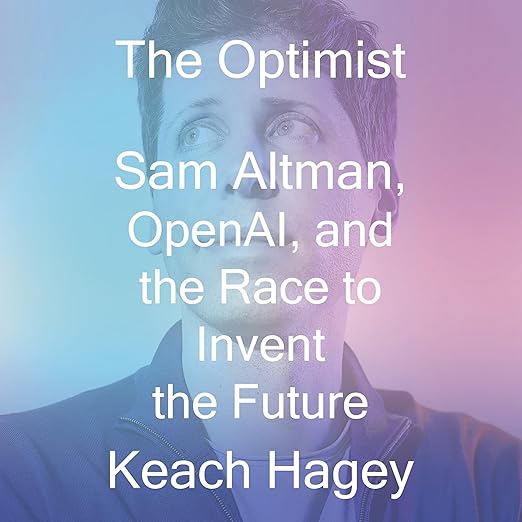
There is a particular problem with writing biography about someone who is still very much in motion. Whatever you publish risks being overtaken by events before the first printing has settled. Keach Hagey, the Wall Street Journal reporter who wrote The Optimist, understands this and has made a considered choice: rather than trying to account for everything, she builds a careful account of how Sam Altman became who he is, trusting that the formation shapes the actions, even the ones that happened after the manuscript was finished.
I listened to most of this over a weekend when I was trying to make sense of what OpenAI has been doing and why. Will Damron’s narration is an excellent match for Hagey’s prose, she writes with the WSJ house clarity, fact-forward and well-organized, and Damron reads it with a pace that keeps both the biographical material and the boardroom drama moving without sacrificing precision. At twelve hours and twenty-one minutes, this is a substantial audiobook, but the structure is efficient rather than padded.
The Y Combinator Years and What They Explain
The most illuminating portions of The Optimist are the chapters on Altman’s time as Paul Graham’s protégé and eventual successor at Y Combinator. This period is where Altman developed the particular combination of capabilities that defines him: a talent for identifying ambitious founders early, a gift for the motivating conversation, and an unusual comfort with the magnitude of his own ambitions. The picture Hagey paints is of someone who learned, in an environment that rewarded it, to think seriously about what was possible rather than what was merely probable. Whether that is admirable or alarming depends on what you think of the ambitions themselves.
Hagey drew on more than 250 interviews, including time with Altman himself, and the depth of sourcing is visible throughout the narrative. She is not inventing texture or speculating about motivation; she is working from documented accounts of conversations, decisions, and relationships. The founding of OpenAI is covered with particular care, the original vision, the recruitment of the team Altman considers the most important in the organization’s history, and the philosophical disagreements about safety and acceleration that were present from the beginning and would eventually produce the November 2023 crisis.
The Firing and the Return: Power Made Visible
The episode that made Altman globally famous outside technology circles, the board’s decision to fire him on a video call on November 17, 2023, and his restoration to the CEO position days later, with most of the directors who voted against him removed, is the dramatic center of the book. Hagey treats it as something more than a corporate drama: a demonstration of how power actually works in AI governance. One reviewer summarized it as “illuminating how tight the bonds are in Silicon Valley,” which captures part of it. But what Hagey is really mapping is the gap between formal governance structures, a board with the authority to fire a CEO, and informal power structures built from relationships, investor pressure, and the kind of reputation that makes employees sign an open letter within hours.
At a rating of 4.2 from 256 listeners, the book has strong word of mouth. One reviewer noted that the story is “almost obsolete in ways” given how quickly Altman’s position has continued to evolve, and that is honest. But the same reviewer continued that it tells the story of “one of the most consequential technologists of the decade,” which is why the biography matters despite its inevitable incompleteness. Understanding how Altman thinks, what he believes about intelligence and its implications, and what relationships and resources he has drawn on to get here is valuable precisely because his decisions will continue to affect everyone.
Who Should Listen and Who Should Skip
Listen if you are trying to understand AI’s current trajectory and want a grounded account of the person most publicly associated with it. Listen if you follow technology journalism and want the biography that pulls together the reporting into a coherent portrait. Listen if you want to understand how Y Combinator shaped the generation of founders who now lead the most consequential technology companies. Skip if you expect the biography to be current through 2025 or 2026; it covers the formative years through approximately the end of 2023. Skip if you are primarily interested in the technical details of how large language models work, this is biography and corporate history, not computer science.
Frequently Asked Questions
Does The Optimist cover Sam Altman’s involvement beyond OpenAI, including his other investments and ventures?
The book covers Altman’s full career arc from Y Combinator through the founding and development of OpenAI, including his investment activities and broader influence in Silicon Valley. The primary focus, especially in the later chapters, is on OpenAI and the 2023 boardroom crisis.
Is Will Damron well-cast for Silicon Valley business biography?
Yes. He reads Hagey’s clear, fact-forward WSJ prose with appropriate authority and keeps both the personality portraits and the organizational mechanics equally legible. He does not dramatize the boardroom crisis but lets the events carry the tension.
How current is the book’s account of OpenAI’s development?
The book covers through approximately the restoration of Altman’s position in late 2023. Events after that, subsequent product releases, governance changes, competitive developments, are not covered. The formation and early history are where the book’s permanent value lies.
Does Hagey take a clear position on whether Altman is a visionary or a danger?
She is notably balanced, presenting both Altman’s own framework for thinking about AI’s potential benefits and the concerns of those who believe the pace of development outstrips our ability to govern it safely. The book is reported rather than polemical.