Quick Take
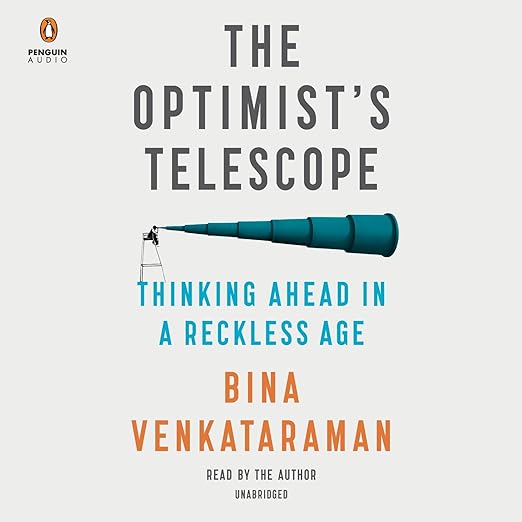
- Narration: Venkataraman narrates her own work with clear conviction, her policy background gives authority to arguments that might sound abstract from a hired voice.
- Themes: Long-term decision-making, institutional shortsightedness, individual and collective foresight
- Mood: Urgent but not alarmist, grounded in reported case studies with genuine forward momentum
- Verdict: A rigorous and readable argument for thinking further ahead, strongest when grounded in specific stories and weakest when it slides into policy prescription.
I was halfway through a commute when Bina Venkataraman described the moment she realized that the communities most devastated by Hurricane Katrina had been warned, repeatedly, for decades, and that the warnings had been technically processed and bureaucratically filed and then forgotten. It stopped me mid-stride on the platform. That pattern, the gap between knowing something is coming and actually preparing for it, is the engine of The Optimist’s Telescope, and it is a more uncomfortable engine than the optimistic title suggests.
Venkataraman, a former climate adviser in the Obama administration and editorial page editor at The Boston Globe, is working a specific problem: why do intelligent, well-resourced individuals and institutions consistently fail to make decisions that serve their own long-term interests? And what can we actually do about it?
From Pompeii to Fukushima, the Evidence Is Consistent
The book’s strongest sections are its case studies. Venkataraman ranges from ancient Pompeii, whose residents had been warned by tremors before Vesuvius erupted, through modern examples including the Fukushima nuclear disaster, financial institutions that ignored their own risk models in 2008, and communities in Louisiana that received federal flood-risk reports and then lobbied to have them buried. She is a journalist by training and it shows: these stories are reported, not just cited, and that makes the difference between abstract argument and something you can actually visualize and remember.
The New York Times Book Review described her as bringing a storyteller’s eye to the question, and that is accurate. Where a policy paper would give you statistics, Venkataraman gives you specific people making specific decisions at specific moments in time, and then steps back to ask what system or cognitive bias made those decisions feel rational in the moment. This is a more generous analytical approach than most crisis-postmortems, which tend to assign blame rather than identify structure.
The Cognitive Architecture of Shortsightedness
Venkataraman draws on research in biology, psychology, and behavioral economics to map why human brains struggle with future-orientation. The discussion of hyperbolic discounting, our tendency to value immediate rewards far more heavily than delayed ones, is clear and well-integrated with her narrative examples rather than sandwiched in as a mandatory science chapter. She is also good on the institutional versions of these failures: how quarterly earnings pressure makes corporate long-term investment feel irrational, how election cycles make political foresight actively risky for individual politicians even when it would serve the public good.
The audiobook format serves this material well. Venkataraman narrates her own work, and her voice carries a quality that is harder to manufacture with a hired narrator: the specific cadence of someone who has actually sat in the rooms she describes, who attended the meetings, who watched the arguments unfold. There is a passage where she describes working with coastal communities to model climate risk scenarios and watching local officials struggle to present those models to town councils. That passage lands differently when you can hear that she was there.
Where the Optimism Earns Its Title
The book’s subtitle promises a look at thinking ahead in uncertain times, and Venkataraman is genuinely interested in solutions rather than pure diagnosis. The practices she identifies for better long-term reasoning range from institutional, like the future-commissioner roles used by some Scandinavian governments, to personal, including concrete techniques for making distant consequences feel real and immediate. A reviewer named William Clark called it brilliant, readable, and actionable, and on the actionable front, that is mostly true for the personal practices. The institutional recommendations feel more like policy advocacy than practical tools, which is a mild but real structural weakness in the final third of the book.
Named an NPR Best Book of 2019, The Optimist’s Telescope holds up well. The specific examples have only grown more resonant: the pandemics Venkataraman mentioned as illustrative cases have since become lived experience for the entire global population, and that adds an unsettling retrospective weight to certain passages that she could not have anticipated.
Who Should Listen, Who Should Skip
This audiobook is for listeners who want a rigorous, reported treatment of foresight and decision-making rather than a self-help prescription. If you have read Kahneman’s Thinking, Fast and Slow and wanted more applied narrative around its core insights, this is a strong complement. Skip it if you are looking primarily for personal productivity tools or want a politically neutral text: Venkataraman’s policy sensibility is center-left and occasionally visible, which some reviewers noted. It does not undermine her analysis, but it is there.
Frequently Asked Questions
Does Venkataraman narrating her own book work, or would a professional narrator have been better?
It works distinctly in her favor here. Her policy and journalism background gives the narration an authority that a hired voice could not replicate, especially in sections where she describes her direct experience working in government.
How does The Optimist’s Telescope relate to the 2008 financial crisis material it references?
The financial crisis serves as one of several case studies illustrating systemic shortsightedness. Venkataraman draws a structural parallel between how risk was underpriced in mortgage markets and how long-term environmental and public health risks get systematically discounted by institutions.
Is this audiobook dated given that it was published in 2019?
Some specific examples have been overtaken by events, but in most cases this makes the book more resonant rather than less. The pandemic, which Venkataraman mentions as a future-risk scenario, has since become a lived example of precisely the institutional failures she diagnosed.
How long is the audiobook and does the pacing hold up over ten hours?
At just over ten hours, the book maintains momentum through its first two thirds largely through strong case-study storytelling. The final third, which leans more toward policy recommendations, is somewhat less gripping but still substantive.