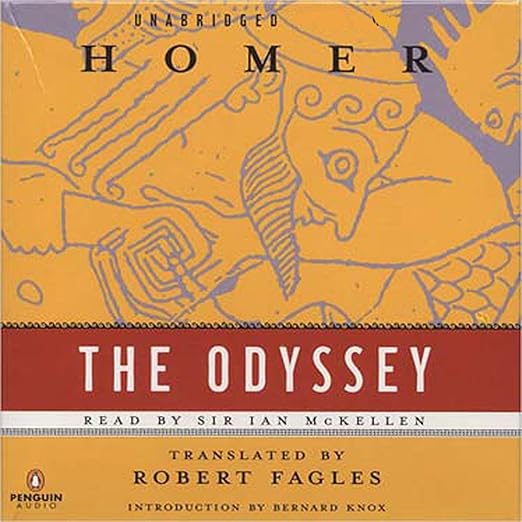
A line of Fagles' verse arrives before anything else in the description: "Sing to me of the man, Muse, the man of twists and turns driven time and again off course." That single sentence tells you which Odyssey you are getting. Not a crib for a seminar, not a stiff period rendering, but a poem built to be spoken out loud. Penguin Audio put the translation in Ian McKellen's hands in December 1999, and the audiobook that came out of that pairing has been sitting on the same listing for more than twenty-five years.
David Evans, in a December 2015 five star, names both halves of the pairing right in the headline: Fagles' approachable translation and McKellen's stentorian narration. The body earns the headline. That listener had met Homer all their life in fragments, from Rick Riordan's Lightning Thief books to a Stickman Odyssey series, and had never sat with the full text until this reading. Sir Ian McKellen, the response says, reads it beautifully. It is the most useful line on the page, because it comes from someone who arrived without a classics degree and stayed to the end.
The description credits Robert Fagles for the translation and quotes the New York Times Book Review calling the result a distinguished achievement. The byline does not. In the author line this listing says Homer and stops, so the one person whose word choices you will actually hear is missing from the credit line. On a Homer recording that omission is not cosmetic. The difference between one Odyssey and the next is almost entirely the translator, and Fagles is the reason this one moves at the speed of speech.
Fagles' own pitch, quoted in the copy, is an Odyssey to read aloud, to savor, and to treasure. A translator making that claim about a printed page is marketing. A translator saying it about a text that a stage actor then performs is closer to a specification. What you get is one voice carrying the whole poem across thirteen hours and three minutes: no cast, no score, no framing essay, no apparatus of any kind standing between you and the verse.
Ian McKellen Makes the Translation Speak
Thaybot, writing in June 2025, puts it bluntly: this is the best translation and reading of The Odyssey, and the other versions are a waste of time. The same response takes a swing at the Emily Wilson translation by name. You do not have to agree with any of that to find it useful, because it tells you what the real comparison is. Nobody shopping here is choosing between Homer and a modern novel. They are choosing between English Odysseys, and on this evidence the reader counts as part of the translation.
Homer's case is made in the description and it holds up. The Iliad is the war epic; the Odyssey is the one about getting home, and its hero survives on wit and wiliness rather than on force, through ten years of divine and natural obstruction. The copy calls it literature's grandest evocation of an everyman's journey through life, which is publisher language for something true: the trials are episodic and self-contained, easy to follow by ear even when you put the poem down for a week and come back to it cold.
Fagles' idiom is the other half of the case. The copy calls it bold and contemporary, and you can hear as much in the one line the description quotes: twists and turns, driven time and again off course, the hallowed heights of Troy plundered. Plain vocabulary, hard stresses, no inversions to untangle in your head before the sense arrives. Set it beside a nineteenth-century verse Odyssey and the gap shows up inside a sentence. For anyone who bounced off Homer in a school anthology, I would argue the idiom alone justifies a second attempt.
Audio Chapters That Don't Match the Books
The most practical complaint on the page comes from a four star filed in October 2022, and it describes a genuine defect: the audio chapters do not line up with the numbered Books of the poem. That listener went as far as logging start times, Book by Book, and posting them so other people could find their place. If you are following along in a print Fagles, or teaching from one, you will be hunting. Nothing in the product data warns you, and the fix currently on offer is homemade.
A five star from June 2018 registers a related gap in a single sentence: exciting story, but no commentary in it about the book. Read that as a specification rather than as a complaint. What was recorded is the poem, and only the poem. No introduction, no notes, nothing to place Ithaca or Troy for someone meeting the names for the first time, no roll call of the gods who keep intervening. Anyone who wants a guided Odyssey has to bring the guide along themselves.
The description also carries a line that no 1999 recording can honor: soon to be a major motion picture directed by Christopher Nolan. That copy was written for a recent print edition and pasted onto an audio listing it postdates by more than two decades. Harmless in itself, it does tell you how this page has been assembled over the years. So does the five star praising the condition of what arrived, which is a note about a parcel rather than about anything anyone listened to.
Look for the Translator's Name Before Buying
Anyone who has met Homer only through retellings and allusions should start here. The Fagles idiom removes the main barrier, and a single unaccompanied voice across the whole poem keeps the narrative line clearer than a full cast usually manages. It suits relistening, too, since the episodes stand alone well enough that dropping back into the return to Ithaca costs nothing in continuity. Long walks, long stretches of housework, broken evenings: this is a text that survives being heard in pieces.
Two groups should look elsewhere. Anyone who needs scholarship, an introduction, notes, a map of the wanderings, gets none of it, because the recording is the poem and nothing else. Anyone who wants variety in the sound should sample first: the credit lists one reader and no cast, so the texture at hour twelve is the texture at hour one. And anyone shopping for a dramatized Odyssey, with a company of actors and sound design, has landed on the wrong listing entirely.
What survives all of it is the pairing, which is the only thing that really matters on a Homer listing: a translation written to be spoken, and one actor handed the whole of it to say. The credit line still reads Homer alone, which is charming and wrong. When you go looking, search on the translator's name rather than the poet's, or you will land in a shelf of Odysseys that share a title, a plot, and nothing else that counts.