Key Details
- Narration: Ralph Cosham brings a deliberate, authoritative register to John Tusa's dense historical material, sustaining attention across 25 hours without sacrificing the precision the subject demands.
- Themes: war crimes and international law, the architecture of justice after atrocity, power and accountability
- Mood: Measured and grave, intellectually demanding, with moments of genuine dramatic intensity
- Verdict: This audiobook rewards the considerable time investment it asks of listeners with a forensic and humane account of one of the twentieth century's most consequential legal proceedings.
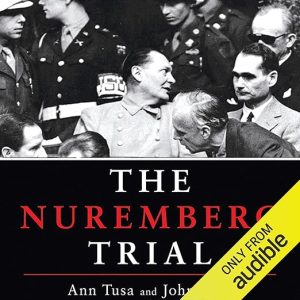
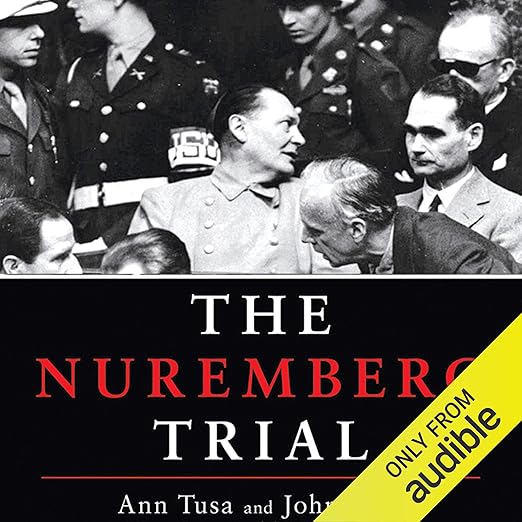
At 25 hours and 45 minutes, this is not a casual listen. John Tusa's The Nuremberg Trial, narrated by Ralph Cosham, makes demands of its audience from the opening chapters onward, and the weight of those demands is entirely proportionate to the weight of what it documents. The Nuremberg trial, the postwar prosecution of the senior hierarchy of the Nazi regime, was not merely a legal proceeding: it was the event through which the concept of war crimes as a prosecutable offense under international law was argued into existence. This audiobook takes that history seriously enough to be genuinely difficult at times, and that difficulty is precisely what makes it valuable.
Tusa's approach is both scholarly and dramatically engaged, a combination that multiple reviewers have praised as unusual. This is not a book that sacrifices rigor for readability, nor one that sacrifices human drama for scholarly comprehensiveness. Cosham's narration is attuned to both registers. His delivery of the courtroom confrontations, from the whimpering of Kaltenbrunner and Ribbentrop on the stand to the icy coolness of Goering, carries the appropriate weight without turning historical actors into dramatic props. This is documentation that knows it is also storytelling.
Cosham Shifts Registers from Evidence to Courtroom
Cosham is an exceptionally well-suited narrator for this material. History audiobooks of this length require a voice that can sustain attention through dense evidentiary passages and then shift into a more immediate register for the courtroom confrontations without losing the listener's trust in the overall frame. Cosham manages this with the kind of authority that comes from genuine investment in the material rather than professional neutrality alone. His reading of the sections dealing with the conflicting Allied political interests behind the decision to hold the trial is particularly strong: these are the passages where Tusa's analytical framework is doing its most sophisticated work, and Cosham's delivery keeps the argument clear without flattening it.
One reviewer offered the slightly paradoxical assessment that this is a definitive account, but a tedious read, and the distinction is worth examining. The perceived tedium is almost certainly a function of the book's ambition: comprehensive coverage of a trial this complex requires sustained engagement with evidentiary and procedural detail that does not lend itself to quick summary. Whether an individual listener experiences this depth as tedium or as reward depends largely on how invested they are in the subject. For listeners who want a full account rather than a highlight reel, the audiobook's density is its greatest virtue.
Still a Model for Prosecuting War Crimes
The central question the trial posed, how do you punish the perpetrators of history's largest genocide in a manner that is itself legitimate, is still the most important question in international criminal law. Tusa's audiobook documents not just what happened at Nuremberg but why it happened the way it did: why a trial rather than summary execution, how the competing political agendas of the four Allied powers shaped the proceedings, which defendants were included and why, and what the legal innovations of the trial established as precedent for all subsequent international criminal justice. That institutional and jurisprudential context is what separates this book from purely narrative accounts of the same period.
Reviewer Claudia Moscovici's description of the audiobook as a model for prosecuting war crimes points directly at why this history remains urgently relevant. The questions debated by the Nuremberg prosecutors, about jurisdiction, the legality of retroactive criminal prosecution, the responsibility of individuals within institutional structures for collective atrocities, are not resolved historical questions. They are the operative questions in every international criminal proceeding since. Cosham's narration gives these legal arguments the seriousness they deserve without reducing them to abstraction.
Goering's Coolness, Ribbentrop's Collapse Under Examination
The individual portraits of defendants deserve particular attention. Tusa's accounts of the defendants as individuals, the specific ways each man confronted or evaded his responsibility for what the regime had done, are among the most revealing sections of the audiobook. Goering's icy coolness, Ribbentrop's collapse under examination, the varied degrees of defiance, denial, and genuine horror at the evidence among the defendants, these are drawn with a precision that makes the legal proceedings feel personally and morally immediate rather than historically distant.
The audiobook's treatment of the decision to include crimes against humanity in the charges is a pivotal intellectual moment worth listening to closely. This was not merely a legal innovation; it was the creation of a new category of moral and legal reality. Tusa explains the political resistance to this framing, the ways it complicated the Allied powers' own histories of colonial violence, with a candor that distinguishes this from more triumphalist accounts of the trial. Cosham's measured delivery ensures the analytical complexity of these sections is fully available to the listener.
Twenty-Five Hours for Lawyers and Historians
This audiobook is for listeners who are prepared to spend 25 hours with a dense, scholarly, and deeply serious historical work. It rewards historians, lawyers, political scientists, and general readers with a substantial prior interest in World War II, international law, or the philosophical questions surrounding justice and accountability. Listeners who want a quick or accessible introduction to Nuremberg should start elsewhere; this audiobook is a comprehensive treatment of the subject, not an overview. Those who find historical detail tedious rather than satisfying will struggle with the length and density. For everyone else, this is one of the most thorough and intelligent accounts of the trial available in audio form.
Is this audiobook appropriate for listeners with only general knowledge of World War II, or does it assume specialist historical background?
Tusa provides enough historical context for listeners with general WWII knowledge to follow the proceedings. Specialist background in either history or law is not required, though the audiobook rewards listeners who bring more prior knowledge to it. The legal proceedings are explained as they unfold rather than assumed to be self-explanatory.
At nearly 26 hours, is this audiobook worth the time investment for a general history listener?
For a listener genuinely interested in how international criminal law was created, or in the human details of how individual Nazi leaders conducted themselves when finally held to account, yes. For a listener wanting a faster introduction to the subject, a shorter overview would serve better. The audiobook is comprehensive rather than condensed by design.
Does this audiobook take a clear moral or political position, or does it try to present the trial neutrally?
Tusa's account is analytical rather than polemical, but it is not neutral in the sense of pretending the proceedings were morally equivalent on all sides. The book engages seriously with the genuine legal and philosophical objections to the trial, including retroactive prosecution, while remaining clear about the gravity of the crimes being prosecuted.
How does Ralph Cosham's narration handle the technical legal content in this audiobook?
Cosham's narration has been consistently praised for its authority and clarity. His delivery of the legal and procedural content is measured and precise without becoming academic, and he shifts register appropriately for the more dramatic courtroom confrontations. For 25 hours of dense material, the consistency of his performance is one of the audiobook's genuine assets.