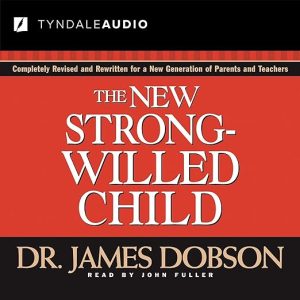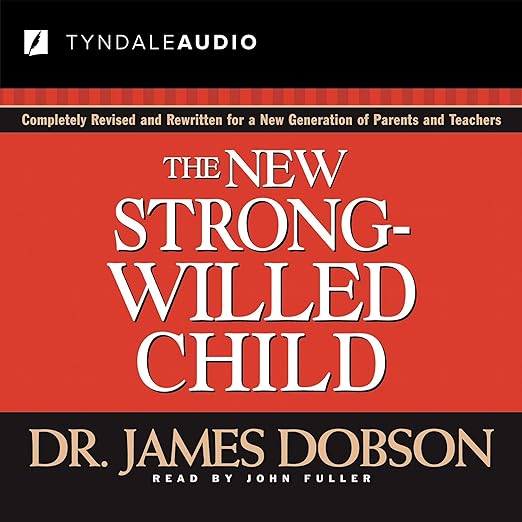
Dr. James Dobson's The New Strong-Willed Child, available as an audiobook narrated by John Fuller and running just under seven hours, is a substantial reworking of the book that made Dobson's reputation as one of America's most influential parenting writers. The original Strong-Willed Child, published in 1978, sold millions of copies across several generations of parents navigating children who resisted every instruction, defied every boundary, and exhausted every strategy the adults around them could devise. This newer version incorporates updated research and expands the original's coverage into territory that has become central to contemporary child development: ADHD diagnosis and management, sibling rivalry, and the effects of low self-esteem on children who fight the world because they feel inadequate within it. John Fuller's narration across six hours and forty-four minutes is measured and consistent, communicating Dobson's practical confidence without overplaying the emotional dimensions of what is, for many parents, genuinely difficult territory.
Dobson writes from within a specific evangelical Christian framework, and The New Strong-Willed Child does not attempt to separate its practical advice from that framework. His understanding of children's development, his views on appropriate discipline, and his recommendations for specific situations are all grounded in a particular theological anthropology. Listeners who share that framework will find the book's integration of faith and practice seamless; those who do not should know that the theological scaffolding is structural, not decorative.
The Best Parts of The New Strong-Willed Child
The audiobook's practical value is concentrated in its detailed attention to the specific experience of parenting a child who seems constitutionally opposed to compliance. Dobson is not describing ordinarily challenging children; he is describing a particular temperament type whose resistance is not defiance in the usual sense but an expression of a deep drive toward autonomy that, if handled poorly in childhood, tends to harden into genuine rebelliousness in adolescence. His framework for distinguishing between these children and their more compliant siblings, and for calibrating responses appropriate to each, is the core of the book's usefulness.
Reviewer VSchmidt713, who nearly did not purchase the book after reading negative reviews claiming it advocates child abuse, found the actual content to be the opposite of what those reviews described. That disparity is worth noting. Dobson's approach to discipline involves clear boundaries and consistent consequences, including positions on corporal punishment that are contested in contemporary developmental psychology, but his overall framework is concerned with building strong, self-directing children rather than compliant ones. Reviewer Sharon Lewis identified this directly: the book is concerned with raising children who eventually internalize their own moral compass rather than simply suppressing the strong-willed quality that makes the early years so demanding.
The sections on ADHD are among the most practically useful additions in the new version. Dobson addresses how to distinguish between genuine ADHD and strong-willed behavior that mimics its symptoms, which is a distinction that has enormous practical implications for parents navigating a diagnosis or a referral. He also covers the relationship between low self-esteem and acting-out behavior, which is relevant to the strong-willed child because many of these children receive so much correction so early that their sense of their own worth takes serious damage before anyone recognizes what is happening.
Before You Commit to The New Strong-Willed Child
Reviewer MikeInWeston noted that the book brought his wife, who had been receiving advice from modern therapists, to a more grounded assessment of their child's behavior. That framing reveals the book's implicit positioning: Dobson is writing partly in dialogue with psychological frameworks he considers too permissive or too willing to pathologize normal strong-willed temperament. Listeners who are working with therapists or pediatricians may want to treat the book as one perspective among several rather than a replacement for clinical guidance.
The audiobook format works reasonably well for this material. Dobson writes clearly and structures his arguments accessibly, and Fuller's narration keeps the pacing comfortable. The sections that involve research citations and statistical data are somewhat denser in audio form than they would be in print, but Dobson does not lean heavily on academic literature in the way that more clinical parenting guides do. Most of the book is practical argument illustrated with case examples, and that format translates well to listening.
Should You Listen to The New Strong-Willed Child?
This audiobook is for parents who recognize their child in Dobson's description of the strong-willed temperament and who are open to practical guidance informed by a conservative Christian framework. It is particularly useful for parents who are early in the process of understanding their child's temperament rather than those who have already built an extensive toolkit. Listeners approaching from a secular or progressive parenting framework should know the book's perspective before committing to nearly seven hours; the advice is not separable from its theological grounding. John Fuller's narration serves the material well precisely because he does not overperform the emotional dimensions; parenting under stress is hard enough without a narrator who adds drama to scenarios that are already dramatic for the people living them. The audiobook's six-hour runtime makes it practical to complete over a few sessions, which is a reasonable investment for a parenting framework that, if it resonates, will shape decisions made every single day. For those who share Dobson's values or are willing to engage his framework on its own terms, the audiobook delivers a substantial and experienced practitioner's view of one of parenting's most demanding challenges.
Before You Press Play
- Narration: John Fuller reads with the steady, even-keeled quality that suits a parenting guide, communicating authority without condescension across the six-hour runtime.
- Themes: Parenting children with strong temperaments, discipline philosophy, ADHD and self-esteem in childhood development
- Mood: Practical, earnest, and informed by a specific faith perspective
- Verdict: The New Strong-Willed Child audiobook delivers Dr. Dobson's updated framework for parents struggling with difficult-to-handle children, though its conservative Christian perspective is inseparable from its practical advice.
A Few Questions About The New Strong-Willed Child
Is The New Strong-Willed Child audiobook appropriate for parents who are not religious?
The book is written from within a conservative evangelical Christian framework, and the practical advice is integrated with that perspective throughout. Secular parents can extract useful observations about strong-willed temperament and developmentally appropriate responses, but the theological framing is structural rather than incidental. Non-religious listeners should be aware of this before investing nearly seven hours.
Does this audiobook cover ADHD, and how does it distinguish between ADHD and strong-willed behavior?
Yes, and this is one of the most valuable additions in the updated edition. Dobson addresses the diagnostic confusion between genuine ADHD and a strong-willed temperament that mimics its behavioral profile, providing practical guidance for parents navigating evaluations, medication decisions, and the relationship between temperament and diagnosis.
Is the audiobook's position on discipline consistent with mainstream child development research?
Not entirely. Dobson's approach includes positions on corporal punishment that are contested in contemporary developmental psychology. The book's framework for building internal moral direction in strong-willed children is broadly consistent with authoritative parenting principles, but some specific disciplinary recommendations diverge from current clinical consensus. Consulting a pediatrician or child psychologist alongside this audiobook is advisable.
Is this audiobook a complete rewrite of the original Strong-Willed Child, or an update to the existing text?
Dobson describes it as a complete rewrite that incorporates updated research and expands coverage of topics including ADHD, sibling rivalry, and self-esteem. The core framework and philosophy from the original remain, but the new edition engages with research and parenting contexts that did not exist when the original was published in 1978.