Quick Take
- Narration: Shawn K. Jain delivers a professional, business-register performance, clear and well-paced for an executive-targeted business book.
- Themes: Enterprise automation strategy, organizational culture change, AI-for-all frameworks
- Mood: Practical and confident, oriented toward organizational decision-makers
- Verdict: A concrete, case study-grounded guide to automation strategy for leaders who have already accepted the premise and want help with implementation rather than persuasion.
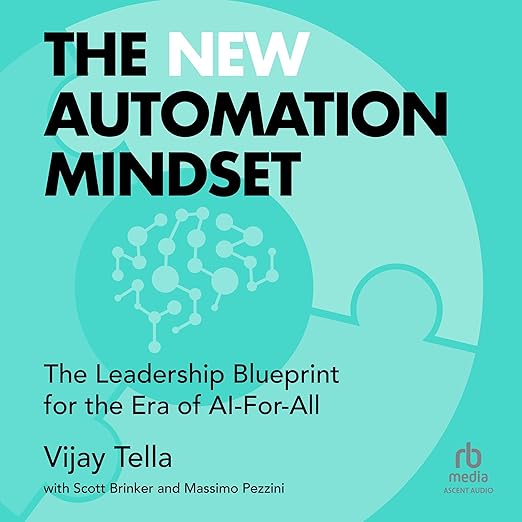
Business books about automation tend to cluster at two extremes: breathless evangelism about the coming transformation, or dense technical guides that assume you already know what RPA stands for. The New Automation Mindset is a deliberate attempt to occupy the space between those two poles, neither a manifesto nor a manual, but something like a leadership framework for the leaders who have already bought the premise and are now trying to figure out what to actually do with it.
I listened to the first two hours on a Monday morning commute, and the experience was appropriate. This is business audio at its most functional: organized, evidence-backed, and designed to be absorbed by someone who has a lot of other things on their mind. That is not a criticism. It is a description of a book that knows its audience and delivers what that audience needs.
The Three Authors and What They Actually Bring
The book credits three authors: Vijay Tella, CEO of Workato; Scott Brinker, editor of chiefmartec.com and a VP at HubSpot; and Massimo Pezzini, a former Gartner analyst. That combination is significant. You have a practitioner, a market analyst, and a platform thinker in the same book, which means the frameworks have been stress-tested against different angles of the automation problem. The result is a book that avoids both the naivety of pure technology enthusiasm and the abstraction of pure analyst thinking.
Reviewer Tony Chen notes that the book covers not just the tools but the “mindset shifts necessary for organizations to thrive in an automated era”, and this is accurate. The most useful sections are the ones that address what happens to roles, to accountability structures, and to decision-making processes when automation is deployed at scale. These are the conversations that technical implementation guides skip over, and they are the conversations that actually determine whether automation initiatives succeed or fail.
Beyond RPA: The Breadth of the Argument
The book explicitly positions itself against an RPA-only conception of automation, and this is one of its more substantive contributions. Robotic process automation, the scripting of repetitive tasks, was the first wave of enterprise automation, and a lot of organizations are still stuck thinking that wave is the whole story. Tella and his coauthors argue for a more comprehensive understanding: automation as a cultural and organizational capability rather than a set of technical implementations. That framing has real implications for who gets involved in automation decisions and at what level.
The case studies here are the book’s strongest selling point. Reviewer Cliente de Kindle calls out the “real-world examples” and “adaptable strategies,” and this is where the three-author combination pays off. The examples span industries and organizational sizes, and they are concrete enough to be analytically useful rather than vague enough to be unfalsifiable. When a business book uses case studies, the question is always whether they are illustrating the framework or just decorating it. Here, they are doing the former.
Limitations and the Honest Question of Audience
At nearly nine hours and change, this is a full-length business book, and some of it reads like one: sections that are thorough without being essential, frameworks that are useful but not surprising to anyone already working in digital transformation. The book is best for leaders who are early in their automation journey, C-suite executives who know they need to move, front-line managers who need to prepare their teams, and strategists who want a vocabulary for the internal conversations that need to happen. People already deep in the implementation work may find the conceptual sections familiar.
Shawn K. Jain’s narration is competent and professional. It is not the kind of narration you will remember, but it is entirely functional for the material. Business audiobooks often benefit from a narrator who does not get in the way of the content, and Jain does that well.
Who Should Listen / Who Should Skip
Listen if you are a business leader trying to build the organizational case for automation investment, or a manager preparing a team for a technology-driven shift in how work gets done. The case study density and the honest treatment of organizational change make it more useful than most books in this genre.
Skip if you are an automation engineer or a technical practitioner looking for implementation guidance. The book operates at the strategic and cultural level, not the technical one. Also skip if you have already read extensively in digital transformation literature; the frameworks here will feel familiar even if the framing is solid.
Frequently Asked Questions
Does the book cover AI specifically, or is it focused on traditional automation tools like RPA?
The book explicitly argues that automation is broader than RPA, and it addresses AI as a component of a wider automation ecosystem. It is not a deep dive into any specific AI technology, but it does treat AI as central to the direction automation is heading and provides strategic frameworks for thinking about it alongside other tools.
Is this primarily a book for executives, or does it have useful content for operational managers and front-line employees?
The book makes a point of addressing all three levels, C-suite, managers, and employees, and the advice is differentiated by role. The executive-facing sections are the most developed, but the authors are explicit that automation requires organizational buy-in at every level, and they address what that looks like in practice.
How current is the automation landscape described in the book?
The book engages with the enterprise automation landscape as it stood in the early 2020s. The strategic frameworks are durable, but specific product references and market dynamics will have evolved. Readers should treat the case studies as illustrative rather than current-state analysis.
With three authors, does the book feel coherent or fragmented?
The three-author structure is handled well. The book reads as a unified argument rather than a collection of separate essays. The different professional backgrounds contribute to the framework’s comprehensiveness rather than creating inconsistency in voice or argument.