The Short Version
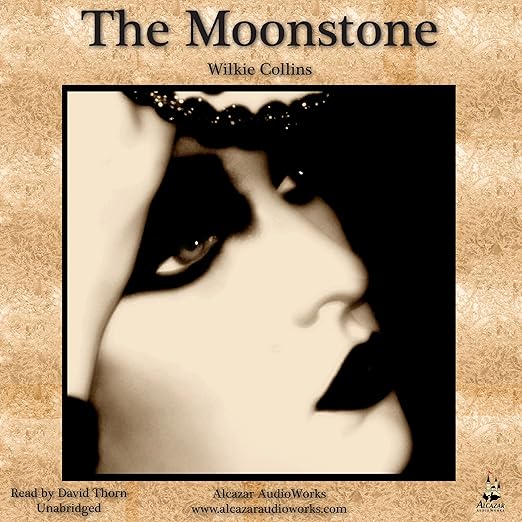
- Read by: David Thorn manages the polyphonic challenge of Collins's multi-narrator structure with reasonable consistency, though the Alcazar AudioWorks production has not been updated since 2010.
- At its heart: The origins of the detective novel, colonial guilt and stolen treasure, the unreliability of memory and witness
- Vibe: Dense and pleasurably labyrinthine, Victorian at its most fully inhabited
- Short version: The genuine founder of the English detective novel, still mysterious and satisfying after 150 years, and an audiobook that rewards patient listeners willing to let Collins's intricate machinery do its work.
I came to The Moonstone knowing the reputation, the first detective story in the English language, the novel that gave us the framework that Conan Doyle and Agatha Christie would inherit. What I did not expect was how genuinely disorienting it would be, how the multi-narrator structure that Collins invented, each character giving their own account of the same events in sequence, would make the mystery feel less like a puzzle to be solved and more like a question about epistemology. How do we know what happened? Whose account can we trust? Can any single witness reconstruct a truth that was distributed among many different consciousnesses? The Moonstone asks these questions in 1868 and has still not received a more elegant treatment of them.
The plot turns on the disappearance of a large yellow diamond, the Moonstone, from the bedroom of Rachel Verinder on the night of her birthday party. The diamond has a colonial origin: it was looted from the statue of a Hindu god during the siege of Seringapatam by Rachel's ne'er-do-well uncle, who bequeaths it to her. Three Hindu priests have been tracking the stone since its theft, determined to return it to its rightful place. The English characters are meanwhile constructing their own stories about the disappearance, stories filtered through propriety, self-interest, selective memory, and, in one remarkable case, opium. David Thorn reads all of these narrators, each with a different social position and verbal register, over twenty hours.
First, the Big Picture
The novel earns its canonical status in a way that some foundational texts do not. It is not simply a historical curiosity, the first of its kind and therefore important regardless of quality. It is genuinely pleasurable, full of the social observation and comic characterization that Collins learned from his close friendship with Dickens, but structured with a mechanical precision that Dickens rarely achieved. The character of Sergeant Cuff, the detective who is introduced to investigate the theft, has the nonchalance and observational precision of Holmes before Holmes. Gabriel Betteredge, the household steward whose narrative opens the novel, is one of Victorian fiction's most endearing unreliable narrators, a man who consults Robinson Crusoe as a philosophical authority and genuinely believes in the infallibility of English domesticity.
What Makes The Moonstone Worth Hearing
The multi-narrator structure is where the audio format presents both its challenge and its reward. In print, readers can track back to earlier chapters, compare accounts, check their memories of what was said. In audio, you must trust the architecture as you move through it, which means small inconsistencies between narrators accumulate in your listening memory rather than being checked against the text. That creates a reading experience closer to what Collins's original readers would have had, absorbing the novel in serial installments without the ability to flip back and forth. The mystery therefore hits harder in audio than in careful print reading, because you have been carrying the same uncertainty the characters have.
A Few Reservations
The Alcazar AudioWorks production dates from 2010, and its production values reflect that vintage. The recording is clean but not as immersive as more recent audiobook productions. David Thorn handles the different narrators with enough differentiation to be tracked across twenty hours, though reviewers note that the multiple voices can be difficult to distinguish in the extended middle sections. The novel itself is demanding in the way Victorian fiction often is, longer than the mystery requires, shaped by the expectation of serial reading rather than cover-to-cover absorption. The sections where secondary narrators take extended detours into their personal histories before returning to the main event are the most challenging in audio form. One reviewer put this diplomatically as the work suffering from the length with which the characters narrate their own participation. Patience is rewarded; the ending is genuinely effective.
Should You Listen to The Moonstone?
Readers who want to encounter the source code of the English detective novel in its full form, those interested in Victorian fiction's engagement with colonialism and the ethics of looted artifacts, and patient listeners who can give twenty hours to a slow-burning, intricate mystery will find this one of the richest experiences in the classical literature audio catalog. Those who find Victorian prose rhythms difficult in audio or who want a tightly paced mystery without digressions should begin with something more contemporary before working back to Collins.
How does David Thorn differentiate between the multiple narrators in this production?
Thorn uses vocal distinctions to mark the different narrators, though reviewers note that over twenty hours the differentiation can blur, particularly between secondary narrators. The most distinct characters, Betteredge the steward, Miss Clack the evangelical spinster, and Sergeant Cuff when his account arrives, are handled with the most consistent characterization.
Is the colonial subtext, the diamond stolen from a Hindu idol, developed significantly or mostly background?
It is woven throughout the novel rather than confined to background. The three Hindu priests who track the stone appear at key plot moments, and the ethical question of what was done with the Moonstone and by whom frames the entire mystery. Collins is more attentive to this dimension than most Victorian crime writers would have been.
At 20 hours, how does the pacing feel? Is there significant padding?
Victorian fiction readers will be comfortable with the pacing. Readers accustomed to contemporary thrillers may find the digressive narrators in the middle sections slow. The novel is structured in a way that distributes its revelations across a wide span, so patience is genuinely required. The final sections move faster and the resolution is satisfying rather than anticlimactic.