Quick Take
- Read by: Aaron Fraser's self-narration gives the outreach advice real credibility, delivered plainly with no studio polish.
- At its heart: athlete and creator sponsorship, personal branding, business structuring for independent riders
- Vibe: Practical and direct, closer to a coaching session than a motivational talk
- Short version: A tight, useful sponsorship playbook for action-sports creators, though its two-hour runtime moves fast through some sections.
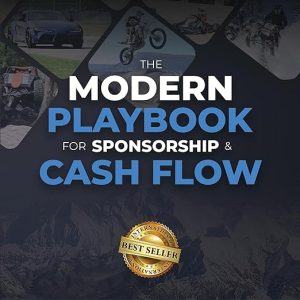
Weekend racers rarely think of themselves as marketing assets, but that's exactly the reframe Aaron Fraser pushes across two hours in The Modern Playbook for Sponsorship & Cash Flow audiobook. Fraser is a former championship racer who now teaches riders, racers, and content creators how sponsorship deals actually get built, and his answer to why most weekend warriors never land a deal isn't talent or luck; it's positioning. The book promises tools for landing sponsorships beyond just free gear, and it delivers that promise inside a runtime shorter than most riders' longest training ride.
Fraser Turns Racing Experience Into a System
Fraser structures the book as a practical breakdown rather than a motivational pitch: the different types of sponsorship deals available beyond simple product discounts, how to actually grow an audience brands want to partner with, and outreach strategies that don't read as desperate. The back half moves into territory most action-sports content skips entirely, tax strategy, business structuring, and financial efficiencies, treating sponsorship not as a hobby perk but as the foundation of an actual business. Reviewer Mika A. calls it 'smart, forward thinking' and 'not your usual self help guide,' language that fits a book more interested in spreadsheets than inspiration.
Fraser's own background does real work here: he's a former championship racer who built a marketing career after leaving competition, and the book reads like someone translating hard-won experience into a repeatable system rather than theorizing from the outside. Reviewer Samaria Hugee describes it as breaking 'the sponsorship process into actionable steps,' which matches how the book is structured, less philosophy, more checklist.
The synopsis breaks the book's promise into specific, listable pieces: the different types of sponsorships available beyond simple discounts, the mechanics of building an audience brands actually want, outreach scripts that avoid sounding desperate, and a framework for structuring activations that keep a sponsor coming back for a second season rather than a single one-off post. That level of specificity, actual categories and actual steps rather than vague encouragement to network, is what separates a genuinely useful business audiobook from a motivational one, and Fraser leans hard into the former.
Fraser doesn't shy away from the less glamorous mechanics either, invoicing, contract terms, deliverable tracking, the unglamorous back-office work that determines whether a sponsorship relationship actually survives past the first check, which is exactly the kind of detail a motivational-only book would skip entirely.
Fraser's Self-Narration Works as a Credibility Check
Fraser narrates his own book, and for this specific genre, a former athlete teaching brand strategy, that self-narration functions as a credibility check as much as a stylistic choice. A listener can hear directly whether the person giving outreach advice sounds like someone who has actually pitched brands himself, and the conversational, no-frills delivery matches the practical, no-nonsense strategies the synopsis promises. This isn't a book dressed up with studio polish; it sounds like a rider explaining what actually worked, which is exactly the register the content needs.
At two hours and one minute, this is one of the shorter business audiobooks in its category, and that short runtime works as a real advantage rather than a shortcoming for its target listener. Reviewer Mia C87, a small craft business owner rather than a motorsports athlete, found the framework transferable well beyond racing specifically, praising Fraser's focus on 'continuous learning, data analytics, and strategic collaborations' as broadly useful. That cross-industry applicability suggests the sponsorship principles here generalize further than the racing-specific packaging might suggest.
The broader context here is worth naming directly: the creator economy has made sponsorship literacy relevant to a much wider group of people than it used to be, not just professional athletes with agents, but weekend racers, hobbyist creators, and anyone building an audience around a passion project. Fraser's specific racing-world framing is really a case study in a much larger shift, brands increasingly want authentic micro-audiences over celebrity reach, and the book's timing rides that shift directly.
Big Topics Squeezed Into a Two-Hour Runtime
Two hours is a tight runtime for a book that promises to cover sponsorship types, audience-building, outreach, activation strategy, and tax and business structuring; by necessity, several of those sections move quickly, more framework than deep dive. Listeners hoping for detailed, step-by-step tax guidance specifically should treat this as a starting orientation rather than a substitute for an actual accountant familiar with athlete or creator income.
The book is also unmistakably written for a specific niche, racing, riding, and driving sponsorship, and while Mia C87's experience suggests the ideas transfer to other creative or small-business contexts, listeners entirely outside action sports may find some examples and terminology assume more familiarity with that world than they have. The book's own closing description positions it as an update to a prior guide, worth a quick check if you've read Fraser's earlier material to make sure you're not covering the same ground twice.
Because social media platforms and their sponsorship norms change quickly, some of the specific outreach tactics here will likely need updating within a few years even if the underlying principles hold up longer. Listeners should treat the strategic framework, how to think about audience value and brand fit, as the durable part, and treat any platform-specific tactical advice as a snapshot of the current landscape rather than a permanent playbook.
Listeners should also know the book assumes at least some existing audience or content history to build from; someone starting completely from zero, no social presence at all, will need to build basic content fundamentals elsewhere before Fraser's specific sponsorship-outreach advice becomes directly actionable, since outreach strategy only works once something concrete exists for a brand to actually evaluate.
For Racers Seeking Sponsors and Brands Evaluating Them
Amateur racers, riders, and drivers actively looking for sponsorship dollars are the direct audience, but reviewer Mia C87's experience suggests small business owners and content creators outside motorsports entirely can pull real value from the audience-building and outreach sections too.
It's also a reasonable listen for brand and marketing professionals on the other side of these deals, anyone evaluating sponsorship pitches from athletes or creators, since Fraser lays out exactly what a well-prepared pitch looks like from the applicant's side, useful intelligence for whoever's on the receiving end of one.
Anyone needing detailed tax or legal guidance rather than a strategic overview, or listeners with zero connection to action sports who might struggle with the industry-specific examples, should treat this as a supplement to more specialized resources rather than a standalone solution.