At a Glance
- Narrator: Mark Deakins gives Thomas a credible teenage voice without over-performing the adolescent uncertainty, and his differentiation of the Glade's varied cast is sharp throughout.
- Subjects: Collective survival, institutional manipulation, loss of memory and identity
- Tone: Claustrophobic and relentless, with the particular dread of a world where nothing explained
- Bottom line: James Dashner's series opener holds up as a genuinely propulsive piece of dystopian YA with a premise that earns its cultural longevity.
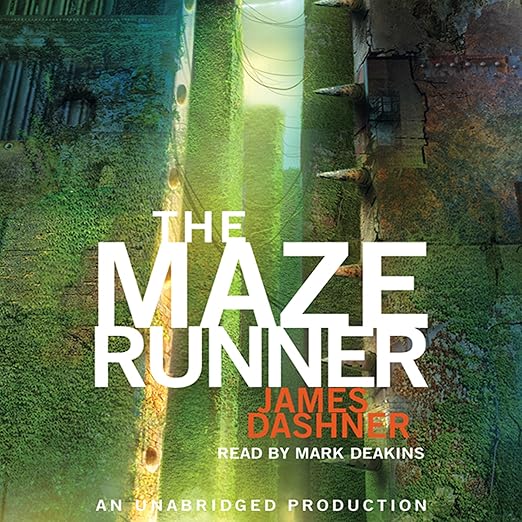
Thomas wakes in a metal box with no memory of who he is or how he got there, and James Dashner's The Maze Runner never really slows down long enough to let him or the reader recover. Book one in what became a five-entry series and a three-film franchise, this is the audiobook that introduced the Glade, the Grievers, and a dystopian survival premise that reviewers at the time compared to a collision between Lord of the Flies, The Hunger Games, and Lost. That comparison is promotional shorthand, but it gestures at something real: Dashner constructed a world whose rules are withheld from the protagonist and the reader simultaneously, which is a craft choice that generates sustained propulsion across ten hours and fifty minutes.
Mark Deakins narrates, and his handling of Thomas's first-person-adjacent close third perspective is one of the production's core strengths. Dashner writes in a mode where Thomas's ignorance is the reader's ignorance, which places significant demand on the narrator to hold uncertainty without making it feel performative. Deakins achieves that balance reliably. He voices the Gladers, the established community of boys who have built a functioning society in their stone-walled prison, with consistent differentiation that matters in a narrative where group dynamics carry as much weight as the maze itself.
One Girl's Arrival Destabilizes the Glade
The Glade functions as an adolescent society under impossible constraint, and Dashner is more interested in how that society operates than he is in pure thriller mechanics. The boys have built hierarchy, language, jobs, and rules in the years before Thomas arrives. The arrival of the first girl, whose message, "Remember. Survive. Run," is delivered as a kind of command that the novel takes seriously in structural terms, destabilizes everything that social order has constructed. Dashner uses that destabilization to push the plot forward, but the underlying interest is in what happens when an established system meets an event it was not designed to process.
The amnesia premise is a standard YA device, but Dashner's application of it is unusually consistent. Thomas doesn't recover his memories in convenient plot-serving chunks; his ignorance is maintained with discipline throughout the first book, which keeps the reader in genuine uncertainty alongside him. The Maze Runner earned a Kirkus Reviews Best Teen Book of the Year designation and an ALA-YALSA Best Fiction for Young Adults listing, and those recognitions reflect the craft of the construction rather than just the commercial appeal of the premise.
Deakins Carries Dashner's Cinematic, Sensation-First Prose
The audiobook format suits Dashner's writing style in specific ways. His prose is cinematic rather than literary, prioritizing pace and sensation over interiority or metaphor. That's not a criticism; it's a description of a particular kind of craft that translates directly to audio. When the Grievers emerge from the maze at night, when Thomas makes his first unauthorized entry, when the girl Teresa's arrival reshapes the entire social calculus of the Glade, Deakins's narration carries those moments with the forward momentum the writing asks for.
At ten hours and fifty minutes, the runtime is substantial but not indulgent. Dashner earns every hour. One reviewer noted an inability to put the book down, specifically citing the "wait, what just happened" quality that operates chapter by chapter. That quality is even more pronounced in audio, where you can't flip back to re-read. Deakins's pacing choices mean that the reveals land with proper weight rather than requiring the listener to assemble them from scattered text on a page.
Invented Slang Divides Glader Loyalists
Dashner's invented slang, the Gladers have their own vocabulary that stands in for profanity and marks in-group membership, is a point of contention for some listeners. Some reviewers find it charming and world-building; others find it irritating. Deakins handles it with a straight face, which is the right call. The slang becomes less obtrusive as the narrative accelerates, and by the time the maze's larger purpose begins to emerge, it has faded into background texture.
The comparison to The Hunger Games in terms of series structure is relevant for audiobook planning purposes: The Maze Runner ends with enough resolution to satisfy on its own terms but establishes a larger architecture that the subsequent books build on. Listeners who find the maze's explanation at the end of book one inadequate will want to continue into The Scorch Trials; those who find the survival-society premise satisfying in itself can close the series here with most of their questions answered.
Best for Teenagers Who Want Action-Forward Plotting
This audiobook is a natural fit for listeners aged fourteen and up who want dystopian survival fiction with genuine narrative tension and a protagonist whose confusion is rendered with real craft. Adults who read the series when it was published in 2009 and want to return through audio will find that Deakins's narration adds a layer of atmosphere the print experience doesn't fully deliver. Parents looking for YA audiobooks that engage reluctant listeners will find this one of the more reliable options in the genre, particularly for teenagers who respond to action-forward plotting over character-driven interiority.
Readers who want strong literary prose, deep psychological interiority, or resolution of all mysteries within a single book should look elsewhere. Dashner is building a series architecture from page one, and some of what drives you forward in book one is deliberately held back for books two through five. That's a feature, not a flaw, but it's worth knowing going in. The comparison to The Hunger Games that circulated around the book's original release is useful as a market signal: if that series worked for you as audio, Dashner's approach to survival-society dystopia will occupy a similar register. The Maze Runner earned both an ALA-YALSA Best Fiction for Young Adults designation and a Kirkus Reviews Best Teen Book of the Year recognition, which between them represent the genre's most reliable quality indicators for this age category.
Good to Know
Is this audiobook appropriate for younger teen listeners, and does it contain graphic content?
The Maze Runner is aimed at a YA audience, generally fourteen and up, and while the Grievers and maze sequences are intense, the violence is not gratuitously detailed. There's no explicit sexual content. The book contains some mild invented profanity specific to the Gladers' world. It earned multiple ALA-YALSA recognition awards, which indicates it sits comfortably within mainstream YA parameters.
Do you need to listen to this audiobook before the rest of the series, or can later entries stand alone?
Book one is the essential starting point. The Maze Runner series builds its world and character relationships from the ground up in this first entry, and the later books assume familiarity with the Glade, its inhabitants, and the events that resolve book one. Starting anywhere else in the series would mean missing the structural foundation.
How does this audiobook compare to the film adaptation in terms of story content?
The audiobook and the 2014 film share the basic premise and main characters, but the novel has more interior texture and the Glade's social organization is more developed in Dashner's original. Several character relationships and world-building details were compressed or altered for the film. Listeners who saw the movie first will find the audiobook expands considerably on what the adaptation compressed.