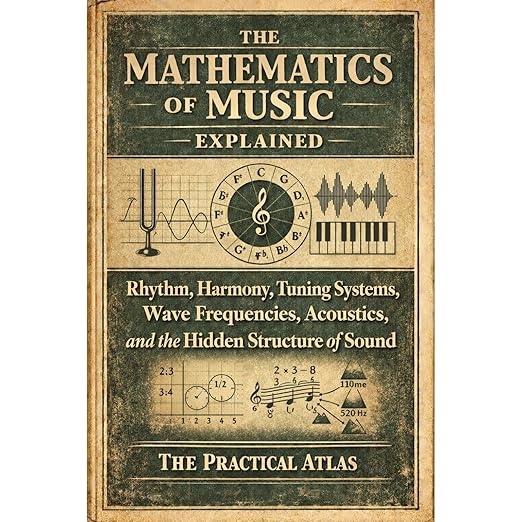
Ratios, logarithms and overtone series are the subject of this audiobook, and none of them are things you can look at while listening. That tension sits at the center of an eighty-four-minute primer that promises to show the numerical framework under every melody, chord and beat, moving from a vibrating string to a digital streaming file. The full subtitle, which the listing leaves off, spells out the territory: rhythm, harmony, tuning systems, wave frequencies, acoustics, and the hidden structure of sound.
A Synthetic Voice Reading About Sound Itself
Three places where music and arithmetic touch most directly organize the first half. Rhythm gets treated as the subdivision of time, which is the easiest of the three to carry in speech, since counting is already an auditory act. Harmony gets traced back to frequency ratios, the reason two notes an octave apart sound like versions of each other. Tuning systems get the hardest job, described in the copy as a balance between pure intervals and practical flexibility, which is the oldest unresolved argument in tuning stated in one clause.
The second half moves outward from notes to sound itself. Wave physics and the overtone series set up an explanation of scales and modes; chord construction is handled as interval stacking; resonance is connected to how instruments are built, and acoustics to how rooms behave. Then comes the most ambitious stretch, where Fourier analysis is used to explain why a violin and a clarinet playing the same pitch do not sound alike, and where the conversion of continuous vibration into numerical data explains what a digital file actually contains. That is a lot of ground for a book that describes itself as needing no advanced calculus.
Two things about the record shape what you get. The byline reads The Practical Atlas, which is an imprint-style name rather than a person, and nothing on the page identifies who wrote the text or what their background in music or mathematics might be. Nobody is credited with the reading: the record's narrator line is filled by Virtual Voice, a synthetic delivery. On most books that second fact is a matter of taste; here it interacts with the material, because a book about the structure of sound is being carried by a voice that is itself a numerical construction, and the description mentions no demonstration audio anywhere.
The Overtone Series Is the Hinge
The overtone series is the hinge, and it is the reason a book like this justifies itself. Once you understand that a single plucked string produces a stack of quieter pitches above the one you hear, the rest of the material stops being arbitrary: scales, chord construction, why certain intervals sound stable, and why instruments built from different materials carry different color. The description puts that concept early and builds forward from it, which is the correct order and not the order most introductions choose.
Accessibility is stated as a design constraint rather than a hope. The copy promises that no advanced calculus is required, and the chapter structure is described as building logically from fundamental principles to advanced applications, which for a listener means each idea should arrive with its prerequisite already delivered. Eighty-four minutes is short enough that the whole argument stays in working memory, and long enough to get past definitions into consequences.
Musicians, composers, students, audio engineers and general readers who simply want to know how music works are all named as the audience. Those groups want different things, and the one this format serves best is the third and fourth. An engineer who already knows what sampling does will find the digital audio material familiar; a curious listener who has never been told why tuning involves a deliberate compromise gets the better deal.
Half Hour Help Runs Nearly Three Times That
Nothing here can be seen, and some of it wants to be. A frequency ratio spoken aloud as three to two is perfectly clear; a logarithmic relationship between pitch and frequency, an overtone stack, or the decomposition of a waveform into its components are all concepts that textbooks illustrate for a reason. The copy is written for a page, referring throughout to a book, to chapters and to readers, and no companion material is mentioned. Listeners who want to follow the numbers rather than the summary should plan on a second source for the figures.
Two labels on the record do not match what is inside it. This is filed under a series called Half Hour Help, and the file runs an hour and twenty-four minutes, which is nearly three times that promise. The listing also carries only the short title, dropping the subtitle that tells a browsing buyer whether tuning systems and acoustics are covered, and the description itself stops mid-word after the sentence about seeing sound through structure and proportion.
Depth is the honest trade. Covering rhythm, harmony, tuning, wave physics, the overtone series, scales, chords, resonance, acoustics, timbre analysis and digital conversion in under ninety minutes means each topic gets minutes rather than a chapter's worth of development. The description promises advanced applications, and at this length those will be described rather than worked through. Anyone hoping to come out able to calculate cents or build a temperament will need a longer book after this one.
An Orientation Before a Heavier Text
Curious listeners who play a little and have always wondered why the rules are the rules will get the most from this, along with students who want the shape of the subject before committing to a semester of it. Audio engineers new to the theory side and music students allergic to mathematics are both well placed, since the promise of no calculus is the whole pitch. It also works as an orientation before a heavier text, precisely because it is short.
Look elsewhere if you want worked exercises, printed figures, or a reading you can pause against a keyboard to test each interval. Anyone who already knows what Fourier analysis does to a signal will find the second half thin. Taken for what it is, an eighty-four-minute orientation to why music sounds organized, it covers more ground than its runtime suggests and asks almost nothing of you first.
- What it covers: frequency ratios and the overtone series, tuning as compromise, acoustics and timbre, sound converted into numbers
- Feel: brisk, explanatory, more orientation than course
- Our call: A well-sequenced short primer for the curious, held back by a diagram-shaped subject delivered entirely in speech.
Can a non-musician follow this audiobook?
Yes, and that listener may be the best fit. The description promises no advanced calculus and builds each chapter from fundamentals toward applications, so the entry point is curiosity rather than training. Reading music is not assumed anywhere in the copy, and the examples are framed around sound rather than notation.
How long is the audiobook, and who narrates it?
This recording lasts one hour and twenty-four minutes, and the reading is credited to Virtual Voice, a synthetic system rather than a performer. It was published in February 2026 under an imprint-style byline, The Practical Atlas, with no individual author identified on the record.
Does it actually work through the mathematics?
It names the mathematics and explains what each piece does. Ratios, logarithms, the overtone series, interval stacking and Fourier analysis all appear in the description, framed as tools for understanding rather than as problems to solve. Expect concepts delivered in prose, not derivations you can check.
Could this replace a music theory course?
No. Theory courses train you to write and analyze music; this explains why the system behaves the way it does, which is a different question. Used before or alongside a course it will make scales, temperament and chord construction feel less arbitrary, but it teaches no practical skills.