In Brief
- Performance: Julian Rhind-Tutt brings charismatic intelligence to Woland's scenes and handles the novel's tonal range, from demonic farce to quiet tragedy, with skill.
- What it covers: Soviet satire, the nature of evil, artistic freedom versus state power
- Feel: Surreal and darkly comic
- Our call: A worthy introduction to one of the 20th century's great novels, though committed readers should seek an unabridged edition afterward.
There are novels you hear about for years before you finally read them, and The Master and Margarita is that novel for a lot of people. I came to it late myself, I'd read Bulgakov's earlier work, admired the craftsmanship, and somehow kept setting this one aside. When the Naxos audiobook appeared in my queue, I decided it was time. I listened to the first two chapters on a long drive and turned the car around to come back and finish it properly.
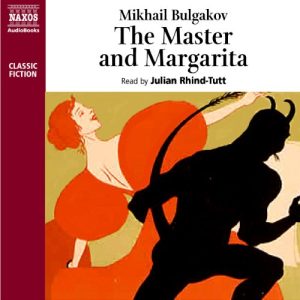
This is Naxos's careful abridgement of a newer translation, read by Julian Rhind-Tutt, and it covers the essential architecture of one of the 20th century's most structurally unusual novels: Satan arriving in Stalin-era Moscow under the name Woland, exposing the comfortable hypocrisies of Soviet society, while a parallel narrative in biblical Jerusalem follows Pontius Pilate through his encounter with Yeshua Ha-Notsri.
First, the Big Picture
Bulgakov wrote this novel over twelve years and never saw it published in his lifetime. That context matters because the book carries the weight of a work written with no expectation of an audience, it's dense, personal, and structurally uncompromising. The comedy is savage, the supernatural elements operate on their own logic, and the Jerusalem sections feel like they belong to an entirely different, more austere novel. What's remarkable is that Bulgakov makes all of it cohere.
Julian Rhind-Tutt is an excellent casting choice. He brings a dry, charismatic intelligence to Woland's scenes and navigates the book's tonal shifts, from absurdist farce to genuine pathos, without overplaying either register. For a novel that requires a performer to embody both demonic menace and comic timing, Rhind-Tutt lands it.
Why Listen to The Master and Margarita
The audiobook format does something interesting for this particular novel. Bulgakov's prose is dense with cultural and literary references that a first-time reader might bog down in on the page. Rhind-Tutt's delivery keeps the narrative momentum alive in a way that lets you ride the surface of the novel first and reach back for the depth later. Listeners who found the novel intimidating in print often report that hearing it helps the structure click.
The eight-hour-and-twenty-one-minute runtime is the consequence of abridgement from a novel that runs considerably longer in full. Something is always lost in abridgement, and a native Russian reviewer in the available reviews notes that this translation doesn't fully capture Bulgakov's style for them. Both observations are fair caveats. But as an entry point into the novel's world, this production earns its place.
A Few Reservations
New listeners should know that the Moscow and Jerusalem storylines don't initially seem connected, and the novel commits to that dissonance for a long time before the relationship between them becomes clear. If you find yourself confused in the first two chapters, that's expected, the book is designed to disorient before it illuminates. Trust the structure.
The translation question is worth acknowledging. This production uses a newer translation rather than the Ginsburg or Pevear and Volokhonsky versions that many scholars prefer. The audiobook doesn't advertise which translation is used in the synopsis, which is a genuine omission for a novel where translation choices carry significant weight.
Should You Listen to The Master and Margarita?
Ideal for literary fiction listeners who want to experience one of Russian literature's most celebrated novels without committing to the full unabridged text as a starting point. Also excellent for anyone who enjoys novels that work simultaneously as political satire, supernatural fiction, and philosophical inquiry. Readers who loved Bulgakov's The White Guard, or who enjoy the tonally layered quality of Kafka or Borges, will find much to appreciate here.
The novel also rewards listeners with some background in early Christian history or New Testament scholarship, since the Jerusalem sections work on multiple levels simultaneously. Bulgakov's Pontius Pilate is a fully realized human being wrestling with a decision whose consequences he understands too late, and the audiobook gives those sequences the gravity they require.
Those who want complete fidelity to the source material should treat this as a preview and seek out an unabridged edition afterward. And if you have strong feelings about translation, as many Bulgakov readers do, research the specific translation used before purchasing.
Before You Listen
Is this the abridged or unabridged version of The Master and Margarita?
This is Naxos's abridged production, running about 8 hours and 21 minutes. The full novel runs considerably longer. The abridgement covers the essential narrative but condenses some scenes and subplots.
Which translation is used in the Naxos audiobook?
The synopsis describes it as 'a new translation' but does not specify the translator by name. This is a notable omission for a novel where translation choices, Ginsburg versus Pevear and Volokhonsky being the two most discussed in English, matter considerably to informed readers.
Do I need background in Soviet history to follow the Moscow storyline?
Basic awareness that Stalin-era Moscow was defined by conformity, surveillance, and ideological enforcement helps the satire land, but the novel is written to be comprehensible without specialist knowledge. The absurdism functions even if you miss some of the specific targets.
Should I listen to this before or after reading the novel in print?
Either order works. Listeners who found the print version hard to penetrate often report that Rhind-Tutt's narration helps the structure click. Print readers who want to experience the novel differently find the audio version a fresh angle on familiar material.