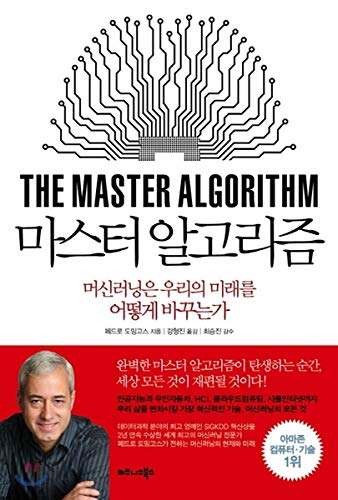
I first encountered The Master Algorithm at a point when machine learning was just beginning to appear in mainstream conversation, and I was trying to understand the gap between what was actually being done in the field and what the popular press was describing. Pedro Domingos's book was the most useful single volume I found. Not because it is simple, it is not, but because Domingos is genuinely trying to explain something real rather than popularize a simplified version of it, and the difference between those two projects is enormous in a field that has been badly served by hype.
Domingos is a professor of computer science at the University of Washington and one of the field's most decorated researchers, having won the SIGKDD Innovation Award twice. He wrote The Master Algorithm with the specific aim of making machine learning comprehensible to a broad audience, including those without mathematical training, while retaining the intellectual honesty the subject demands. The book is organized around the five major tribes of machine learning, the symbolists, connectionists, evolutionaries, Bayesians, and analogizers, each named for the biological or mathematical metaphor at the center of their approach. Domingos's central argument is that the Master Algorithm, a single universal learner capable of learning anything from data, is theoretically possible and that the five tribes are each working toward it from different directions.
The tribal metaphor is one of the book's most useful structural devices. Rather than presenting machine learning as a unified field with a single coherent approach, Domingos shows it as a contested intellectual landscape where different foundational assumptions lead to genuinely different methods. A symbolist, working from logic and rule-based systems, approaches a learning problem completely differently from a connectionist building neural networks inspired by the brain's architecture. Understanding why these differences exist, and what each approach gets right that the others miss, gives the listener a genuine purchase on why the field is complex rather than a false sense of having grasped it.
The book was published in 2015, which means it predates the explosive development of large language models and the current generation of AI systems that have captured public attention. Domingos's focus on the theoretical framework underlying machine learning remains relevant as context even as the specific applications have evolved far beyond what the book describes. Listeners seeking an up-to-date account of current AI capabilities will need to supplement this with more recent material. Listeners seeking to understand the conceptual foundations that make current AI possible will find The Master Algorithm indispensable.
What Works
Technical nonfiction audiobooks live or die by whether the narrator can maintain the listener's conceptual tracking across dense passages without losing the thread of the argument. Mel Foster is a reliable and experienced narrator of nonfiction, and his work on The Master Algorithm reflects that experience. He handles Domingos's more mathematical passages with the measured pace they require, giving the listener time to process before moving forward, while keeping the argumentative sections at a pace that maintains momentum.
At 13 hours and 3 minutes, the book is substantial. It is not a background listen. The concepts require active engagement, and Foster's narration is calibrated to support that engagement rather than to make the book feel easier than it is. The 4.4 rating across more than 5,000 listeners reflects a readership that came with genuine intellectual intent and found the experience worth the effort.
What to Watch For in The Master Algorithm
The book's greatest strength is its honesty about what machine learning cannot yet do and about the genuine philosophical puzzles that the pursuit of artificial general intelligence raises. Domingos does not promise that the Master Algorithm is around the corner or that its development will be straightforwardly good for humanity. He is clear that a machine that can learn anything from data is a transformative technology whose implications we do not fully understand.
Where the book shows its age is in its treatment of neural networks and deep learning as one tribe among five rather than as the dominant paradigm they have become since 2015. Listeners returning to this book after the developments of recent years will find that Domingos's theoretical framework remains valuable even as the practical landscape has shifted dramatically. That is actually the sign of genuinely good science writing: the framework survives even when the specifics need updating, because it was built on conceptual foundations rather than on the current state of the art.
Who It's For
General readers who want to understand why machine learning is consequential and what actually distinguishes it from conventional programming will find The Master Algorithm worth the commitment. Readers with technical backgrounds may find the explanatory scaffolding more extensive than they need, but Domingos's choices about what to emphasize are interesting enough that even specialists typically find value in his framing. The best approach to the 13-hour runtime is active and incremental: a few hours at a time, with space between sessions to let the material settle. The book rewards that kind of attention in ways that straight-through listening does not fully capture.
Listeners who finish The Master Algorithm curious to go deeper will find that Domingos's framing opens doors to more technical treatments of the subject. The book is explicitly designed as a gateway rather than a destination, and it succeeds at that function better than most popular science writing does, partly because Domingos is honest about what he is simplifying and why. That intellectual honesty is the rarest quality in popular science, and it is what makes this book worth the investment of nearly 13 hours.
Common Questions
Does The Master Algorithm require mathematical background to follow?
Domingos writes explicitly for non-mathematically trained readers and explains concepts through analogy and example rather than formal notation. Some passages are conceptually dense and require slow engagement, but formal mathematical knowledge is not a prerequisite.
Is the book out of date given how rapidly AI has developed since 2015?
The specific applications have evolved significantly since publication, particularly with the rise of large language models. But Domingos's conceptual framework, especially the five tribes structure and the theoretical argument for the Master Algorithm, remains useful foundational context for understanding current developments.
What does Domingos mean by the Master Algorithm?
The Master Algorithm is Domingos's term for a hypothetical universal learning algorithm capable of learning any skill or knowledge from data, regardless of domain. His argument is that such an algorithm is theoretically achievable and that the field's various approaches are partial approximations of it.
How does Mel Foster handle the denser technical passages in the narration?
Foster takes a measured pace through conceptually complex material, giving listeners space to process each idea before the argument moves forward. This deliberate approach works well for a text that requires active intellectual engagement rather than passive listening.