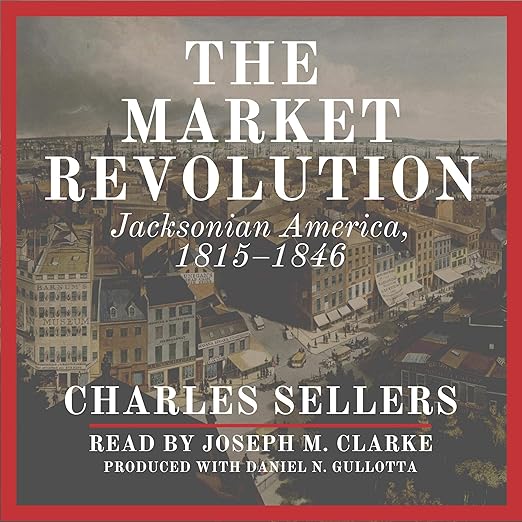
The Market Revolution
Audiobook & Ebook

The Market Revolution by Charles Sellers | Free Audiobook

By Charles Sellers

Narrated by Joseph M. Clarke

🎧 26 hours and 31 minutes 📘 Charles Sellers 📅 January 10, 2019 🌐 English
🎧 Listen Free on Audible 📖 Read on Kindle

Free 30-day trial · Cancel anytime

About This Audiobook

In The Market Revolution, one of America’s most distinguished historians, Charles Sellers, offers a major reinterpretation of a pivotal moment in United States history. Based on impeccable scholarship and written with grace and style, this volume provides a sweeping political and social history of the entire period from the diplomacy of John Quincy Adams to the birth of Mormonism under Joseph Smith, from Jackson’s slaughter of the Indians in Georgia and Florida to the Depression of 1819, and from the growth of women’s rights to the spread of the temperance movement. Equally important, he offers a provocative new way of looking at this crucial period, showing how the boom that followed the War of 1812 ignited a generational conflict over the republic’s destiny, a struggle that changed America dramatically.

Sellers stresses throughout that democracy was born in tension with capitalism, not as its natural political expression, and he shows how the massive national resistance to commercial interests ultimately rallied around Andrew Jackson. An unusually comprehensive blend of social, economic, political, religious, and cultural history, this accessible work provides a challenging analysis of this period, with important implications for the study of American history as a whole. It will revolutionize thinking about Jacksonian America.

🎧 Listen Free on Audible

Free 30-day trial · Cancel anytime

Quick Take

  • Narration: Joseph M. Clarke delivers this dense academic history with clarity and measured pacing, making the 26-hour runtime as approachable as the material’s inherent density permits.
  • Themes: Capitalism versus democracy in early American history, Jacksonian populism as resistance to market expansion, religion and social reform as responses to economic disruption
  • Mood: Dense, scholarly, sweeping, and genuinely rewarding for listeners who bring real historical context and patience to it
  • Verdict: A landmark work of American historiography that deserves its reputation, but requires sustained commitment and genuine interest in the antebellum period to deliver its full return.

There are books that sit on a reading list for years, not because you doubt their quality but because you know they will demand more than a casual afternoon and you are not yet ready to make the commitment properly. Charles Sellers’ The Market Revolution was exactly that book for me. I had cited it in a piece about economic history years ago without having read it thoroughly, which is an embarrassing admission I will make once here and not again. When I finally committed to the audiobook, spreading the listening across several weeks of focused morning sessions, it returned the investment with something approaching compound interest. This is what serious historical scholarship does when it is also serious writing.

Published originally in 1991 and now considered one of the seminal works on antebellum American history, this is Sellers’ argument that democracy was not capitalism’s natural political expression but was instead born in fundamental tension with it, a tension that the standard American narrative has long preferred to minimize or ignore entirely. The Jacksonian movement, in his reading, represented a massive popular resistance to commercial interests that transformed the young republic’s character and determined the shape of American politics for generations that followed. That central thesis is not merely a reinterpretation of a historical period. It is a direct challenge to a foundational American story about markets and freedom being complementary and mutually reinforcing forces rather than competing ones.

The Scope and What That Scope Demands

The twenty-six and a half hours of this audiobook reflect a genuinely comprehensive historical sweep that is not rhetorical ambition but actual coverage. Sellers moves from the diplomacy of John Quincy Adams to the birth of Mormonism under Joseph Smith, from Andrew Jackson’s Indian Removal campaigns in Georgia and Florida to the Depression of 1819, from the early temperance movement to the growth of women’s rights organizing in the antebellum period. He connects these threads through a unifying argument about how the commercial expansion that followed the War of 1812 transformed every dimension of American life, spiritual, political, cultural, and economic simultaneously, and provoked resistance across all of them in ways that shaped the politics of the following decades.

This is not a book that makes concessions to readers who want their history as narrative entertainment moving at a comfortable pace. One reviewer who knows the material well called it a slog at times and densely written even while insisting it is entirely worth the sustained effort. Another reviewer suggested limiting it to serious history readers and recommended Daniel Feller’s Jacksonian Promise for anyone who wants a more accessible overview of the same period. Both assessments are fair and not mutually exclusive. The book was written for a scholarly audience first, and the audio format does not change that fundamental orientation.

Sellers’ Thesis as Counter-Narrative

What makes the intellectual commitment worthwhile is the clarity and force of Sellers’ central argument once it comes fully into focus. The standard narrative frames Jacksonian democracy as capitalism’s populist political expression, the common man rising against entrenched Eastern elites with the market as his natural arena of freedom. Sellers inverts this almost entirely. He documents how ordinary Americans, particularly subsistence farmers, artisans, and rural communities not yet integrated into commercial networks, resisted market transformation at every available level, using religious revivalism, political organizing, and community solidarity as tools of resistance against the encroachment of market logic into every domain of daily life they had previously understood as governed by different principles entirely.

That inversion reframes everything it touches. Jackson himself becomes less the champion of the common man in the conventional sense and more the vessel of a genuine popular resistance to what commercial capitalism was doing to the social fabric of American life outside the cities and the commercial corridors. The religious revivals of the period, typically treated as separate cultural phenomena unconnected to economic change, become in Sellers’ reading a form of resistance to the alienation and disruption that market expansion creates in communities not built around commercial logic and not prepared for its consequences.

Joseph M. Clarke and the Challenge of Academic Prose

Clarke’s narration handles demanding academic material with a discipline that earns genuine respect across twenty-six hours. This is technically complex prose to read aloud, full of subordinate clauses, historical specificity, and argumentative density that requires the narrator to maintain listener attention through momentum of delivery rather than through narrative incident or dramatic revelation. Clarke navigates it with enough variation in pacing and emphasis to keep the thread intact during the most compressed analytical passages. Sustaining that level of performance and attention to the material across the full runtime is itself a significant achievement that should not be taken for granted.

Who This Audiobook Serves and Who It Does Not

This is not a gateway into American history for the general listener who wants to start understanding the antebellum period. It is a reward for those who already carry sufficient historical context to appreciate what Sellers is arguing against and why his reinterpretation mattered when it appeared in 1991 and continues to matter in how American political and economic history is understood and taught. For graduate students of American history, for serious history readers who have already worked through more accessible accounts of the Jacksonian era, and for anyone who finds the standard market-friendly narrative of American democracy incomplete or evasive about its own contradictions, this is essential listening. For everyone else, the twenty-six hours will feel precisely as demanding as they are, and the return on that investment will be proportionally reduced by the absence of the contextual foundation the book assumes you already have.

Frequently Asked Questions

Is The Market Revolution accessible to listeners without a strong background in American history?

Prior knowledge is genuinely essential. The book assumes familiarity with the basic timeline and major figures of early nineteenth-century American politics. Listeners without that foundation will find it difficult to track the argument across twenty-six hours. Daniel Feller’s Jacksonian Promise is frequently recommended as a more accessible entry point to the same historical period.

How does Sellers’ thesis about Jacksonian democracy differ from the standard historical interpretation?

The standard narrative frames Jacksonian democracy as capitalism’s populist political expression. Sellers argues instead that Jacksonian politics represented massive popular resistance to capitalist market expansion, particularly among subsistence farmers and artisans threatened by commercial transformation. He presents democracy and capitalism as fundamentally in tension rather than naturally allied, which directly inverts a foundational American political story.

Is the audiobook format effective for a book this academically dense, or is print preferable?

Several reviewers prefer print for a book this complex, noting that the ability to re-read dense passages is valuable and not available in audio format. However, Clarke’s narration handles the academic register clearly, and disciplined morning listening sessions distributed across multiple weeks is a viable and productive approach to this material.

Does the book cover only Jacksonian politics, or does it engage with social and cultural history as well?

It is unusually comprehensive across multiple historical domains. Sellers covers the temperance movement, early women’s rights organizing, evangelical Christianity’s growth, the birth of Mormonism, westward expansion and Indian Removal, and the economic disruptions of the 1819 depression, all unified through his central argument about capitalism’s transformation of American social life during the antebellum period.

Ready to listen?

🎧 Listen to The Market Revolution for free

Free 30-day trial · Cancel anytime

What Listeners Are Saying

★★★★★

One of the seminal works on antebellum US history

For some reason, this marvelous book escaped my reading until recently. Using a multi-disciplinary approach and a free flowing writing style (though full of uncommon words that sent me to the dictionary often enough), Charles Sellers has presented a history of the emergence of the market based capitalist society during…

– Roger H. Anderson
★★★★★

Don’t Go By the One Star Reviews

First and foremost I just got my copy today and am already 20 pages into it, it’s not a difficult read and anyone who’s proficient at a 9th grade level of education shouldn’t have any trouble reading this.Land and Market is the first chapter in this book and it’s impressive….

– Amazon Customer
★★★★★

a must read!

This is one of my favorite books of all time. Most impressive is the sheer breadth and scope of the book. The book is, to be sure, a slog and at times densely written, but it's well worth your time! An incredible look at Jacksonian America.

– M. Melton
★★★★☆

it's lucidly and entertainingly written and provides an excellent overview of the important points of 19th Century American …

While some parts of this book seem a little heavy handed politically for my tastes, it's lucidly and entertainingly written and provides an excellent overview of the important points of 19th Century American history. I could see myself assigning it to students in a 100-level course if I were a…

– Gunlord
★★★☆☆

Think before you purchase

Probably the thing most important word on the era of Jacksonian America and the Market revolution.However, you must be a serious serious history buff to consider this book. It is so profoundly dry that it becomes painful and tedious to read. It is not intended for leisure reading.If you are…

– Somewhat academic

Start Listening: The Market Revolution


Free 30-day trial · Cancel anytime

Alexandra Reed

Written by Alexandra Reed

Founder & Literary Critic