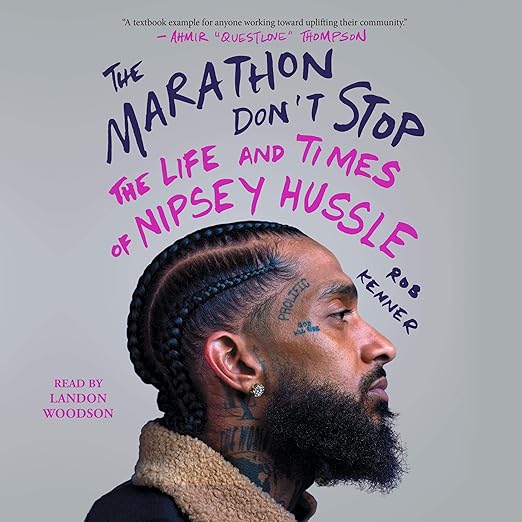
Rob Kenner spent years reporting The Marathon Don't Stop, and that accumulated work is audible in every chapter. This audiobook, running at 12 hours, is the first serious biographical treatment of Nipsey Hussle, the Crenshaw-born rapper, entrepreneur, and community organizer who was shot and killed in front of his own Marathon Clothing store in 2019. Kenner approaches his subject the way the best music journalists approach theirs: with genuine intellectual respect for the art, and equal rigor about the context that produced it.
The title comes from a phrase Hussle used as a mixtape name, a clothing brand, a philosophy. Kenner unpacks what the marathon actually meant to Hussle's thinking: not just persistence as a motivational cliche, but a specific commitment to winning on your own terms while bringing your community with you. That is an easy thing to reduce to a slogan, and Kenner is careful not to. He traces how those ideas developed through Hussle's early years in Crenshaw, his affiliations, his business decisions, and his increasingly visible platform as both artist and activist.
From Boy to Mogul, Skipping the Grief
Kenner's craft comes through in how he structures the biography. He does not open with the shooting and work backward in grief, which would be the easy choice. He builds Hussle chronologically, letting readers arrive at the later chapters with enough investment in the person that the cultural loss becomes specific rather than abstract. Reviewer Viceroy Andrews Jr. praised the book as thorough and engaging, noting that Kenner plots Nipsey Hussle's trajectory from his early years as a boy well into his transition to becoming a man, leader, mogul, gangster, visionary, and humanitarian. That arc is the biography's central achievement.
The hip-hop historical context Kenner provides is substantial and never feels like padding. Understanding where Hussle's music sits in relation to West Coast rap traditions, and how his independent business model represented a conscious departure from major-label structures, requires listeners to understand the landscape he was operating in. Kenner supplies that context without becoming academic, which is harder than it looks.
Woodson Narrates While Quincy Jones Applauds
Landon Woodson narrates with a clarity that suits the material. He does not perform Hussle's cadences or try to capture the feeling of the music through voice alone; instead, he gives Kenner's journalistic prose a directness that keeps the 12-hour runtime moving. The book includes reporting from interviews with people close to Hussle, and Woodson handles the transition between Kenner's narration and quoted material fluidly, which matters for a biography this dense with first-person sources.
The endorsement from Quincy Jones, who called the book a beautiful tribute to a legendary artist, and Kevin Powell's description of it as belonging alongside the best biographies ever about iconic figures we have loved and lost, are the kind of blurbs that can feel like marketing. In this case, they are accurate. Kenner writes about music biography as a form, not just about Nipsey Hussle as a subject, and the result is a book that holds up against serious comparison to the genre's best work.
Owning His Masters, Anchoring the Neighborhood
Listeners who come to this audiobook primarily as hip-hop fans wanting an intimate portrait of Hussle as an artist may find the structural and historical emphasis occasionally pulls focus from the personal. Kenner is a journalist first, and the biography's texture comes from reported scenes and interviews rather than psychological speculation. You get the decisions Hussle made and the ideas he held; the interior emotional life is more inferred than excavated.
The book also does not shy away from the contradictions in Hussle's story, including the gang affiliations and the ways in which some of his community investments required navigating deeply complicated relationships with the streets he was trying to help. Kenner handles these honestly without turning them into either condemnation or hagiography, which is the right approach. But listeners expecting a purely celebratory portrait should know the biography is more complicated than that.
Kenner's access to sources close to Hussle gives the biography a granularity that distinguishes it from more surface-level celebrity accounts. The chapters covering Hussle's formative years in Crenshaw, his early affiliations, and his gradual shift toward entrepreneurship as a response to the limitations he saw around him are particularly strong, drawing on interviews that clearly took significant time and trust to secure. That reporting infrastructure is audible throughout the audiobook, in the specificity of the details and the way Kenner handles contradictory accounts of the same events without papering over the contradiction.
The book also places Hussle in a longer tradition of artists who used cultural production as a vehicle for community building, and that historical framing extends the audiobook's relevance beyond listeners who came for the hip-hop biography. The business decisions Hussle made, particularly around ownership of his masters and the Marathon Clothing store as a neighborhood anchor, anticipate conversations that have only become more central to hip-hop culture since his death. Kenner's decision to cover these in depth rather than treating them as footnotes to the music gives the biography a forward-looking dimension that hagiographic accounts tend to miss.
Community Economics Fans Will Value This Too
Hip-hop fans with serious interest in the genre's history and business dimensions will find this audiobook rewarding and rigorous. Listeners interested in community economics, the intersection of art and activism, and the specific landscape of South Los Angeles will find Kenner's contextual reporting particularly valuable. General biography readers who do not follow hip-hop can still engage with this if they are willing to absorb some context. Those who want a quick emotional tribute rather than a deeply reported account may prefer to start with the music itself and return to the book when they are ready to go deeper.
Questions Listeners Ask
Does this audiobook require prior knowledge of Nipsey Hussle's music to appreciate?
No. Kenner provides sufficient context about the music, the era, and the West Coast hip-hop landscape that listeners new to Hussle can follow the biographical and historical argument without prior familiarity. Existing fans will find additional depth, but it is not a prerequisite.
How does The Marathon Don't Stop audiobook handle the circumstances of Hussle's death?
Kenner does not open with it or use it as the primary frame. The shooting is covered in context, as part of the full arc of Hussle's story. The approach is journalistic rather than sensationalized, which gives the material more weight rather than less.
Is this audiobook primarily about the music, or does it cover the business and community work in equal depth?
All three dimensions get substantial attention. Kenner treats Hussle's entrepreneurial thinking, his community investments in Crenshaw, and his music as interconnected parts of the same project. The business and community material is as rigorously reported as the musical analysis.
At 12 hours, does this audiobook sustain its pacing throughout?
The pacing is consistent with the journalism-based biography format: detailed and sometimes dense, but always purposeful. Listeners who prefer lighter biographical touch may find certain sections information-heavy, but reviewers consistently describe the book as engaging from beginning to end.