Quick Take
- Voice: Jason Wilson reads his own book, and the self-narration is the right choice, the ten characteristics of the comprehensive man he outlines carry more authority in his own voice, and his personal testimonies throughout land with directness that an actor couldn't replicate.
- Big ideas: rejecting distorted masculinity, emotional intelligence as strength rather than weakness, the ten roles of the comprehensive man
- Atmosphere: Earnest, personal, and practically oriented
- Worth it?: A Christian-framed but broadly accessible examination of modern masculinity that offers a more nuanced framework than most books in this space, the personal testimony throughout gives it weight beyond the conceptual.
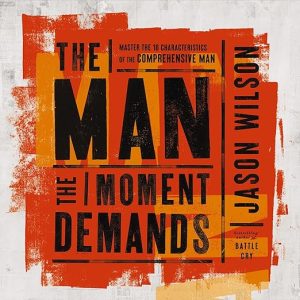
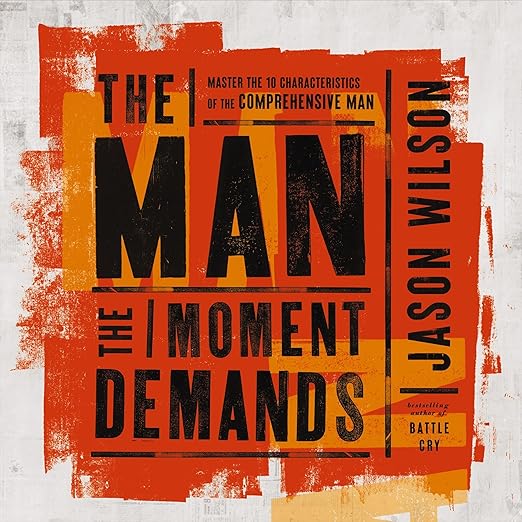
Books about masculinity and manhood occupy a spectrum that runs from clinically useful to ideologically exhausting, and I approach new entries in the category with calibrated skepticism. Jason Wilson's The Man the Moment Demands lands closer to the useful end than I expected. I listened to it over three evenings and came away with a clearer sense of what distinguishes this work from the crowded field it enters: Wilson is not interested in posturing. He is interested in what he calls emotional incarceration and how men might get out of it.
Wilson is the founder of the Cave of Adullam Transformational Training Academy, a Detroit-based organization that works with young men, and that practical experience is visible throughout the book. He is not theorizing from the outside. He is describing what he has seen fail and what he has seen work.
The Ten Characteristics of Wilson's Comprehensive Man
The book's organizational framework is the ten characteristics of what Wilson calls the comprehensive man: the Fighter, the Provider, the Leader, the Lover, the Nurturer, the Gentleman, the Friend, the Husband, the Father, and the Son. These categories are deliberately not presented in hierarchy, Wilson's point is that the alpha-male mythology that has captured much discourse about masculinity is based on selecting one or two of these roles and inflating them to total identity. The comprehensive man is someone who can inhabit all ten depending on what the moment requires.
The most useful thread running through the book is Wilson's argument about emotional expression. He is explicit that the suppression of feeling is not stoicism, it is incarceration, a word he uses deliberately. The ability to express the full spectrum of emotions while maintaining self-control is not softness in Wilson's framework; it is the prerequisite for every other characteristic on his list. One reviewer noted that Wilson provides personal testimony about his own journey throughout, and those sections are where the book is most effective, the framework becomes convincing because it is illustrated through lived experience, not just described as an ideal.
Narration That Reaches Beyond Religious Lines
Wilson's self-narration gives the book an intimacy that suits the content. The sections where he describes his own failures and the moments that required him to become something different from what his cultural conditioning had prepared him to be benefit enormously from being in his actual voice. The production is clean and the pacing is consistent across six-plus hours, this is not a perfunctory self-help audiobook, and it doesn't sound like one.
Multiple reviewers highlighted the book's accessibility to men regardless of religious affiliation, which is worth noting. The framework is explicitly informed by Christian teaching and Biblical principle, and that is not concealed. But the practical content, the ten characteristics, the critique of alpha-male mythology, the argument about emotional intelligence, carries across denominational lines and, based on reviewer testimony, to men with no religious affiliation at all. One reviewer bought additional copies to give to men in his community, which is the most concrete endorsement this category gets.
Written for Men in a Christian Voice
The book is explicitly addressed to men, and the voice and examples reflect that. Listeners approaching it from outside that address, women reading it to understand something about the men in their lives, for instance, will find it useful as a window but will occasionally encounter passages that assume a male listener navigating specific internal pressures.
The Christian framework is present throughout. Wilson does not write in a secular register, and readers who are uncomfortable with Biblical reference as argument will encounter it consistently. The reviewers who found the book broadly applicable note that the faith content is integrated rather than separable, Wilson doesn't offer a secular version of his framework alongside the religious one.
Faith-Informed Growth for Fathers and Believers
Well suited for: men who feel the inadequacy of dominant masculinity discourse but haven't found an alternative framework they can use, fathers who want a language for what they're trying to model, men in Christian communities who want faith-informed personal development that doesn't reduce to performance, and readers who appreciate author-narrated nonfiction where personal testimony is central to the argument. Less suited to listeners seeking a secular self-help framework or those who find Biblical framing alienating rather than neutral background.