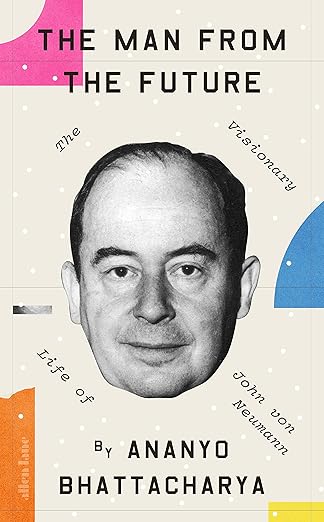
John von Neumann's fingerprints are on so many of the structures that define contemporary life that a biography covering the full scope of his work necessarily reads as an intellectual history of the twentieth century as much as a portrait of one man. Ananyo Bhattacharya's The Man from the Future, narrated by Nicholas Camm, sets out to map that scope across nearly 14 hours, moving from von Neumann's Budapest childhood and his early mathematical work through the Manhattan Project, the formulation of game theory and Cold War geopolitics, the construction of the first programmable digital computer, and the deathbed reflections on the relationship between brains and computing that anticipated neural network research by decades. This audiobook is the biography that von Neumann's legacy has been waiting for.
Von Neumann is one of those figures whose contributions are both foundational and strangely invisible. Reviewer JohnT compared him to Leonardo da Vinci as a figure of equivalent breadth and importance, noting that his major contributions to quantum mechanics, early computing, and modern economic theory have been surpassed by few people in history. Reviewer Franco described him as the most intelligent person ever known in the human story, which is the kind of assessment that tends toward hyperbole but which the biographical record makes oddly plausible. Bhattacharya's task is to make the scope of that record accessible without either flattening the mathematics into analogy or losing the human being inside the intellectual achievement.
Nicholas Camm's narration is a careful match for Bhattacharya's prose. The biography is written for an educated general audience, technically honest without requiring specialist background, and Camm delivers it with the kind of measured enthusiasm that characterizes good science journalism read aloud: interested in the material without overclaiming wonder, precise without becoming pedantic. The quantum mechanics sections, the most technically demanding of the biographical periods, benefit from Camm's willingness to follow Bhattacharya's analogies at their own pace rather than rushing through the mathematics to get back to the narrative.
The Cold War sections are where the biography generates its most unsettling territory. Von Neumann was not merely an observer of mid-century geopolitics but an architect of some of its more extreme strategic frameworks, including positions on nuclear preemption that would have been catastrophic if implemented. Bhattacharya handles this without either excusing the positions as products of their time or condemning them as evidence of a moral deficiency. The result is a portrait of a man whose intellectual generosity and political recklessness coexisted without the one negating the other, and Camm's steady narration allows that complexity to register without editorializing.
The Strengths
At nearly 14 hours, the audiobook has the room to follow von Neumann's work into genuine depth in each domain rather than summarizing contributions that deserve extended treatment. The game theory section, which covers the foundation of a discipline that now underlies fields from evolutionary biology to international relations, gets the kind of extended treatment that shorter biographies cut for pacing. Reviewer Yass called the book one that makes you fall in love with learning, and that response comes specifically from Bhattacharya's willingness to let each intellectual territory open fully before moving on.
The audio format serves the biographical structure particularly well because von Neumann's career was organized around institutional and social contexts, the Budapest mathematical culture of his youth, the Princeton Institute for Advanced Study, Los Alamos, the early computer projects, that are easier to inhabit in audio's linear time than to track across the spatial layout of a printed page. Camm keeps the institutional geography coherent across the full runtime, so that when the Manhattan Project section arrives, the listener already understands what network of relationships and obligations brought von Neumann to that work.
What to Watch For in The Man from the Future
Listeners approaching without any mathematics background will find the quantum mechanics and early computer architecture sections require more active attention than the biographical narrative sections. Bhattacharya writes these passages as accessibly as the material allows, but the audiobook format means there is no visual diagram to fall back on when the prose analogy does not fully land. The strategic choice to listen with a notepad nearby for the more technical sections is worth considering.
The biography also does not attempt to be a psychological portrait in any deep sense. Von Neumann's interior life, his emotional relationships, his experience of his own intelligence, is rendered from the outside through anecdote and observation rather than from reconstructed inner life. Biographies of mathematicians and scientists often face this limitation, and Bhattacharya does not pretend otherwise. The result is a book that is better at explaining what von Neumann did and why it mattered than at explaining what it was like to be von Neumann, which is an honest trade-off given the available historical record.
The deathbed section, in which von Neumann dictated the Yale Silliman Lectures from his hospital bed while struggling with bone cancer, is one of the most affecting passages in the biography precisely because Bhattacharya is honest about what it costs a mind of that caliber to work under those conditions. The lectures themselves, on the parallels and limits of brains versus computers, anticipated decades of subsequent research in neural networks and computational neuroscience. Camm's narration of those final pages carries the weight of a life's work arriving at its most urgent questions just as the time to answer them runs out.
Recommended For
Listeners interested in the intellectual history of the twentieth century who want a detailed account of how computing, game theory, nuclear strategy, and quantum mechanics all passed through a single mind will find this audiobook essential. The technical sections are accessible without specialist background, and Bhattacharya's framing consistently returns the mathematical work to its human and historical context. Listeners who want biography primarily as personal drama or psychological revelation will find the book's exterior perspective on its subject a limitation. Those who understand intellectual biography as the tracing of ideas through their historical conditions will find nearly 14 hours of consistently illuminating material.
Before You Press Play
- Read by: Nicholas Camm brings a measured intellectual authority to Ananyo Bhattacharya's biography, well suited to a subject whose breadth of contribution requires a narrator who can shift registers from quantum mechanics to geopolitics without losing the thread.
- At its heart: Genius and historical circumstance, the ethics of applied science, the architecture of modern computing
- Vibe: Intellectually exhilarating and, in the Manhattan Project sections, genuinely sobering
- Short version: Bhattacharya's biography of John von Neumann is one of the most illuminating intellectual biographies of the twentieth century available in audio, covering ground that extends well beyond any single discipline.