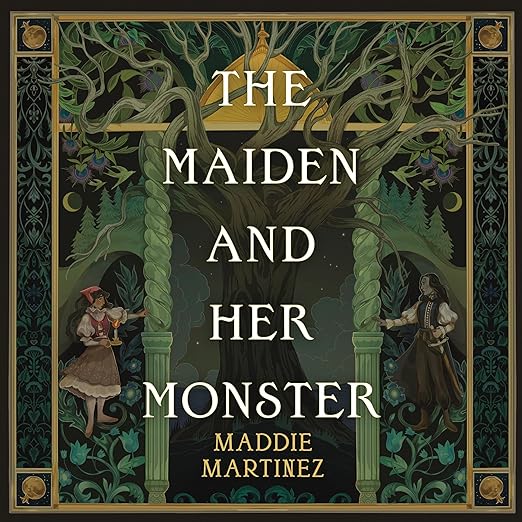
Quick Take
- Narration: Nikki Massoud handles the atmospheric weight of the material well, lending Malka a quiet determination that suits a protagonist defined by impossible choices.
- Themes: Jewish folklore and faith, the nature of stories, complicity and survival
- Mood: Dense and atmospheric, slow-building with genuine moral complexity
- Verdict: An ambitious debut that earns its literary blurbs but demands patient listeners willing to sit with moral ambiguity and a layered folkloric world.
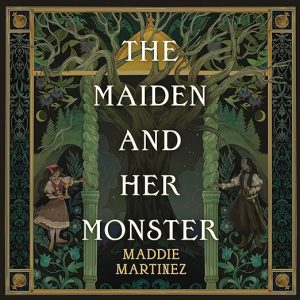
When Samantha Shannon and Ava Reid both blurb a debut novel, the expectations arrive fully loaded. The Maiden and Her Monster had been on my list for months before I finally settled into it on a Saturday morning with nowhere to be. By the time I surfaced several hours later, I had formed a view that is more complicated than the breathless advance praise suggested, and I think that complication is actually a mark in the book’s favor.
Maddie Martinez is doing several things simultaneously here, and not all of them land with equal force. The premise is excellent: Malka, a healer’s daughter in a village suffering under the Ozmini Church’s authority, bargains with a zealot priest to bring him the monster lurking in the cursed forest, or watch her mother be executed for a murder she did not commit. The monster she finds, Maveteh, is a disgraced golem who agrees to implicate herself in exchange for help freeing the rabbi who created her. What follows is a study in two women bound by deals neither of them fully understands, and growing feelings neither of them expected.
Our Take on The Maiden and Her Monster
The literary comparison the book most invites, and which reviewers raised, is Naomi Novik. The Jewish folkloric elements, which Martinez embeds through a culture she calls Yahadi in the narrative, are handled with the specificity that distinguishes genuine research from decoration. One reviewer described the book as a story about stories: how the tales told within Maveteh’s village, around the prince’s birth, about the golem and the curse, weave together to become the story you are inside. That meta-textual quality is real and occasionally beautiful.
The book’s primary weakness, which several reviewers flagged, is density. There are a lot of characters, a lot of place names, and a lot of folktales embedded within the narrative. One reviewer specifically noted the need for a glossary and pronunciation guide, and that is a fair request. On audio, the challenge is amplified: without a physical text to scan back through, keeping track of the full cast requires active attention. Martinez does not make enough concessions to the listener who has lost the thread.
Why Listen to This Audiobook Specifically
Nikki Massoud brings genuine restraint to Malka, which is the right call. This is a protagonist defined by impossible bargains and suppressed fear, and a narrator who oversold the emotion would undermine the character’s particular kind of quiet courage. The atmospheric quality of the prose translates well to audio: the blood-soaked forest, the zealot priest’s cold authority, the strange particularity of a golem who has her own sense of honor all register clearly in Massoud’s hands.
At thirteen hours, this is a deliberate listen. Martinez is building something, and the early sections feel slow as a result. Multiple reviewers noted the pacing, but all noted that the payoff justified the patience.
What to Watch For in the Forest Sections
The dynamic between Malka and Maveteh is the book’s best element. Their sapphic romance is slow-burning in the most literal sense: they are bound together by a practical arrangement, and their growing closeness is given space to develop through shared danger and mutual revelation rather than through conventional romantic beats. Martinez is interested in what it means to form an attachment to a creature you were taught to fear, and the golem’s perspective on her own nature gives the romance an unusual philosophical texture.
One reviewer called this debut novel fully polished and compared its resonance to the contemporary world of nationalism and greed. The Ozmini Church functions as something more than a fantasy antagonist, and listeners who want their dark fairy tales to carry historical weight will find it here.
Who Should Listen to The Maiden and Her Monster
This is for listeners who enjoyed the literary density of Naomi Novik’s Uprooted or Ava Reid’s A Study in Drowning and want something with more explicit folkloric specificity. If you have patience for worldbuilding that reveals itself slowly and do not need a brisk pace to stay engaged, this rewards that patience. Listeners who bounced off dense fantasy casts or who dislike embedded folktale narratives within a larger story should proceed carefully. The sapphic romance is central but not the book’s only or even primary register.
Frequently Asked Questions
Is the Jewish folklore in the book authentic or secondary worldbuilding?
Martinez uses a fantasy analog culture she calls Yahadi rather than naming real-world Judaism directly, but the folkloric elements are clearly drawn from Jewish tradition and appear to reflect genuine research. Reviewers with relevant background responded positively to the specificity.
How graphic is the violence in the forest sequences?
The book deals in genuine darkness. The cursed forest involves real threat and some graphic imagery. The publisher category is adult fantasy, not YA, and the content reflects that. Emotional violence and themes of execution and oppression are present throughout.
Is this the first book in a series?
The Maiden and Her Monster is published as a standalone debut. The ending resolves the central narrative, though the world Martinez has built is rich enough to support further stories.
Does Nikki Massoud distinguish the golem character Maveteh vocally from Malka?
Yes. Massoud gives Maveteh a distinct cadence that reflects the character’s non-human quality without making her alien or unsympathetic. The differentiation is subtle but consistent throughout the audiobook.