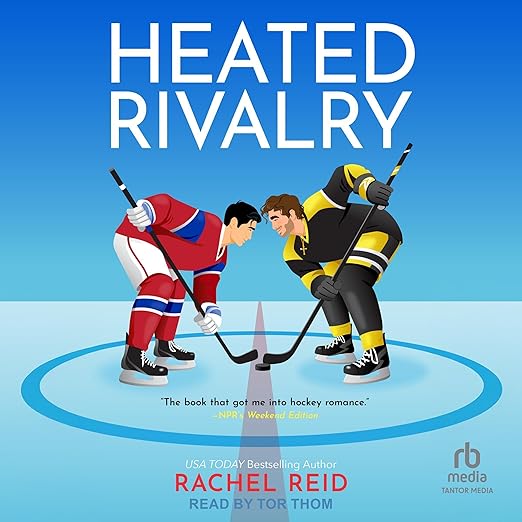
Hockey supplies the structure and the alibi. Shane Hollander captains the Montreal Voyageurs and has a spotless reputation; Ilya Rozanov captains the Boston Bears and has the opposite of one, and the rivalry the sports press has built between them is perfect cover for what happens when the skates come off. Rachel Reid's second Game Changers book runs nine hours and thirty-two minutes as an audiobook, and Tor Thom is the credited reader. The premise is doing more work than the sports setting suggests: two men whose careers depend on being publicly legible are conducting the least legible thing in their lives in hotel rooms.
Two Captains Risk Everything to Keep This Secret
Concealment is the engine, and it runs on something better than a misunderstanding. Neither man is hiding out of cowardice; both are captains, both are the public face of a franchise, and the description is explicit that exposure could ruin them both. That turns every private scene into a risk calculation and gives the yearning an actual price, which is what separates this from enemies-to-lovers books that manufacture obstacles and then dissolve them. When Ilya realizes he wants more than a few secret hookups, the copy says he knows he must walk away. His obstacle is the world, not a plot device.
Sports writing in romance often stops at the uniform. Here the league is load-bearing: Shane's captaincy is the thing he protects, Ilya's self-proclaimed kingship of the ice is the persona he cannot put down, and the legendary rivalry the two of them have built is a professional asset for both clubs. Take the hockey out and you lose the reason concealment is rational. The description puts it plainly enough by opening on the claim that nothing interferes with Shane's game, a line about priorities as much as about sport.
The Show Came First, the Books Supply the Thinking
Television changed who arrives at this page. A five-star from early 2026 says outright that the show came first and the books second, and credits the books with something the screen could not supply: access to what the two of them are actually thinking. It calls the book hot without qualification, which is useful as a content signal, since the publisher copy gestures at heat without ever naming a level. That entry also breaks off in mid-word while looking ahead to a seventh book, which is your first clue that Game Changers runs a good deal further than the numeral on this listing.
Enemies to Lovers, Read as Far as Spain
Trope literacy pays off here. A five-star filed from Spain names the machinery precisely: enemies to lovers, a hidden romance assembled in hotel rooms, and a pace that carried that reader through the whole thing in one sitting before sending them on to the rest of the saga. It is written in Spanish, on an English-language page, which tells you something about how far this series has traveled. The tropes are not a complaint. They are the promise, and the book delivers them in roughly the order the label implies.
Thom Carries Two Personas and a Russian Accent
Spoken aloud, a story built on two people lying by omission changes shape. On a page, an unspoken thought sits in white space; read out, it has to be carried by the same voice that delivered the public version of the same man in the same scene minutes earlier. That is a specific technical demand, and it is why single-reader dual-perspective romance either works completely or does not work at all. Nine hours and thirty-two minutes gives the arrangement room without stretching it, and the premise has no padding to skip past.
Nine and a half hours falls to one voice, and the assignment has three demands stacked inside it. Tor Thom has to hold two point-of-view characters who spend the book performing versions of themselves for cameras, has to carry a Russian speaker without tipping into caricature, and has to read explicit scenes at a register that neither rushes nor smirks. Nobody who has written here addresses the recording at all. Fifty-five people have graded the title, and the column beneath the grades is about printed books and a television series.
Years of Story, Reviewed Only After the TV Show
Reservations exist, and a four-star carries the sharpest one. That entry describes being torn: real affection for Shane and Ilya as characters, real enjoyment of the yearning and the rivalry, then a flat admission of wanting more. It also supplies a structural fact the publisher copy withholds, which is that the book covers years, opening with the two of them meeting at seventeen and running forward through their arrival in the NHL and into adulthood. Years is a long span for nine and a half hours, and it explains the complaint. Compression is the price of that timeline.
Timing on this page deserves a look before you trust the reception. Audio arrived in October 2019, and every written entry visible here was filed inside a three-month window six years later. What you are reading is not a record of how the recording landed on release; it is a record of what happened after an adaptation sent people looking for the source. Nothing about that is dishonest, but it changes what five entries can tell you, because they describe readers who arrived with the show already in their heads.
Series position is the practical trap. This is book two of Game Changers, the listing supplies the number and nothing else, and no note anywhere says whether the earlier book is required first. One of the five entries is four words long, which puts the thinness of parts of that 4.7 in perspective. Buyers who care about reading order will have to research it away from this page, because the page itself offers a series name, a numeral, and no map.
Sports Romance Readers Get the Closet Taken Seriously
Sports romance readers who want the closet treated as a genuine professional problem, and not as a tidy misunderstanding, should start here, particularly if you like your yearning to run for years before resolving. It suits listeners who came in from the adaptation and want the interior monologue a camera cannot supply, and it suits anyone who reads enemies-to-lovers for the rivalry more than for the reconciliation, since the rivalry gets the better material here.
Explicit content arrives with no advisory on this listing, so anyone wanting a low-heat romance should treat the hotel-room framing in the description as understatement. Listeners who need a fully self-contained story will find the years-long span and the unexplained series numbering frustrating. Newcomers who have not seen the show may also want to know that most of the enthusiasm collected here comes from people who had. Take it as a strong installment in a long series, graded by an audience that found it late and loved it anyway.
Quick Take
- Narration: Tor Thom is the only credited voice, so both captains and every explicit scene arrive from one reader across nine and a half hours.
- Themes: Enemies to lovers, closeted athletes, secret relationship, professional risk, sports rivalry
- Mood: Charged, secretive and slow-burning
- Verdict: A sports romance where hiding is a career calculation and not a plot excuse, though a years-long timeline leaves some scenes compressed.
Do I need the first Game Changers book before this one?
The listing supplies a series name and the number two and no guidance past that. The central premise is set up inside this book, since the rivalry between the two captains is established here, but nothing on the page confirms which characters or events carry over. Anyone who cares about reading order will need to check elsewhere.
How explicit is the Heated Rivalry audiobook?
Plan for a high heat level. The description builds the relationship out of secret hookups and nights spent awake over a rival's body, and no content advisory appears anywhere on the listing. Nothing in the copy suggests the scenes fade out, so expect fully explicit material inside a story that is otherwise about restraint.
What does the Heated Rivalry audiobook give you that a screen adaptation cannot?
Interior access. Both men spend the story managing what other people are permitted to see, and prose can put a listener inside that calculation while a camera can only film the result. The running time is a long stretch to spend inside two heads that are lying to nearly everyone.