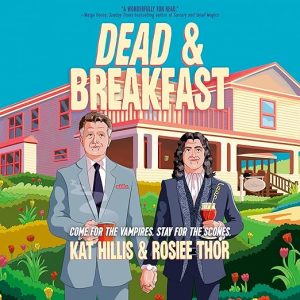
Cozy mystery worldbuilding succeeds when its internal logic is airtight, and the Dead & Breakfast audiobook builds one of the more carefully considered paranormal ecosystems I have encountered in this genre. Arthur and Sal, the vampire innkeepers at the center of Kat Hillis's debut mystery, wear sunscreen, eat garlic - though it gives Sal indigestion - and maintain friendly if one-sided relationships with the local raccoons, the only creatures they can actually communicate with. The specificity of these constraints is what separates inventive fantasy worldbuilding from generic monster-with-quirks storytelling, and Hillis has clearly thought hard about what it would actually mean to be a vampire running a B&B in small-town Oregon.
Running a Bed and Breakfast as an Actual Vampire
The setup rewards the kind of reader who enjoys watching a writer follow their premise to its logical conclusions. If you are a vampire who cannot go out in direct sunlight, running a bed and breakfast - a hospitality enterprise built around human arrival and departure rhythms, typically in daylight - is an act of creative problem-solving. If you have replaced human social connection with raccoon conversation, your relationship with your guests has a particular quality of managed distance. And if the mayor turns up dead in your begonias with two puncture wounds, the fact that you are, in fact, a vampire means your window for being taken seriously as an investigator is approximately zero.
Daniel Henning's narration handles the comic timing of this premise with a light touch that avoids mugging. The humor in Hillis's prose is dry and observational rather than broad, and Henning matches that register. Arthur's narrative voice in the audio has a quality of mild, persistent astonishment at the situation he finds himself in - which is exactly right for a vampire who has managed to be surprised by ordinary human chaos after centuries of existence. The LGBTQ+ marriage at the center of the story is treated as entirely unremarkable by the narrative, which is its own kind of statement: these two men have been together long enough that their dynamic is settled, their affection expressed in bickering and competence rather than grand romantic gesture.
The supporting cast - the werewolf barista, the elven coroner, the entirely human city manager who is probably having a very strange week - gives Hillis room to sketch a town that has apparently accommodated the supernatural for long enough to have developed functional protocols. That background texture is what distinguishes Trident Falls from a generic paranormal setting.
Henning's Pacing Keeps the Investigation Moving
The audiobook format suits the cozy mystery pacing well. Henning keeps the investigation moving without rushing the atmospheric beats that give Hillis's world its texture. The mystery itself - who actually killed the mayor, and why the puncture wounds were placed to frame the only literal vampires in town - is fairly plotted and resolves with the satisfying click that the best cozy mysteries deliver. Reviewer SC's description of it as 'full of larger-than-life characters and bursting with humor' captures the tone accurately.
The LGBTQ+ representation is organic rather than announced. Arthur and Sal's marriage is the relationship at the center of the story not because it is the point the book wants to make, but because they are the protagonists and they are married. Their dynamic is affectionate and functional in the way long partnerships are - they know each other's rhythms, they compensate for each other's weaknesses, and they get on each other's nerves in specific and recognizable ways. Henning's narration gives both of them distinct vocal qualities without overplaying the differentiation.
This is a first-in-series entry that establishes a world and a tone without front-loading too much mythology or backstory. Hillis trusts the reader to absorb the rules of Trident Falls through immersion rather than exposition, and Henning paces the disclosure well. By the time you reach the investigation's midpoint, you understand the social and supernatural topology of the town without having been lectured about it.
Debut Seams Show, but the Raccoons Still Underused
The mystery plotting, while satisfying, is not particularly complex. The satisfaction is textural and tonal rather than puzzle-based. Listeners who approach cozy mysteries primarily as whodunits with red herrings to track will find the investigation somewhat straightforward. The genre pleasure here is atmospheric and character-driven; the resolution matters, but the journey to it is the real offering.
Reviewer Gina's note that it is 'ok for a first novel' is both fair and worth contextualizing. The debut novel seams are visible in places - the pacing slightly uneven in the middle section, some supporting characters sketched more thinly than the central pair. These are first-book issues that typically resolve in subsequent entries, and the foundation Hillis has built in Trident Falls is strong enough to support a longer series.
The raccoon communication detail, while delightful in concept, is underused in the actual narrative. It establishes something important about Arthur and Sal's isolation from ordinary human social connection, but the raccoons themselves do not contribute much to the mystery plot. This feels like setup for future payoff rather than a limitation of this book specifically.
Fans of Henning's Ensemble Work in Trident Falls
Cozy mystery listeners who enjoy paranormal settings will find this a strong new-series entry. If you have worked through the obvious paranormal cozy options and are looking for something with its own distinct flavor, the sunscreen-wearing, garlic-digesting, raccoon-whispering vampire innkeepers of Trident Falls offer a genuinely fresh variation. Hillis's internal logic is consistent in a way that paranormal cozy writers sometimes sacrifice for easy plot solutions.
LGBTQ+ readers looking for cozy mysteries where queer characters are simply the protagonists - not the subject of a coming-out arc or a community-under-threat narrative - will find this a comfortable and enjoyable listen. Arthur and Sal's marriage is the relationship architecture of the story, full stop. Their queerness is not an obstacle or a theme; it is just who they are.
Fans of Daniel Henning's narration will want to hear how he handles an ensemble paranormal cast, and the answer is: well. He gives the town of Trident Falls a vocal consistency that helps listeners track the social dynamics of a place that is apparently quite used to its werewolf baristas and elven coroners.
I would also suggest this for readers who enjoy the British cozy tradition - gentle humor, community setting, murder as a social problem rather than a horror - but want a thoroughly American Pacific Northwest atmosphere. Trident Falls has the rain and the coffee culture and the mild collective eccentricity that the Oregon coast delivers, and Hillis uses that setting effectively.
At a Glance
- Voice: Daniel Henning's dry, measured delivery matches Hillis's observational humor perfectly - gives Arthur a quality of mild astonishment that lands every time
- Big ideas: Paranormal community, LGBTQ+ partnership, identity and belonging, the social logistics of being literally a vampire
- Atmosphere: Warm, dry, gently comic with a properly plotted mystery underneath
- Worth it?: A debut paranormal cozy with airtight internal logic and a married vampire couple worth following into future installments