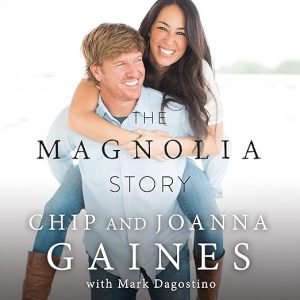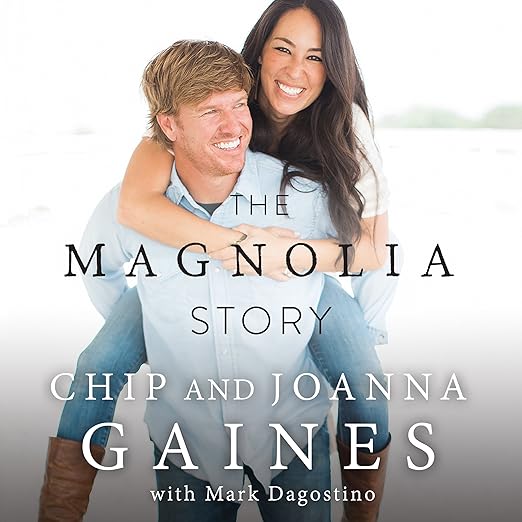
Whose voice do you actually hear when a book written by two people is credited to one? That question hangs over this audiobook from the first minute. The description is unambiguous that The Magnolia Story is "the first book from dynamic husband-and-wife team Chip and Joanna Gaines". The byline on the listing names Chip alone. The reader credit names Chip alone as well. And one of the five people who wrote about the book calls it "a true dialogue" in which the two of them take turns.
First, the Big Picture
So the first thing to settle is what a listener actually gets. Nothing on this page maps a voice to a chapter, and nothing states who reads which turns. What the page does establish is that a book built as an alternating conversation carries a single name in the reader's slot. If the alternation is the pleasure, and I suspect for most buyers it is, that is what a sample needs to answer before you commit five hours.
Set the question aside and the book itself is charming and slighter than its reputation. This is an origin story: two people at Baylor, a car dropped at the tire shop where Joanna worked behind the counter, and a serial entrepreneur who had already run a lawn care company, sold fireworks and flipped houses. Then four children, countless renovations, a blog noticed by a television producer, and a show. The arc is familiar because television has already told it. What the book adds is the ledger.
And the ledger is the good part. The description does not skip the houseboat bought sight unseen that turned out to be a leaky wreck, or Joanna closing her dream business to raise the children, or "the project that nearly cost them everything". Harrowing is the word the copy reaches for when it gets to the money. An entrepreneurial couple describing the downs, in their own voices, on the back of a very public success, is a more interesting proposition than another book about the ups. A television property built on finished rooms rarely advertises the years when the money did not work, and the distance between those two versions of the same couple is where this book earns its keep.
Two responses out of five frame the reading in explicitly religious terms, one describing being led to the book and the other feeling addressed by particular chapters. That is not incidental to how this was received, and it is worth knowing in advance. The book itself, on the description's evidence, sells warmth and perseverance rather than doctrine. But the audience that found it first read it as testimony, and the vocabulary of the pool reflects that.
The Best Parts of The Magnolia Story
Chip reading his own pages is the best reason to choose this version over print. The description closes on the question of whether he is really that funny away from the camera, and answers it with Joanna's line that he was and still is her "first fixer upper". Comic timing is precisely the quality that survives being spoken and dies on a page, so a self-read comic memoir puts the claim somewhere a buyer can test it directly, inside the first few minutes, at no cost.
Length is the second argument. Five hours is a single afternoon, and this suits being taken in one go, because the appeal is cumulative rather than sectional. The reviewers keep reaching for the same vocabulary about pace. One calls the book "SO wholesome" and promises that a fan of the show will "fly through it". Another describes it as candid and continuous, like being told the whole story in person by somebody sitting across the table. Those are compliments about momentum, and momentum is what a short recording protects.
Waco is the third reason, and the least predictable of them. The description covers the couple sharing their success with others and bolstering the city itself, along with the significance of the word magnolia and why it runs through everything they do. A brand origin explained by the people who chose the name is a small, specific pleasure. One reviewer's headline simply quotes the book's own advice back at it, about finding what you love and doing it until it hurts.
A Few Reservations
Photographs are promised and cannot be supplied. Memories and photos from the wedding sit in the bulleted list of what fans will discover, and an image is the one thing a recording cannot carry. On a book about renovation, design and a couple whose entire public identity is visual, that absence costs more than it would elsewhere. Anybody buying for the pictures should buy the printed edition and treat the audio as a companion rather than a substitute.
Expect stories rather than method. The listing files this under house and home, which sets up an expectation of instruction, and nothing in the description promises any. No technique, no budgeting guidance, no walkthrough of a project from demolition to reveal. What you get is how two people met, what they risked and what it cost them. That is a good book. It is simply not the book the shelf implies it is.
Joanna Gaines is the other thing to notice. She appears in the description as co-author, in the written responses as one of the two people telling the story, and in the credit line nowhere at all. It changes nothing about the recording itself, but it does mean the listing under-describes the book, and anybody buying in expectation of two perspectives should confirm what the sample contains before parting with money.
Who Should Listen to The Magnolia Story
Fixer Upper viewers are the obvious buyers and will be well served. So will anybody curious about what a small-city business looks like before television arrives, since the years covered here are mostly the lean ones. Listeners who enjoy faith-adjacent memoir told without argument will find the register comfortable, and one response comes from a reader who met the couple through the show and wanted more of them than an episode allows.
Renovation instruction is not on offer, so pass if that is the purchase you had in mind. Pass as well if photographs are part of what you are paying for, because they cannot follow the book into this format. And weigh the credit question honestly, since a conversational book with one credited voice may be exactly what you want or may be half of what you expected. Sample the opening ten minutes, listen for whether a second voice arrives, and buy on the answer.
Does Joanna Gaines read any of this audiobook?
The listing credits Chip Gaines alone in the reader's slot and publishes no breakdown of who speaks when. Both names sit in the author line on the same page, and the book itself is built as an alternating conversation. Anybody expecting to hear both should settle the question with a sample rather than with the credit.
Is this audiobook a renovation guide?
No. Nothing in the description promises technique, budgeting or a project walkthrough. It covers how the couple met, the businesses Chip ran before television, the venture that nearly ruined them, Joanna closing her own shop, and the origin of the Magnolia name. The house-and-home filing oversells the instructional content considerably.