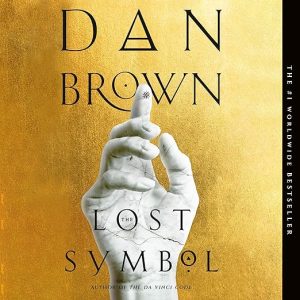
Dan Brown's Robert Langdon series raises a consistent critical question: can a novel built primarily on the architecture of puzzle and revelation function as literature in any conventional sense? The Lost Symbol, the third Langdon audiobook, sets its symbologist loose in Washington DC, inside the Capitol Building, and deep into the world of Freemasonry. At seventeen hours and forty-seven minutes, this is a substantial audio commitment, and whether it pays off depends almost entirely on your tolerance for Brown's particular brand of chapter-ending revelation.
The setup is efficiently assembled. Langdon receives an unexpected invitation to deliver a lecture at the US Capitol, only to discover a severed hand artfully arranged inside the Rotunda, encoded with five symbols he recognizes as an ancient invitation into a lost world of esoteric knowledge. His mentor and friend Peter Solomon, a prominent Mason and philanthropist, has been kidnapped. The only way to save Solomon is to accept the mystical invitation and plunge into a clandestine world of Masonic secrets, hidden history, and one inconceivable truth , all under the watchful eye of a terrifying enemy.
The Lost Symbol received considerably more mixed reviews than its predecessors, and for reasons that have some validity. Brown's short-chapter technique generates artificial momentum through constant cliffhanger cutting, and this works differently on audio than in print. Paul Michael's narration carries you through the chapter breaks smoothly enough that the device becomes less visible, but the underlying structural repetitiveness can still surface over a seventeen-hour runtime. The book is also more deliberately invested in its ideas than either The Da Vinci Code or Angels and Demons, spending more time on the philosophical implications of Noetic Science and Masonic symbolism, which either deepens the experience or slows it depending on what you came for.
Highlights
The genuine pleasure this audiobook offers is the Washington DC setting, handled with a specificity of detail that makes the city feel like a character in its own right. Brown's research into Masonic history and the architectural symbolism embedded in the Capitol's design is extensive, and Paul Michael delivers the expository passages with enough energy that they feel like revelation rather than lecture. For listeners who find the symbolic and esoteric genuinely interesting rather than merely instrumental to the plot, this is the Langdon novel that spends the most time in that territory.
Michael's narration is a reliable asset throughout. He does not do elaborate character-voice differentiation in the mode of some thriller narrators, but his clean, intelligent delivery keeps the pace disciplined. At nearly eighteen hours, maintaining listener engagement is not a trivial challenge, and Michael's consistency matters. The villain of this novel, a tattooed figure known as Mal'akh whose backstory unfolds across alternating chapters, is handled with appropriately unsettling calm rather than melodrama, which is the right call for material that risks tipping into caricature.
Before You Commit to The Lost Symbol
One reviewer who specifically loved this novel noted that the mixed critical response may stem from expectations set impossibly high by The Da Vinci Code's cultural moment. That is a fair point. Brown is doing the same things here that he always does: compressed chapters, alternating perspectives, a climax built on symbolic revelation rather than physical confrontation. If those devices wore out in earlier Langdon novels, this one will not rehabilitate them. If you still find the approach entertaining, the DC setting and Masonic depth make this arguably the most content-rich of the series.
The philosophical dimension of the final act, which turns on the relationship between ancient wisdom and modern science and asks whether ancient secrets are merely descriptions of truths that neuroscience is only now articulating, is either the book's most interesting move or its most overreaching one. Brown is clearly interested in these ideas on a genuine level, not just as plot mechanics, and listeners who engage with that dimension will find the conclusion more satisfying than those who came purely for the thriller architecture.
One element Brown handles better in this novel than in some of his earlier work is the pacing of his exposition. The Masonic history and Noetic Science content, which could easily feel like Wikipedia excerpts dropped into a thriller, is woven through action sequences in ways that make the information feel earned rather than inserted. Paul Michael's narration is critical to this: he delivers the expository content with the same forward energy as the action passages, preventing the lectures from becoming interruptions. For a seventeen-hour audiobook, that consistency of delivery is not a minor achievement.
Brown's Washington DC is rendered with the tourist-guide specificity that characterizes all his location writing at its best. The Capitol's Rotunda, the Library of Congress, the Washington National Cathedral, the House of the Temple: each location is presented with enough architectural and symbolic detail that the listener develops a sense of the city as a text to be decoded, which is precisely the novel's central metaphor. Paul Michael delivers these passages with enough pace that they feel like discoveries rather than guidebook entries, maintaining the thriller rhythm even when the content is purely descriptive.
Who It's For
Listeners who have enjoyed previous Robert Langdon audiobooks and are not exhausted by Brown's structural approach will find this a strong installment, particularly for the Washington DC immersion and the Masonic historical content. Those who found The Da Vinci Code overhyped or its sequel monotonous will likely share those reservations here. Paul Michael's narration is a genuine draw for audio-first listeners. Anyone with a pre-existing interest in Masonic history, noetic science, or the symbolic architecture of Washington DC will find more to engage with here than the average Brown skeptic might expect.
Quick Take
- Narrator: Paul Michael brings the brisk, declarative energy that Langdon thrillers require, maintaining clarity across seventeen-plus hours of DC-set propulsion.
- Subjects: Masonic secrecy, ancient wisdom in modern America, the boundary between science and faith
- Tone: Fast-moving and dense with symbolic detail, occasionally pausing to breathe
- Bottom line: A Dan Brown audiobook that rewards listeners who enjoy the puzzle architecture more than the prose, and who find Masonic iconography genuinely fascinating.