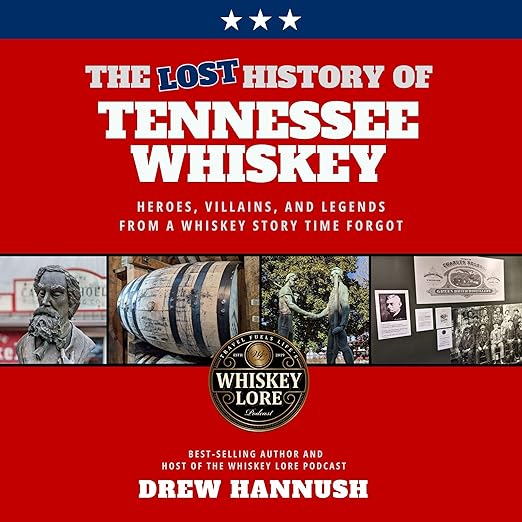
Quick Take
- Narration: Hannush reading his own meticulous research creates an authoritative and genuinely enthusiastic guide through 250 years of Tennessee distilling.
- Themes: forgotten American history, regional identity, the politics of spirits
- Mood: Rich and unhurried, the audio equivalent of settling in with a good glass
- Verdict: The definitive audio history of Tennessee whiskey, a serious and comprehensive work that will reshape what most listeners think they know.
I started this one on a rainy Friday evening with something amber-colored in a glass and no plans for the next several hours beyond paying attention. That is, I realize, an unusually specific listening context to admit to, but it was the right one. Drew Hannush’s The Lost History of Tennessee Whiskey is the kind of deeply researched narrative history that rewards exactly the kind of slow, attentive engagement that Friday evenings are for.
The premise of the book is a provocation: everything you think you know about Tennessee whiskey has been organized around the wrong names, the wrong timeline, and the wrong mythology. Jack Daniel, that universally recognized face on black-labeled glass, does not even make his first appearance until the book’s twelfth chapter. What comes before is a full American history, filling in names like Stump, Boyd, and Kilgore alongside more recognizable figures like Crockett, Jackson, and Boone. Hannush argues, with considerable documentary support, that Tennessee’s distilling tradition not only predates Kentucky Bourbon but also predates the Whiskey Rebellion, which is the founding event most whiskey historians start from.
Our Take on The Lost History of Tennessee Whiskey
Hannush narrates his own research with the enthusiasm of someone who has spent years in archives and county records uncovering a story that has been buried partly by neglect and partly by the commercial mythology of the two or three brands that came to represent the whole tradition. His delivery is not the polished neutrality of a professional narrator but the particular warmth of an expert who has found something genuinely astonishing and cannot quite believe others do not already know it. One reviewer, a twenty-year Tennessee resident, described being shocked by how much they did not know. That reaction tracks with what Hannush is offering: a systematic dismantling of received knowledge.
Why Listen to The Lost History of Tennessee Whiskey
At seventeen hours, this is a long audiobook by any measure, and it earns its length. The Lincoln County Process, the specific filtration method that legally distinguishes Tennessee whiskey from Bourbon, gets the historical treatment it deserves, including its origins, its commercial and political history, and why it matters. Revenuers and moonshiners appear alongside tavern owners who defied prohibition pressure and made state history. The real George Dickel, not the brand identity but the actual man, gets an extended portrait. These are not celebrity histories with familiar names. They are recoveries of figures and events that the historical record has allowed to fade, and Hannush restores them with the care of someone who understands what was at stake in losing them.
What to Watch For in The Lost History of Tennessee Whiskey
This is a history book first and a whiskey book second. Readers who come for drinking recommendations or distillery tourism guidance will find neither. The book is concerned with documentation, causation, and the political and economic forces that shaped an industry, not with tasting notes or modern craft distilling trends. The depth is also genuinely demanding: Hannush does not simplify complex historical causation for a general audience. He trusts that his readers can hold multiple competing interests and timelines simultaneously, which means the book requires active rather than passive listening.
Who Should Listen to The Lost History of Tennessee Whiskey
Whiskey enthusiasts with a genuine interest in American history will find this essential. History readers who enjoy regional and economic American history through a specific cultural lens will also be well served. Reviewers who note Hannush has written comparable histories of Bourbon and Irish whiskey suggest that listeners who have followed his prior work will know exactly what they are getting here. Casual listeners who know Jack Daniel from label recognition and want to understand what they are actually drinking will come away substantially better informed. Anyone who expects a breezy introduction to Tennessee distilling should be aware that this is serious historical scholarship, thoroughly enjoyable but genuinely demanding of attention.
Frequently Asked Questions
Why does Jack Daniel not appear until chapter twelve in a book about Tennessee whiskey?
Because Hannush’s thesis is that Tennessee’s distilling tradition has been reduced to one famous name when it actually spans 250 years and dozens of significant figures, many of whom predate Daniel by generations. The delayed introduction is a deliberate structural choice that forces the reader to encounter the full history before arriving at the brand that now defines it commercially.
Is this audiobook accessible to listeners who know nothing about whiskey, or does it assume prior knowledge?
Hannush provides enough context for whiskey newcomers to follow the history, including clear explanations of the Lincoln County Process and why Tennessee whiskey is legally distinct from Bourbon. However, listeners with some existing whiskey knowledge will have richer context for appreciating what the historical revelations actually disrupt.
Does The Lost History of Tennessee Whiskey cover modern craft distilleries, or is it focused on historical periods?
The focus is historical. Hannush follows the story from the earliest settlements through Prohibition and its aftermath. Modern craft distilling in Tennessee is touched upon in the context of the industry’s political recovery, but it is not the book’s central concern.
How does this compare to Drew Hannush’s other whiskey history books on Bourbon and Irish whiskey?
Reviewers who have read Hannush’s previous work describe this as consistent in quality and depth. One reviewer noted they could not wait to see other regions like Japan receive the same treatment, suggesting that Hannush’s methodology translates well across different traditions.