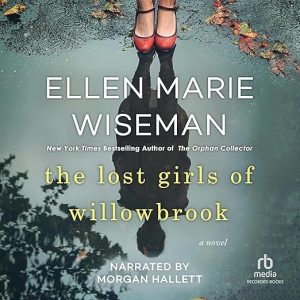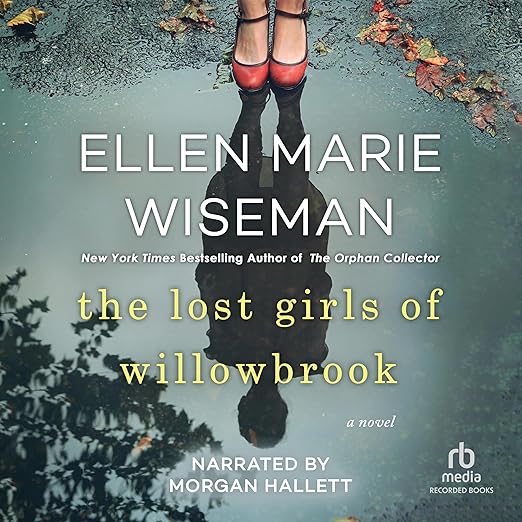
Ellen Marie Wiseman builds The Lost Girls of Willowbrook around a device that could easily have felt like a gimmick in less careful hands: identical twins, one presumed dead for six years, the other committed under circumstances her own family kept hidden. Sage Winters, sixteen and still grieving a sister she believes died of pneumonia, learns from her resentful stepfather that Rosemary never died at all. She was institutionalized at Willowbrook State School and has just gone missing, and Sage's own resemblance to her twin becomes this audiobook's central engine once she walks through the school's doors and is mistaken for the sister she came to find.
The Verdict, Briefly
The mistaken-identity device works because Wiseman grounds it in a real place. Willowbrook State School was an actual Staten Island institution exposed in 1972 by Geraldo Rivera's television reporting, which revealed severe neglect and overcrowding in the care of children with disabilities. Setting a mistaken-identity plot inside a documented historical horror, rather than an invented facility, raises the stakes considerably: Sage is not just risking her own safety to find her sister, she is walking into conditions the book did not need to invent.
One reviewer, who described doing fieldwork as a psychology student at a comparable institution in Queens during the 1970s, confirmed that the sounds and smells Wiseman describes read as accurate rather than exaggerated for effect. That is meaningful outside corroboration for historical fiction dealing with institutional abuse, where the temptation to sensationalize for narrative impact is real and where getting the texture wrong would undercut the book's credibility.
The publisher's own comparison, pitching the book as Girl, Interrupted meeting One Flew Over the Cuckoo's Nest, is ambitious shorthand, but the twin-identity structure gives Wiseman a plot engine neither of those reference points had, letting the book function as a mystery and a social-injustice narrative at once rather than choosing one mode over the other.
Sage's relationship with her stepfather Alan adds a quieter, more domestic layer of tension beneath the institutional horror. Alan resents being left responsible for a stepdaughter he never especially wanted, and that resentment, not villainy exactly, just weary avoidance, is what allowed Rosemary's real fate to stay hidden for six years. Wiseman gets real mileage out of that kind of ordinary, unglamorous family failure rather than relying purely on institutional cruelty to generate its darkest moments.
The title's plural, 'Lost Girls,' signals something the marketing copy doesn't fully spell out: this is not only Sage and Rosemary's story but implicitly the story of every child Willowbrook swallowed and never adequately accounted for. That wider scope, even filtered through one family's specific search, gives the novel a documentary weight beyond its central mystery plot.
Why Listen to The Lost Girls of Willowbrook
Reviewers consistently praise Wiseman's prose specifically. One called this her most powerful novel yet, and another noted going straight to archival footage of the real Willowbrook exposé immediately after finishing, about as strong a signal of engagement as historical fiction can produce. The book appears to send listeners looking for the true story behind it.
For listeners newer to Wiseman's catalog, this is described as her most fully realized work to date by at least one reader with prior familiarity with her other novels, worth noting for anyone deciding whether to start here or with an earlier title.
The real Willowbrook exposé did not end with Rivera's reporting. It led directly to the 1975 Willowbrook Consent Decree, a landmark legal settlement that reshaped disability rights and institutional care standards in New York State and influenced deinstitutionalization policy well beyond it. Knowing that the outrage depicted in the novel produced lasting, documented legal change gives the historical backdrop a weight beyond simple period atmosphere.
Points to Consider
This is unflinching material. Institutional abuse and neglect of children with disabilities is not softened for the sake of pacing, based on how reviewers describe the book's depiction of Willowbrook's actual conditions, and listeners sensitive to depictions of institutional cruelty toward children should know that going in rather than discovering it mid-listen.
Morgan Hallett narrates, and I could not find any earlier work of hers to compare against, so the performance can only be assessed on what the material demands: carrying both a determined teenager's voice and an institutional horror atmosphere without letting either tip into melodrama. At just over thirteen hours, the narrator also needs enough stamina and control to sustain that balance across a long single narrative.
Once inside, Sage has to maintain the deception of being mistaken for Rosemary without fully understanding what her sister actually experienced there, which creates a specific, sustained tension distinct from a typical whodunit: the danger is not identifying a culprit but simply surviving long enough inside the institution to learn the truth and get out.
Should You Listen to The Lost Girls of Willowbrook?
This suits readers of character-driven historical fiction dealing with institutional history, and anyone who appreciated the real journalistic history behind the Willowbrook exposé and wants to see it explored through fiction. Listeners who enjoy a mystery structure layered onto social history will find both elements genuinely present rather than one serving as window dressing for the other.
It is a poor fit for anyone seeking a lighter historical read or wanting to avoid depictions of institutional abuse of children entirely. Given the subject matter's real-world basis, this also rewards listeners willing to sit with discomfort rather than expecting a tidy, softened resolution.
The book's dual genre tagging, historical fiction and world literature, undersells how squarely commercial and readable it actually is; this is not dense literary fiction demanding patience, but a fast, emotionally direct historical mystery that happens to be built on rigorously researched, real institutional history.
Questions Listeners Ask
Is The Lost Girls of Willowbrook audiobook based on a real place?
Yes. Willowbrook State School was an actual Staten Island institution exposed in 1972 by Geraldo Rivera's reporting, and Wiseman builds her twin-identity mystery around that documented history.
How graphic is the depiction of institutional abuse in this audiobook?
It is unflinching. Reviewers, including one with direct professional fieldwork at a comparable 1970s institution, confirm the sounds and conditions are portrayed accurately rather than softened, so sensitive listeners should be prepared.
Do I need to have read Ellen Marie Wiseman's other novels first?
No prior familiarity is required. This stands as a complete, self-contained historical mystery, though at least one reviewer with earlier Wiseman titles under their belt called this her most powerful yet.