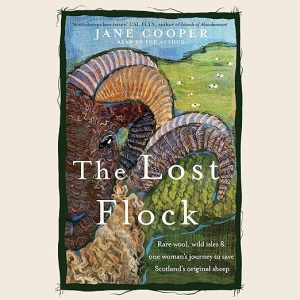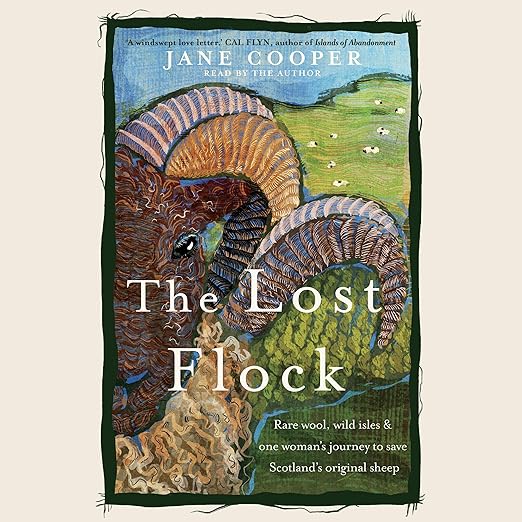
I came to The Lost Flock knowing very little about sheep and even less about the Orkney Islands. What drew me in was the audiobook's runtime - just over seven hours - and the fact that Jane Cooper narrates her own memoir. There is something particular about authors reading their own work, especially when the story is this personal and this strange. I started it on a Tuesday evening and was still listening at midnight, which I did not anticipate from a book about rare-breed sheep conservation.
That is the thing about The Lost Flock. It is not what you expect it to be, which is partly why it works so well.
Jane Cooper begins as a knitter in Newcastle and ends up as the sole custodian of the Orkney Boreray, a unique group within the UK's rarest sheep breed and one of the few surviving examples of primitive sheep in northern Europe. That sentence sounds niche to the point of inscrutability. But Cooper's memoir unfolds like a real detective story, and the mystery at its center - where did these sheep come from, and what exactly are they - turns out to be genuinely gripping. The historical threads she unspools, from Viking times through Highland crofts and into what the synopsis describes as "nefarious research experiments in Edinburgh," give the book an unexpected depth. This is conservation memoir, yes, but it is also a story about what it means to be the only person who cares about something rare.
Cooper's Untrained Voice Carries Real Stakes
Self-narrated audiobooks succeed or fail on the author's voice, and Cooper's is warm, precise, and quietly compelling. She is not a professional narrator and does not pretend to be - the performance has an intimacy that a studio casting would likely have smoothed away. When she describes her first encounter with the Boreray, or the moment she realizes she may be the sole keeper of this flock in the world, the stakes in her voice are real because they are actually real. One reviewer noted that they knew nothing about sheep or wool but loved the book for its Scottish history and its portrait of determination against significant odds - and that captures exactly what Cooper's narration delivers. You do not need to be a fiber enthusiast to feel invested.
Research and Archive-Diving Replace Thriller Confrontation
Readers who want a conventional narrative with a clear three-act structure may find the pacing occasionally discursive. Cooper is a knitter and a shepherd before she is a memoirist, and some sections meander through technical detail about fleece and breed characteristics in ways that will thrill the wool-obsessed and mildly tax everyone else. The detective story thread is also more investigative journalism than thriller - the revelations come slowly, through research and archive-diving, not confrontation. If you go in expecting urgency, adjust those expectations. The book rewards a patient, leisurely listening pace, ideally one cup of tea at a time.
Ordinary People, Extraordinary Custodianship, No Sentimentality
Rare breed enthusiasts, hand spinners, and anyone with a connection to Scottish or Orcadian heritage will find this essential. But the book has a wider reach than that audience might suggest - one reviewer with no background in sheep or fiber found it compelling purely for the history and the portrait of one woman's stubborn determination. Readers who loved books like rural relocation memoirs will recognize something familiar in Cooper's account of upending her life for a cause nobody else had claimed. Those looking for fast-paced narrative or tidy resolution should look elsewhere - but if you have ever found yourself unexpectedly moved by something obscure and worth saving, The Lost Flock will resonate. There is also something worth noting for listeners who grew up reading accounts of ordinary people pulled into extraordinary custodianship by accident: this book belongs in that lineage, and Cooper tells the story without sentimentality or self-congratulation.