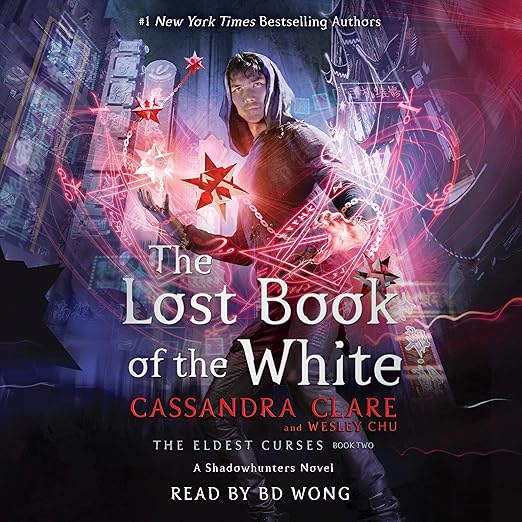
The Short Version
- Narration: BD Wong is exceptionally well-cast for Magnus Bane, bringing warmth, wit, and the high-warlock's particular register of theatrical confidence to the performance.
- Themes: Chosen family under threat, courage as love expressed in action, the cost of magical power
- Mood: Adventure-forward with emotional warmth at the center
- Verdict: A strong installment in the Eldest Curses series and a rare fantasy audiobook where the narrator casting feels like an integral part of the creative work.
I came to The Lost Book of the White as someone who had missed the first book in the Eldest Curses series. One reviewer notes that this book picks up four months after Tales of the Shadowhunter Academy, and approximately three years after the first Eldest Curses installment, which is a significant time jump. What I found was that the book is generous enough with re-establishing its characters that the gap was navigable, though I am aware I was missing texture that existing Shadowhunters readers would simply have as background.
What I was not missing was BD Wong. The choice to cast Wong as the narrator for a story centered on Magnus Bane is one of those audiobook casting decisions that feels genuinely intentional rather than simply competent. Magnus is a character defined by centuries of accumulated style and genuine emotional depth beneath it, and Wong carries both registers without the performance tipping into caricature.
What We Made of It
The synopsis describes this as a death-defying mission that is also a romantic getaway, which is an accurate summary of the book's emotional logic. Magnus and Alec are established as a couple, living together, raising their warlock son Max, building a life. The theft of the Book of the White and the weapon that begins corrupting Magnus's powers disrupts that life rather than being the story of how the relationship is formed. This is a different kind of fantasy romance than most, because the love is already established and the book is about what the characters are willing to risk to protect what they have.
One reviewer describes the scenes of Alec and Magnus as new parents as making their heart warm and fuzzy, and I understand why. The Max scenes are brief but loaded with the specific tenderness that comes from writing characters who have arrived at something they did not expect to want as much as they do. Clare and Chu give that domesticity genuine texture, which is rarer in fantasy than the genre often admits.
Why The Lost Book of the White Works as an Audiobook
The decision to take Magnus and Alec to Shanghai for the central set-piece brings something visually and tonally distinct from the New York Shadowhunters world. The urban supernatural geography of Shanghai, the demon incursions and the darker threat that waits beyond them, gives the plot momentum a new environment to move through. For readers who have spent considerable time in the Shadowhunters world, this is a meaningful expansion. For newcomers, it functions as a demonstration of the world's scope without overwhelming the emotional focus on the central characters.
The supporting cast, Clary, Jace, Isabelle, and Simon in his newly minted Shadowhunter capacity, are deployed efficiently rather than being given equal development. This is Magnus and Alec's story, and the book is appropriately focused on that. The ensemble serves the momentum rather than fragmenting it.
A Few Reservations
Wong is best in the quieter moments between Magnus and Alec, which is where the emotional core of the book lives. The action sequences he handles cleanly, but the private scenes carry the performance. There is a moment near the end involving what Alec does that one reviewer describes as blowing their mind, and Wong's delivery in that sequence is restrained in exactly the way the moment requires.
The Right Listener for The Lost Book of the White
This is unmistakably for Shadowhunters readers, and specifically for the portion of that readership who care most about the Malec relationship. The book is marketed as accessible to new readers, and it largely is, but the emotional payoff is proportional to the investment readers have already made in these characters across many previous volumes.
Listeners new to Clare's world should probably start with The Red Scrolls of Magic rather than here. The series rewards reading in order, and starting with the Eldest Curses first means missing the foundation that makes the character work here land with full force.
Can I listen to this without having read The Red Scrolls of Magic first?
The book is designed to be accessible, but one reviewer notes a three-year time jump from the previous installment that readers unfamiliar with the preceding events will feel. Starting with The Red Scrolls of Magic first is strongly recommended for the emotional investment to fully function.
How central are the side characters like Clary and Jace to this story?
They appear as supporting cast and serve the plot without being primary focus. This is Magnus and Alec's story. Clary, Jace, Isabelle, and Simon contribute to the Shanghai mission but do not have their own arc within this book.
Why is BD Wong such an effective choice as narrator?
Magnus Bane is a character who requires wit, warmth, and centuries of accumulated charisma all in the same register, and Wong brings all of that without the performance becoming theatrical in a way that undercuts the emotional scenes. He is one of those casting decisions that changes how the book feels.
How much does the book deal with Magnus's magical instability and what does it mean for the plot?
The weapon used against Magnus creates genuine jeopardy throughout the narrative. His powers becoming unreliable is not just a plot device but something that raises the cost of the mission and forces both Magnus and Alec to reckon with what they are willing to risk. It is handled with enough seriousness that the stakes feel real.