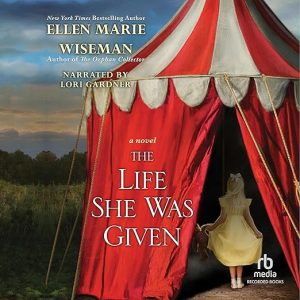
In 1931, the Depression-era traveling circus was one of the few institutions in America where people who did not fit the world outside its canvas walls could find something resembling a place. Ellen Marie Wiseman understood that when she wrote Lilly Blackwood into the sideshow at the center of this audiobook, and Lori Gardner's narration carries the novel's dual timeline with a steadiness that honors the material's emotional range. The Life She Was Given opens with an act of betrayal so intimate and so specific that it reframes everything the word 'family' is supposed to mean.
The Verdict, Briefly
Wiseman constructs the novel across two timelines: the 1931 story of Lilly Blackwood, a girl kept hidden in a Blackwood Manor attic by a mother who called her an embarrassment and sold her to a circus sideshow, and the post-WWII story of Julia Blackwood, who inherits the estate at nineteen and discovers the attic room's secrets in old photographs of circus scenes. The structural choice is well-executed. The two women never meet, but their stories form a continuous moral argument about what families do to protect themselves and what they bury in the process.
Lilly's arc is the novel's heart. Her introduction to the Barlow Brothers' Circus, first as a spectacle, then as someone who discovers a genuine bond with the elephants Pepper and JoJo and their handler Cole, charts a transformation from a girl defined by her mother's shame to someone who finds worth and agency in an unlikely community. Wiseman avoids making the circus sentimental; it is 'ragtag, sometimes brutal,' and Lilly's path through it is not without cruelty. The emotional development is earned rather than gifted.
Julia's timeline carries different pleasures: the mystery structure works, the estate atmosphere is well rendered, and the gradual revelation of what happened to Lilly has genuine momentum. Julia is a less vividly drawn character than Lilly, which some readers have noted, but she serves as an effective lens through which the past is uncovered without needing to compete with Lilly for the novel's sympathy.
Lori Gardner handles both women's voices with care. She distinguishes the timelines tonally without overdoing the contrast, and her work with the circus ensemble, the animal handlers, the sideshow performers, adds texture to a cast that could easily flatten into types. This is a novel that depends on atmosphere, and the narration sustains it.
Why The Life She Was Given Works as an Audiobook
The dual timeline structure is a natural fit for audio. Gardner's voice shifts create a cleaner separation between 1931 and the postwar years than page-based chapter headers alone would achieve, and the thirteen-plus hours pass steadily because the alternating timelines create a rhythm of revelation and deferral that keeps the listener invested in both strands simultaneously.
Wiseman researched the Depression-era traveling circus with evident care. The period detail, from the economics of the sideshow to the lives of animal handlers during lean years, gives the novel an authenticity that historical fiction can easily paper over with generic atmosphere. Listeners who care about setting as much as story will find this richly placed.
The emotional range is also genuinely wide. Wiseman allows Lilly's story to be 'tender and heartbreaking' while also finding 'moments of joy,' and the novel does not collapse into either unrelieved darkness or false comfort. That balance is harder to achieve than it looks, and it is a significant reason why readers have responded strongly to the book.
Points to Consider
The ending disappointed some readers who felt it resolved too quickly, leaving questions unanswered after thirteen hours of setup. That criticism has merit. The final chapter compresses a reconciliation that the preceding narrative suggested would require more space to feel earned. Listeners who invest heavily in the mystery of Lilly's fate may feel that the resolution underdelivers relative to the anticipation built throughout.
Julia's sections, while structurally necessary, are occasionally less propulsive than Lilly's. The mystery framework in Julia's timeline is competent rather than gripping, and her character's interiority is thinner than the novel's emotional ambitions might require. This is not a fatal flaw, but it means the listener's attachment to Julia depends more on the mystery's momentum than on Julia herself.
The subject matter includes child neglect, abuse within institutional settings, and the specific cruelties of the Depression-era circus world. Listeners who find those subjects difficult should know they are present and handled honestly rather than avoided or softened.
The Depression-era circus sections of this audiobook are also a kind of social history, and Wiseman uses that context wisely. The sideshow was not simply entertainment; it was a labor market for people whose physical differences made them unemployable in conventional settings, and the novel's treatment of that reality, including the genuine community that formed among performers, gives Lilly's arc an authenticity that a purely sensationalized account would lack. Her bond with the elephants Pepper and JoJo, and with Cole their handler, represents the novel's clearest argument about what belonging means for someone who has never been allowed to belong anywhere. Lori Gardner's narration brings these circus scenes to life with a warmth that makes the novel's darker turns hit harder for contrast. The structural gamble of putting Lilly's story at the center while Julia drives the mystery from outside it pays off in the listening experience; the two timelines create a sustained forward momentum that keeps the hours moving.
Should You Listen to The Life She Was Given?
Fans of Lisa Wingate, Kate Quinn, and other writers of dual-timeline historical fiction will find this a strong addition to the genre. Readers who responded to novels centered on women finding agency outside the domestic sphere, and particularly those involving the circus world, will connect with Lilly's story in particular. The novel is also well suited to book club listening; it generates substantial discussion around questions of family loyalty, historical complicity, and what constitutes justice when the people responsible for a betrayal are long dead by the time it is uncovered.