Quick Take
- Narration: Tanya Eby brings the conversational accessibility that Goerlich’s writing calls for, clear, engaged, and professional without clinical distance.
- Themes: BDSM and kink community navigation, affirming clinical practice, intersectionality within kink spaces
- Mood: Thoughtful and informative, like a well-run continuing education seminar with unusually good case studies
- Verdict: Winner of the 2021 AASECT Book Award and consistently praised by working therapists, this is the most credentialed and substantive clinical guide to kink-affirming practice currently available in audio.
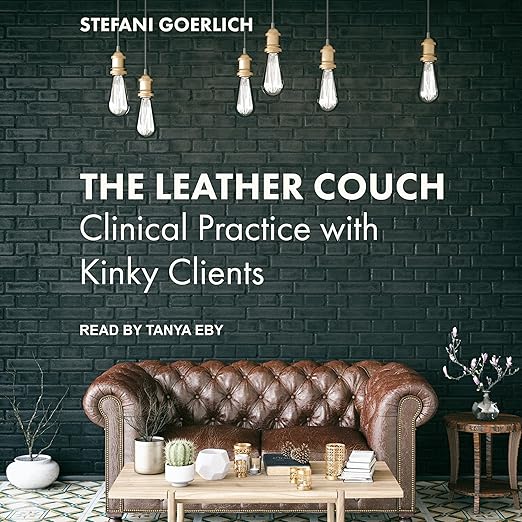
I came to The Leather Couch through a recommendation from a friend who is a social worker, not through the erotica shelves where it has been somewhat oddly classified. She mentioned it while we were talking about gaps in clinical training, the way therapists frequently encounter clients from BDSM and kink communities and have almost no formal preparation for meeting those clients with competence, let alone genuine affirmation. That framing is exactly how author Stefani Goerlich positions this book, and it’s the frame that makes sense of its 4.8 rating and its 2021 award from the American Association of Sexuality Educators, Counselors, and Therapists.
This is not an erotica title in any conventional sense. It belongs in a category alongside resources like Jack Morin’s The Erotic Mind or the more clinical work of Patrick Califia, books that approach sexuality, particularly non-mainstream sexuality, with genuine intellectual rigor and professional purpose. That it has been filed under erotica on some platforms reflects the persistent problem of taxonomizing books about sex, rather than anything about the book’s actual content or register.
From Kink-Aware to Kink-Affirming
The subtitle distinction Goerlich draws between “kink-aware” and “kink-affirming” practice is the book’s organizing principle, and it’s a meaningful one. Kink-aware clinical practice means a therapist knows these communities exist and doesn’t pathologize them. Kink-affirming practice means they actively support clients in living their authentic sexuality without subtle pressure toward conventional norms. That second position requires more than familiarity, it requires the kind of specific knowledge this book provides.
Goerlich covers the BDSM 101 material competently, the basic vocabulary, common practice types, community structures including munches, play parties, leather bars, and conferences, but that’s genuinely introductory material. The more substantive chapters are the ones on risk assessment, differential diagnosis, and the specific question of how to distinguish consensual power exchange from domestic abuse. That last topic is handled with particular care. Goerlich gives clinicians actual frameworks for assessment rather than relying on instinct, which is exactly what the clinical context requires.
Intersectionality and the Community It Depicts
The chapter on intersectionality within the kink community is one of the book’s more quietly important sections. BDSM communities have their own histories of racial dynamics, gender hierarchies, and ableism that don’t disappear simply because the community positions itself as sexually liberated. Goerlich addresses this without either excusing the dynamics or condemning the communities wholesale, she gives clinicians the grounding they need to work with clients who are navigating these specific tensions.
The case studies woven through each chapter are what transform this from a survey text into something clinically useful. They’re specific enough to be illustrative without being voyeuristic, and they cover a range of clinical presentations: a submissive woman whose therapist kept trying to pathologize her dynamic, a gay leather man navigating family estrangement, a heterosexual couple where the male partner’s submissiveness was creating anxiety he couldn’t name. These examples ground the book’s frameworks in recognizable human situations.
What Tanya Eby Brings to This Material
Eby is a skilled audiobook narrator who has worked across a wide range of genres, and she handles Goerlich’s accessible academic prose well. The book doesn’t require a narrator who can convey emotional intimacy, it requires someone who can carry clinical and conceptual material clearly for an extended runtime of nearly nine hours. Eby does that without making the book feel dry. The conversational quality that reviewers consistently praise in the text comes through in the performance.
Three separate professional reviewers, all identifying as therapists or clinicians, gave five-star reviews specifically praising its clinical utility. One called it “the best clinical book I’ve ever read.” Another noted referring back to it actively in her private practice with clients. That kind of ongoing utility is the benchmark for professional reference material, and it’s a higher bar than general reader satisfaction.
Who Should Listen, Who Should Skip
The primary audience is mental health clinicians, social workers, sex educators, and primary care providers who work with clients from kink and BDSM communities. It will also be valuable to people in those communities who want to understand how the clinical world frames their lives and to find language for explaining their experiences to practitioners.
Listeners looking for erotic content or exploration guides will find the wrong book here. Goerlich is writing for a professional context throughout. General readers with curiosity about BDSM communities as a cultural phenomenon may find the intersectionality and community navigation chapters engaging, but the clinical framing will feel like a mismatch for casual curiosity.
Frequently Asked Questions
Is The Leather Couch appropriate for members of the BDSM community who aren’t clinicians, or is it too academically dense for general readers?
Goerlich explicitly states the book is written accessibly for both clinicians and community members. Several sections give kinksters language and frameworks for understanding their own experiences through a clinical lens, which some readers find validating. It’s not academic in the traditional sense, reviewers consistently praise its accessibility.
Does the book address how clinicians should handle mandatory reporting obligations when a client describes BDSM activity that sounds potentially abusive?
The chapter on distinguishing domestic violence from consensual power exchange is specifically designed to address this challenge. Goerlich provides risk assessment frameworks for exactly this clinical situation, which is one of the more complex and high-stakes decisions clinicians face.
Is the content applicable to LGBTQ+ clients and communities, or is it written primarily with heterosexual kinksters in mind?
The book explicitly addresses intersectionality including LGBTQ+ identities within the kink community, and the leather community’s history is deeply rooted in gay male culture. Goerlich’s framework is inclusive across orientations and gender identities throughout.
How does the 2021 AASECT Book Award affect how this book should be positioned relative to other kink-affirming clinical resources?
AASECT (American Association of Sexuality Educators, Counselors, and Therapists) is the primary professional organization for certified sex therapists in the US. An award from them carries significant weight as a credentialing signal, it suggests the book meets the standards of the field’s primary professional body. No other kink-affirming clinical audiobook appears to carry equivalent recognition.