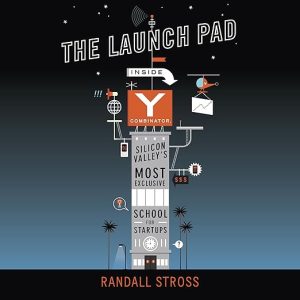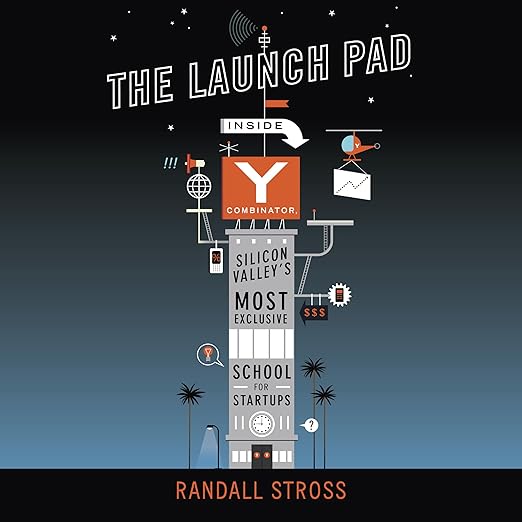
Every six months, Y Combinator hands total strangers three months and one nearly impossible assignment: turn a raw idea into a viable business before demo day arrives. Randall Stross became the first journalist granted genuine fly-on-the-wall access to the program, and The Launch Pad audiobook follows one specific cohort through that entire compressed cycle, tracking how founder Paul Graham built an institution that could plausibly produce the next Dropbox or Airbnb out of a handful of unproven two- and three-person teams. The book covers Y Combinator's selection process, its rapid-fire mentorship model, and the specific pressure of turning a concept into something fundable in a matter of weeks.
Facebook Was Never Actually a YC Company
What separates this from a general Silicon Valley overview is the specificity of the access: reviewer Jason Y. Shen discloses directly that he was one of the entrepreneurs in the actual Summer 2011 Y Combinator session the book covers, and that kind of firsthand corroboration is rare and valuable. A participant confirming the book's portrayal matches his own lived experience of the program gives Stross's reporting real credibility beyond the usual journalist-observes-from-a-distance framing that dominates most startup-culture nonfiction.
Reviewer Randall Degges came in as a longtime Hacker News reader already deeply familiar with Y Combinator's general reputation, expecting the book to cover ground he already knew, and found instead that the granular, inside-the-room detail offered something genuinely new even to an already-informed audience. That is a meaningful signal for potential listeners: this is not a surface-level explainer aimed at total newcomers but a reported account with texture worth hearing even if you already follow the startup world closely.
A quiet irony sits inside the book's own framing of hundreds of aspiring Mark Zuckerbergs: Facebook itself was never a Y Combinator company, funded instead directly by outside investors including Peter Thiel. The comparison works as aspirational shorthand for ambition and scale rather than a literal alumni claim, and understanding that distinction actually sharpens what Stross's book is really examining, a specific, replicable process for building a company, not a guarantee of Facebook-level outcomes.
Demo day itself functions as the book's real narrative pressure point: three months of mentorship, iteration, and course correction all compress into a single afternoon where investors and venture capitalists hear a founder's pitch once, often for only a few minutes, before deciding whether to write a check. Stross uses that structural deadline the way a sports book might use a championship game, as the moment every earlier chapter has been quietly building toward.
Ruiz's Clear Delivery Suits a Journalistic Register
René Ruiz narrates with clear, well-paced delivery that suits Stross's journalistic register, treating the material with the same seriousness a business reporter would bring to a magazine feature rather than hyping the entrepreneurial mythology for its own sake. That restraint fits Stross's approach specifically, since the book earns its stakes through granular process detail, how mentors actually critique a pitch, how founders react under real time pressure, rather than through breathless success-story framing.
Paul Graham himself remains a genuinely significant figure in Silicon Valley history, and the book's account of how he built Y Combinator from scratch into an institution capable of vetting hundreds of aspiring founders per cycle gives listeners real insight into the mechanics behind an accelerator model that dozens of imitators have since tried to replicate. Understanding the original version, told with this level of specific access, has real value even for listeners mainly interested in startup culture generally rather than Y Combinator specifically.
Paul Graham's own background lends real weight to the institution the book documents: before founding Y Combinator, he co-founded Viaweb, one of the first web-based application companies, sold to Yahoo and relaunched as Yahoo Store, and later built a reputation as an influential essayist on startups and technology. Stross's access to Graham while he was actively shaping YC's mentorship model captures a founder figure whose own hands-on experience directly informed the program's famously blunt, no-nonsense advice style.
Far Too Short or Long and Monotonous
This book reports on a specific, now-dated cohort, and the startup landscape it describes has shifted considerably since. The Dropbox and Airbnb valuation figures cited as aspirational benchmarks reflect numbers from years ago, both companies are worth dramatically more today, and funding norms, accelerator competition, and the broader venture capital environment have all changed since Stross did his reporting. Treat this as a historical snapshot of a specific moment and program rather than a current guide to today's startup landscape.
Reviewers genuinely disagree on pacing, and that disagreement is worth flagging directly rather than picking a side. Rob Ryan calls the book actually far too short, pushing back against another review he references that found it long and monotonous, and that split suggests your own tolerance for granular, day-by-day process detail will determine which camp you land in more than anything about the book's objective quality.
Both comparison companies named in the synopsis have moved dramatically past the figures cited: Dropbox and Airbnb are now both public companies trading at valuations many multiples higher than the five-billion and one-point-three-billion figures the book uses as aspirational benchmarks. That gap is worth sitting with directly, since it underscores just how much runway even a modest, unglamorous three-month accelerator cohort can eventually produce, even if the specific numbers themselves now read as a snapshot of an earlier era.
Y Combinator's original bet on small, two- or three-person teams was itself a departure from how venture funding traditionally worked, favoring nimble founders over larger, more established ventures with existing infrastructure. That thesis, unremarkable now that accelerators are common, was a genuinely distinctive wager when Graham first built the program, and Stross's access captures that model while it was still being tested rather than after it had already become the industry default.
The Programming and Software Development tag on this listing runs a little narrow for what the book actually covers; this is a business and journalism account of an investment program's process and culture, not a technical guide to writing code. Listeners hoping for coding instruction should recalibrate, though anyone interested in the business side of the tech industry will find the computers-technology and money-finance genre pairing considerably more accurate.
Historical Cohort Detail Over Today's Funding Figures
Aspiring founders, startup-culture readers, and anyone curious about how accelerator programs actually function behind the scenes will get real value here, especially listeners who want granular process detail rather than a broad, surface-level survey of Silicon Valley culture.
Skip it if you specifically need current, up-to-date startup landscape data or funding figures, since this documents a specific historical cohort rather than today's accelerator environment, and the value here is process insight and historical grounding rather than current market intelligence.
Good to Know
Is this audiobook still relevant given how much the startup world has changed?
The specific figures and cohort are dated, but the process insight into how accelerator mentorship and pitch preparation actually work still holds real value.
Does this audiobook require a tech background to follow?
No, Stross writes for a general business-nonfiction audience, and René Ruiz's narration keeps the material accessible without assuming specialized technical knowledge.
Which Y Combinator cohort does this audiobook focus on?
A reviewer who participated confirms it covers the Summer 2011 session, giving the account a specific, verifiable anchor rather than a generalized composite.
How long is this audiobook?
It runs eight hours and forty-nine minutes, and reviewers disagree on whether that length feels too short or too long, largely depending on appetite for granular process detail.