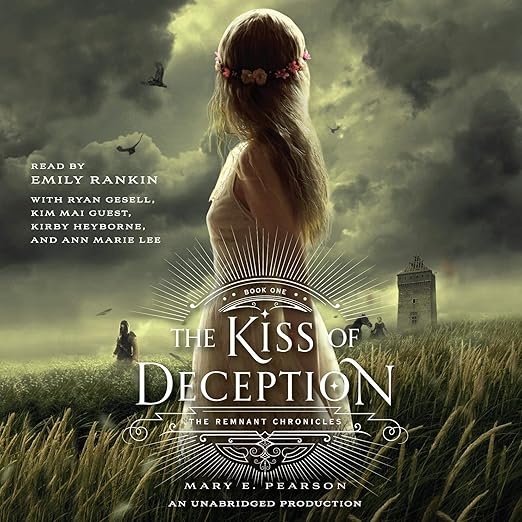
Princess Lia's flight from her own wedding morning is the kind of opening that announces exactly what kind of audiobook The Kiss of Deception intends to be, and Emily Rankin delivers it with the right mixture of urgency and relief. I came to Mary E. Pearson's Remnant Chronicles relatively late, having bypassed it during the initial YA fantasy wave of the mid-2010s, and the audio format turned out to be the right way to finally catch up. Rankin's narration makes the book's central structural gambit land in ways that require hearing to fully appreciate.
Pearson's central structural choice is the book's greatest asset and its primary source of tension. Two men arrive in the village where Lia has hidden herself after fleeing the arranged marriage: one is the prince she jilted, and one is an assassin sent to kill her. Pearson does not immediately reveal which is which. The chapters alternate between their perspectives, and both men's feelings for Lia develop genuinely before the reader is given the information that would reframe everything they have already experienced. Reviewer Nicole Lay notes this as a 4.5-star book with specific misgivings about POV structure, but also acknowledges the romance-fantasy-political-intrigue combination is executed well.
The worldbuilding Pearson has constructed, a society where the gift of sight carries genuine political weight and where princesses function primarily as diplomatic instruments, does enough to ground the story without overwhelming the emotional core. Lia herself is the book's strongest creation: someone who understands exactly what she is running from, which gives her choices weight rather than making her seem naive about the world she has rejected. Her life in the village, the friendships she builds, the work she finds, feels genuinely earned rather than merely a convenient backdrop for two handsome strangers to arrive against.
The book's ambiguity about the two male characters is also an ambiguity about what kind of story Pearson is telling. Lia is falling for someone, but she does not know, and neither does the reader, whether she is falling for her would-be husband or the man sent to end her life. That layering of romantic uncertainty onto genuine physical danger gives the novel a tension that most YA fantasy romance does not carry, and it sustains through the full thirteen-hour runtime.
Why Listen to The Kiss of Deception
Emily Rankin is well matched to Pearson's writing. The novel requires a narrator who can hold ambiguity without signaling resolution too early, and Rankin does exactly that. When narrating from the perspectives of the two mystery figures, she maintains enough warmth in both performances to make either outcome emotionally plausible. The listener genuinely cannot determine, from audio cues alone, who is the prince and who is the assassin. That restraint is the narration's most important achievement across the full runtime.
Reviewer Eri at Airy Reads describes starting the book 'a little hesitant' and being caught 'hook line and sinker' by what the novel actually delivers. That trajectory is common for the first book in a series that asks listeners to invest in a structure before fully explaining it, and Rankin's narration accelerates the hook considerably. The thirteen-hour runtime feels appropriate for a first volume in a trilogy; Pearson uses the space to build relationships that the subsequent books will complicate and deepen.
What to Watch For in The Kiss of Deception
The beginning of the book requires patience. Pearson spends significant time establishing Lia's daily life in the village, her friendships, her work, the way she is carving out an existence that is genuinely her own rather than the preordained one her parents assigned her. Reviewer Nicole Lay flags the opening as her primary area of concern, and it is the section most likely to lose listeners before the two strangers arrive and the story finds its real shape.
Reviewer L. Whitney calls it 'the best book I've read in the last year' with 'absolutely perfect' plotting, which represents the enthusiast position. The more measured reviewer places it at 4.5 stars, noting the romance-fantasy-political-intrigue framing is not uncommon lately. Both responses are honest. The book is very good within its genre; whether that rises to all-time levels depends on your appetite for this specific flavor of YA fantasy.
Pearson's decision to withhold the identities of the two male POV characters is a formal choice that pays off more completely in audio than in print. On the page, readers can flip back, check names, look for structural clues. In audio, the listener is committed to the same uncertainty Lia experiences, which makes the discovery of which man is which land with considerably more force. Rankin's narration takes full advantage of that formal difference. She plays both characters with equal narrative sincerity, giving the listener no sonic shortcut to the answer, and the reveal, when it finally comes, carries genuine weight as a result.
Who Should Listen to The Kiss of Deception
YA fantasy listeners who want a structural gambit that actually pays off, a protagonist with genuine agency and self-awareness, and a romance that builds on actual complexity rather than proximity will find this audiobook delivers what the format promises. Emily Rankin's narration is a genuine asset here rather than a serviceable add-on, making the ambiguity central to the novel land with full effect.
Listeners who need a faster-paced opening, or who find the 'princess flees arranged marriage' premise well-worn enough to test their patience, may need to push through the first few hours before the story's real architecture becomes visible. The patience is worth it, but it is worth knowing in advance that this audiobook earns rather than announces its pleasures.
- Voice: Emily Rankin holds the novel's central structural ambiguity with impressive restraint, keeping both mystery POVs equally plausible without telegraphing the reveal.
- Big ideas: Identity versus expectation, deception and trust, the politics of arranged marriage in a fantasy setting.
- Atmosphere: Romantic and suspenseful, slow to build but structurally rewarding.
- Worth it?: A well-constructed YA fantasy first novel with a genuine structural gambit, served by narration that understands exactly what the conceit requires.
Before You Listen
Does Emily Rankin's audiobook narration reveal which character is the prince and which is the assassin?
No, and that restraint is the performance's key achievement. Rankin maintains equivalent warmth in both male POV chapters, which keeps the central ambiguity intact for the full length of the audiobook.
Is this audiobook complete as a standalone, or does it end on a cliffhanger?
It ends on a genuine cliffhanger. The central mystery of identity is resolved, but the consequences open into the second book of the Remnant Chronicles. Plan to continue with The Heart of Betrayal if you want full closure.
How does The Kiss of Deception audiobook handle the YA fantasy worldbuilding?
Pearson integrates the worldbuilding gradually rather than front-loading exposition. The gift of sight, the political alliance system, and the structure of the society emerge through character experience rather than dedicated explanation sections, which suits the audio format well.
At thirteen hours, is the audiobook pacing consistent throughout?
Not entirely. The opening third is slower as Pearson establishes Lia's village life, which several reviewers noted. Once the two strangers arrive, the pacing tightens considerably and sustains through to the end of the audiobook.