Quick Take
- Narration: Alex Freeman delivers the technical content with clarity and appropriate pacing, though code-heavy passages and table references hit the inevitable wall that comes with converting dense data science material to audio.
- Themes: Competition strategy, machine learning model optimization, data science career building
- Mood: Dense but rewarding, with bursts of practical insight
- Verdict: If you already know your way around a Jupyter notebook and want an honest map of how Grandmasters actually think about competition problems, this is one of the most substantive audiobooks in its niche.
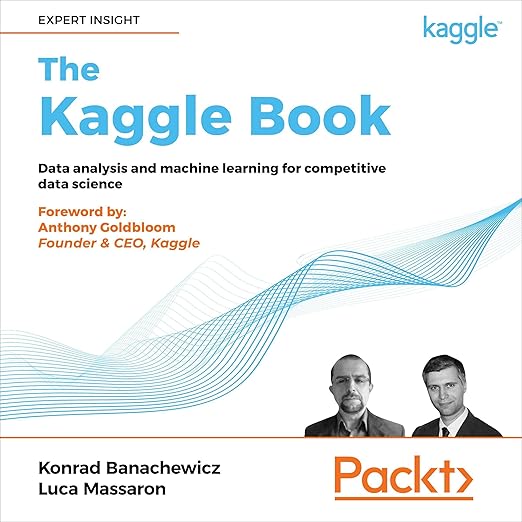
I was somewhere between a beginner SQL refresher and an intermediate machine learning course when a colleague mentioned The Kaggle Book at lunch. She’d been listening to it on her commute for two weeks and kept pausing it to take notes. That detail stuck with me. A data science audiobook that makes someone pull out a notebook in traffic is either genuinely valuable or confusingly arcane. It turned out to be both, depending on the chapter.
Two Kaggle Grandmasters wrote this, and that lineage matters. This is not an introductory survey of machine learning concepts recycled from a blog post. Authors Konrad Banachewicz and Luca Massaron have spent years in the trenches of Kaggle competitions, and the book reads like a conversation with people who’ve made the mistakes so you don’t have to. They are specific in a way that lesser data science books rarely manage to be.
What Grandmaster Status Actually Requires
The most honest review in the batch I read said it plainly: this book won’t teach you anything new if you already have formal data science training, but it will show you how to game Kaggle. That framing undersells it a little, but it’s not wrong. The real value here isn’t the individual techniques, most of which any working data scientist has encountered. It’s the strategic layer: how you think about competition architecture, how you design validation schemes that actually generalize, and how you approach the difference between a model that wins a leaderboard and one that performs in production. The authors are explicit that Kaggle skill and real-world skill overlap but are not identical. That intellectual honesty is refreshing and earns the book a lot of trust.
The section on evaluation metrics is a good example of the book at its best. Rather than simply listing metrics and explaining them mathematically, Banachewicz and Massaron discuss how the choice of metric shapes the entire modeling strategy. It’s the kind of layered thinking that separates practitioners who understand why from those who just know how.
Where the Audio Format Strains
There is a PDF companion, which the audiobook mentions, and it is not optional. This is a book built on tables, code snippets, and structured diagrams that present techniques chapter by chapter. Freeman’s narration is competent and steady, but when a chapter pivots to walking through ensemble stacking configurations or explaining gradient boosting hyperparameter grids, the audio medium imposes real limits. You can follow the conceptual logic, but you will miss the visual scaffolding that makes the specific implementations actionable.
The honest question for any potential listener is: what are you getting from the audio version that you couldn’t get from reading? The answer, I think, is a strong grounding in the competitive philosophy and the strategic reasoning. The tactical details, the code-level implementation, the specific library recommendations, those are best absorbed with the PDF open alongside the audio. The book works best as a hybrid experience.
The Real-World Caveat the Authors Don’t Shy From
The reviewer who flagged concern about Kaggle enthusiasts misunderstanding real-world data had a point worth taking seriously, and the authors clearly anticipated that critique. They address it directly, noting that production data is messier, stakeholders are less cooperative than competition rules, and the clean evaluation frameworks of Kaggle don’t map neatly onto organizational realities. This is a book that respects the listener enough to name its own limitations. That quality is rare in technical audiobooks, which tend to oversell their applicability.
The competition-specific chapters, those built around specific match structures like winning on tabular data versus image classification, are the most listenable. They have a narrative shape. You follow a problem, understand the challenge, and see how experienced competitors have approached it. These sections reward audio listening in a way that the more reference-heavy chapters do not.
Who Gains the Most from This Recording
A working data scientist who wants exposure to competition thinking without the time commitment of actually competing will find substantial value here. The Grandmaster perspective on model validation alone is worth the listen. Entry-level practitioners who haven’t yet completed their first real project will struggle with the assumed baseline knowledge, and that’s not a flaw in the book but a calibration note for the audience. Someone preparing for a Kaggle competition for the first time would do better starting with the foundational ML curriculum and returning to this book once they have their bearings.
Those who will find it least useful are absolute beginners expecting a hands-on tutorial. The book doesn’t function as a step-by-step guide. It functions as a perspective shift for people who already have enough context to know what they’re hearing.
Who Should Listen, Who Should Skip
Listen if you have intermediate ML experience and want to understand how top competitors approach problem framing, validation design, and ensemble strategy. Listen if you work in data science and want a more strategic view of your modeling decisions. Download the PDF companion first and treat it as a reading experience with audio accompaniment.
Skip if you’re new to data science and need foundational instruction. Skip if you’re looking for code-forward tutorials that walk you through implementation step by step. This is a book of ideas and competitive philosophy, not a coding school.
Frequently Asked Questions
Do I need to be an active Kaggle competitor to get value from this audiobook?
Not at all. The competitive framework is a vehicle for teaching modeling philosophy, and much of the strategic thinking around validation, evaluation metrics, and ensemble design applies directly to real-world data science work. That said, listeners with no machine learning background will struggle with the assumed knowledge.
How essential is the PDF companion that comes with the Audible purchase?
Very essential for the technical chapters. The audio narration handles the conceptual and strategic content well, but implementation details, code examples, and structured tables lose a lot in audio-only format. Download the PDF before you start and have it accessible for reference.
Is this book useful for someone who wants to climb the Kaggle rankings, or is it more broadly applicable?
Both, though the emphasis shifts by chapter. The Kaggle-specific tactics around leaderboard strategy and competition structure are clearly targeted at competitors, but the sections on model validation design, metric selection, and ensemble thinking are broadly applicable to any data science practitioner regardless of whether they compete.
How does The Kaggle Book compare to Designing Machine Learning Systems by Chip Huyen for someone choosing between them?
They serve different purposes. The Kaggle Book is oriented toward predictive modeling excellence and competition strategy, with emphasis on what makes models win. Designing Machine Learning Systems focuses on production infrastructure, deployment, and the operational complexity of real-world ML. A serious practitioner would eventually want both; for pure modeling philosophy, The Kaggle Book goes deeper.