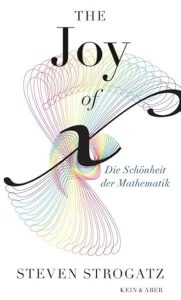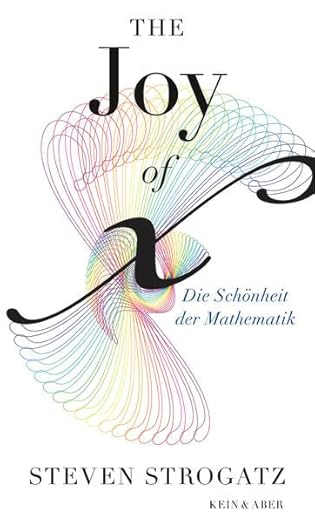
The Short Version
- Voice: Jonathan Yen brings a measured and precise delivery to Strogatz's prose, keeping the explanatory passages clear without oversimplifying. He handles the transitions between playful and rigorous content with reasonable grace.
- Big ideas: Mathematics as everyday language, historical discovery, the beauty of abstract thinking
- Atmosphere: Curious and illuminating
- Worth it?: A strong audio introduction to mathematical thinking for listeners who want genuine understanding rather than surface-level wonder, though be aware this listing carries a German-language synopsis that may indicate a different edition.
Steven Strogatz is a mathematician at Cornell who has spent years explaining calculus and complex systems to audiences who thought they had no interest in either. The Joy of X, narrated in this audiobook by Jonathan Yen, is his most accessible attempt at that project: a guided tour through mathematics from counting and algebra through calculus, probability, and the infinite, aimed at readers who want to understand why mathematics is interesting rather than simply being told that it is. Before going further, a practical note: the synopsis attached to this listing is written in German, which raises the possibility that this catalogue entry is for the German-language edition. If you're seeking the English-language audiobook of Strogatz's work, verify the edition before purchasing.
The Review
Strogatz's organizing principle is that mathematics is not a collection of formulas to be memorized but a set of ideas to be understood, and that the understanding, when it arrives, produces the same kind of pleasure as a well-constructed sentence or a satisfying chord resolution. He earns that claim rather than simply asserting it. The chapters on prime numbers, for instance, don't just enumerate facts about primes. They trace why mathematicians became obsessed with them, what the Riemann hypothesis means in terms a non-specialist can follow, and why the question of how primes are distributed feels genuinely urgent despite having no obvious practical application.
The algebra chapters are where many math-adjacent readers might expect to check out, because algebra is where formal education most reliably destroyed enthusiasm. Strogatz addresses this directly. He shows how algebraic notation evolved as a way to compress ideas that were previously described in pages of prose, and he gives the compression back its meaning. When he explains why the quadratic formula works rather than just how to apply it, the satisfaction is real and earned. This is one of the rarer mathematics books that doesn't simply celebrate the edifice of formal math but tries to explain why the founders of each area were asking the questions they were asking.
Jonathan Yen's narration serves the material well. He keeps a steady pace through explanations that require listeners to hold a concept for a few sentences before it resolves, and he avoids the mistake of speeding through numerical examples in ways that lose listeners who can't visualize on the fly. The six hours and nine minutes cover a substantial range of mathematical territory, and Yen's consistency across the full length keeps the audio experience from feeling fragmented.
The structure is episodic rather than progressive. Strogatz moves from topic to topic without requiring mastery of one area before entering the next. This works in audio because each chapter functions as its own self-contained explanation. You can follow along without feeling like you missed a prerequisite, which is precisely the anxiety most adult listeners bring to mathematical content. The chapter on infinity, for instance, introduces Cantor's discovery that some infinities are larger than others in a way that even listeners with no prior exposure to set theory can follow and find genuinely startling.
Audio is a particularly good format for this kind of mathematical writing because the explanations are built in prose rather than on diagrams. Strogatz made a deliberate choice to write mathematics that lives in language, and Yen's narration delivers that language at a pace that allows ideas to settle. The experience is closer to having someone walk you through a concept in conversation than to reading a textbook, and the relaxed authority of the delivery reinforces the book's argument that mathematical ideas are accessible rather than esoteric.
The historical anchoring of each topic is one of the audiobook's most reliable pleasures. Strogatz doesn't treat mathematics as a set of timeless truths that arrived fully formed. He situates each idea in the specific intellectual problem someone was trying to solve, which makes the concepts feel like human achievements rather than abstract obligations. Newton's calculus makes more sense when you understand what specific planetary motion question it was designed to answer, and Strogatz is careful to provide that context before building the mathematical explanation.
Weak Spots in The Joy of X
The episodic structure means the audiobook doesn't build toward a single unified insight. Listeners who want a sustained argument about mathematics, in the manner of Marcus du Sautoy or Ian Stewart, may find the chapter-by-chapter format more of a survey than a thesis. Strogatz is offering breadth and accessibility over depth, and that's a legitimate trade-off, but it's worth knowing going in that this is a tour rather than an investigation.
Some of the later chapters, particularly those dealing with probability and statistics, assume a comfort level with abstract reasoning that not all listeners will have developed by the time they arrive. Strogatz does his best to bring everyone along, but the final quarter of the audiobook is genuinely harder than the first, and listeners who struggled with those concepts formally may find the audio format insufficient to compensate for the underlying difficulty. The German-language synopsis issue flagged above is also worth repeating: confirm the language of the edition you're purchasing before downloading.
Who It's For
This audiobook is best suited for intellectually curious adults who have always felt a vague sense that they were missing something in mathematics and want to close that gap without enrolling in a course. Readers who appreciated Brian Greene's popular physics writing or Mary Roach's approach to science communication will recognize the same combination of rigor and accessibility. Listeners who are already mathematically fluent will find the material too introductory, and those with no tolerance for abstract reasoning at all will find even Strogatz's careful explanations challenging. The sweet spot is the genuinely curious non-specialist who wants understanding rather than entertainment, and for that listener, this is among the best mathematics audiobooks currently available.
Questions Listeners Ask
Is this audiobook available in English, or is it the German edition?
The synopsis on this listing is in German, which strongly suggests the edition catalogued here may be the German-language version. Strogatz's The Joy of X does exist in English as an audiobook narrated by Jonathan Yen, but verify the edition and language before purchasing from this listing.
Do you need any math background to follow this audiobook?
Strogatz writes for the general reader and explicitly avoids assuming prior mathematical knowledge beyond basic arithmetic. The first half of the book is accessible to essentially anyone. The later chapters on probability and calculus are more demanding, but Strogatz works hard to make them followable through prose explanations rather than formulas.
How does this audiobook compare to other popular math books like those by Marcus du Sautoy or Simon Singh?
Strogatz is more personal and conversational than du Sautoy, who tends toward sustained narrative arguments about specific mathematical ideas. Singh builds tightly plotted stories around single mathematical puzzles. Strogatz is broader and more episodic than either, prioritizing range and accessibility over depth on any single topic.
Is the audio format appropriate for a mathematics audiobook, or is this better read in print?
Strogatz specifically wrote The Joy of X in prose rather than notation-heavy text, which makes it unusually well-suited to audio. Jonathan Yen's narration keeps the explanatory passages clear. Listeners who find mathematical notation in print anxiety-inducing may actually find the audio version more accessible than the book.